



Use Wozber and land your dream job
Create CV
No registration required
Tracking school presence, but your CV's absent from top positions? Punch in to this Attendance Clerk CV example, created with Wozber free CV builder. Learn how to log your organizational skills to match job requirements, making sure your career attendance is as stellar as a straight-A student's!

Attendance work sits at the point where student records, family communication, and school compliance meet. A hiring team looking for an Attendance Clerk wants to see that you can keep daily attendance data accurate, follow up on absences and tardiness without creating confusion, and handle confidential student information with steady judgment.
When that experience is tailored to the posting, the CV is easier to sort in both human review and ATS screening. Wozber's free CV builder helps you match the language of the role, organise school-facing administrative work in an ATS-friendly CV format, and make core qualifications such as SIS use, reporting accuracy, and communication with parents immediately visible.
For an Attendance Clerk, the top of the CV should read like reliable school-office documentation. Keep this section clean and direct so the employer can confirm your identity, role focus, and any location requirement without hunting for details.
Use your full name in a clear, readable format. Skip nicknames and decorative styling. Attendance work depends on accuracy and consistency, and that expectation starts with how your own information appears on the page.
Place "Attendance Clerk" under your name when that is the role you are pursuing. It helps frame the rest of the CV around attendance tracking, record maintenance, parent communication, and reporting instead of general office support.
Include a phone number and professional email address that you check regularly. Since the role involves responsive communication with parents, teachers, and administrators, your contact details should suggest the same level of professionalism and reliability.
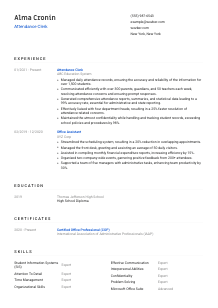
If the posting names a location requirement, reflect it in your city and state. Here, listing "New York, New York" immediately addresses a stated condition of the job and removes a basic screening question before it slows down your application.
A LinkedIn profile or professional website can help if it supports your administrative background and matches the CV exactly. If it is outdated or thin, leave it off. For school office roles, accuracy matters more than extra links.
This section only needs to do a few things, but it needs to do them well. Make it easy for the school to confirm who you are, how to reach you, and whether you meet any immediate logistical requirement.




Experience matters heavily in attendance roles because the work is operational from day one. Schools want proof that you can manage daily records, respond to absences quickly, produce clean reports, and coordinate with staff without letting errors build up across the week.
Before rewriting your bullets, mark the responsibilities that define the job: daily attendance entry, communication with parents and teachers, report generation, coordination with counselors or administrators, and confidentiality. Then match your past work to those functions using the employer's terminology where it reflects your real experience.
List your most recent position first and include job title, employer, and dates. For an Attendance Clerk CV, this structure helps reviewers quickly see whether you already have school office, records, or administrative experience and how recently you handled it.
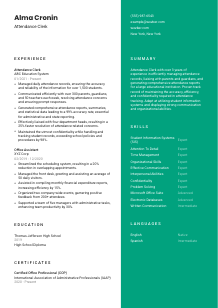
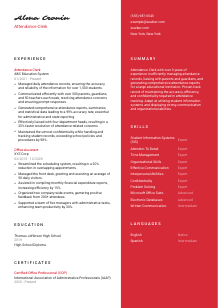
Do not stop at "responsible for attendance." Show what you handled and what standards you maintained. The example CV does this well by tying attendance management to over 1,500 students and linking reporting work to 99% accuracy, which tells a school much more than a generic task list.
Quantify the scale of your work where possible. Student count, weekly parent contacts, number of teachers supported, reporting accuracy, response time, or faster issue resolution are all native measures for this type of role. Metrics like 300 parent and guardian communications per week or a 25% faster resolution rate make the workload and impact concrete.
If part of your background comes from a general office role, keep the bullets that show transferable value such as scheduling, front-desk coordination, database work, reporting, and support for multiple staff members. Trim anything that does not help prove you can handle record-keeping, communication flow, and administrative precision in a school setting.
A school should be able to see how you handle attendance operations from these bullets alone. Prioritise record accuracy, communication volume, reporting, coordination across departments, and confidentiality over vague administrative claims.
For most Attendance Clerk openings, education is straightforward, but it still needs to confirm eligibility quickly. A clear entry for your diploma or equivalent keeps the focus on your work history while showing that you meet the stated baseline requirement.
If the posting asks for a high school diploma or equivalent, make sure that appears plainly in this section. There is no benefit in burying a required credential when the employer is using it as an initial screen.
List the school name, credential, and graduation year or completion date. Clean formatting helps both recruiters and ATS tools read the section correctly, especially when they are scanning for a basic requirement rather than academic detail.
If you completed coursework or school-based training in office administration, records management, data entry, or education support, include it when space allows. These details can reinforce your comfort with structured documentation and administrative workflows.
Honors, leadership roles, or activities belong here only if they reinforce habits that matter in attendance work, such as reliability, organisation, discretion, or clerical support. If they do not connect to the role, keep the section lean.
If you already have 2+ years in a school or office environment, your experience section will do most of the convincing. In that case, education should stay brief and confirm the requirement without taking up space needed for attendance records, reporting, or communication achievements.
For this role, education is usually a checkpoint rather than the main selling point. Make it easy to verify, then give more room to the work that shows how you manage attendance systems and school communication.
Certifications are not always required for Attendance Clerk roles, but the right one can strengthen your profile, especially when it points to office systems, records handling, or compliance-minded administrative work. Use this section to add relevant professional development, not to fill space.
Look at the role before deciding what belongs here. If the job emphasizes record-keeping, electronic systems, confidentiality, and organisation, choose certifications that support those areas. In the example, the Certified Office Professional credential reinforces the administrative side of the role even though it is not school-specific.
List certifications related to office administration, student records, data privacy, software platforms, or education support workflows. A training credential in a student information system, records compliance, or Excel reporting would be more relevant than a broad unrelated certificate.
Show the year earned and, if applicable, whether the certification is current. That is especially useful when the credential reflects up-to-date software knowledge or ongoing professional development in administrative procedures.
Attendance work increasingly depends on digital records, standard reporting, and policy compliance. Relevant certifications can show that you stay current with the systems and procedures that support accurate attendance tracking and secure record handling.
A well-chosen certificate can back up your CV with concrete training in systems, records, or administrative practice. Keep the list focused on qualifications that strengthen your case for handling school attendance work accurately and professionally.
The best skills section for an Attendance Clerk reads like a practical match for the school's workflow. It should point to the systems you use, the administrative habits you rely on, and the communication strengths that keep attendance records accurate and issues resolved quickly.
Use the posting as your guide for what to prioritise. Here, that includes student information systems, electronic databases, Microsoft Office Suite, attention to detail, time management, organisation, and communication. Add them only if you can support them elsewhere in the CV.
Lead with tools and capabilities that are central to attendance work, such as SIS proficiency, database accuracy, reporting, confidentiality, and written and verbal communication. In the example, SIS and Microsoft Office appear alongside detail-oriented administrative strengths, which makes the section feel grounded in the actual job.
Do not overload this section with every skill you have used. Choose the capabilities that connect directly to student records, attendance follow-up, reporting, and coordination with families and staff. A shorter, sharper list usually reads better than a long inventory of generic strengths.
A hiring manager should be able to scan this section and recognize the practical tools of the job. Prioritise systems, reporting, organisation, confidentiality, and communication that match day-to-day attendance responsibilities.
Language proficiency can matter in school settings because attendance communication often involves families, students, teachers, and support staff with different language needs. Even when only English is required, this section can strengthen your profile if it reflects how you can support clear communication in the school community.
If the posting specifies advanced English, include English clearly with an accurate proficiency level. This matters in a role that involves documenting attendance correctly, writing reports, and discussing sensitive absence issues with families and staff.
List the languages most useful to the job first after English. In many school communities, a second language can be helpful when contacting families or clarifying attendance concerns, but it should support the role rather than distract from the required qualifications.
If you speak another language at a workable level, include it if it could help with parent outreach or front-office interaction. The example CV includes Spanish at an intermediate level, which may be useful in many school environments without overstating fluency.
Use honest labels such as native, fluent, advanced, intermediate, or basic. In attendance work, overclaiming language ability can create problems quickly if you are expected to explain absence procedures or discuss records with families.
This section is most useful when it supports real school communication. If a second language helps you answer parent questions, reduce misunderstandings, or build trust during attendance follow-up, it adds practical value to your application.
For an Attendance Clerk, language skills matter when they help information move clearly and respectfully between the school and home. Keep the section accurate and tied to day-to-day communication needs.
The summary should quickly establish that you understand the core of attendance work. In a few lines, show your experience level, the setting you have worked in, and the specific strengths that make you dependable with records, reporting, and family communication.
Base your summary on the job's operational core. For an Attendance Clerk, that usually means attendance record management, timely communication about absences and tardiness, reporting, database use, and confidentiality. This keeps the opening aligned with how the role functions day to day.
Open with your title and relevant years of experience, then name the environment if it helps, such as a school office, district setting, or high-volume administrative office. The example's "over 3 years of experience" works because it immediately places the candidate above the stated minimum and anchors the profile in attendance work.
Choose two or three capabilities that are central to the role, such as SIS proficiency, report generation, accuracy, confidentiality, and communication with parents and teachers. Add one concrete result where possible so the summary sounds proven rather than generic.
Aim for a short paragraph that reads cleanly on first pass. Avoid broad claims about passion or dedication unless they are backed by actual work. A concise summary built around records accuracy, communication volume, and reporting responsibility will carry more weight for this role.
Your summary should make the school expect reliable attendance administration before they reach the first job entry. When it clearly names your experience, systems knowledge, communication strengths, and record accuracy, the rest of the CV has a strong foundation.
An effective Attendance Clerk CV makes everyday school operations visible. It shows that you can maintain accurate attendance records, communicate clearly with families and staff, generate reports that hold up for administrative or state use, and protect confidential student information.
Use these sections to keep your experience aligned with the posting, then refine the wording and structure in Wozber's AI CV builder so the final document stays ATS-compliant and easy to review. The result should make one thing clear right away: you can step into attendance tracking and school record work with accuracy, discretion, and dependable follow-through.