



Use Wozber and land your dream job
Create CV
No registration required
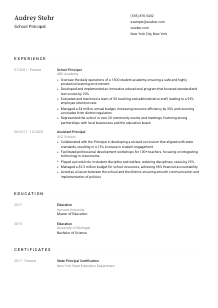
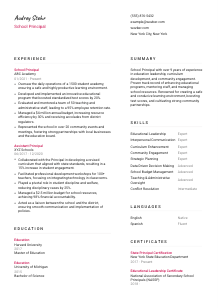
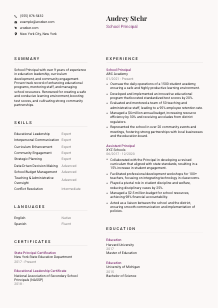
Leading schools, but your CV gets detention? Check out this School Principal CV example, created with Wozber free CV builder. Learn how to highlight your educational leadership chops to match the job description, making your career move as smooth as recess!

A School Principal CV has to show far more than time spent in education. District leaders and school boards look for someone who can run a complex school environment, improve student outcomes, support teachers, manage budgets responsibly, and keep families confident in the direction of the building. If your CV reads like a general education leadership profile, it can miss the operational scope that defines principal-level work.
That distinction becomes clearer when your CV mirrors the language of the opening and surfaces the right proof early. Using Wozber's free CV builder helps you shape an ATS-compliant CV around leadership outcomes, staff supervision, curriculum improvement, and school operations, so hiring teams can quickly see whether your background matches the scale and accountability of the principal seat.
School leadership hiring starts with practical filters as much as credentials. Your header should make it easy to confirm who you are, how to reach you, and whether you meet any location or title expectations tied to the role.
Use your full name in the most prominent text on the page so the CV reads like a professional leadership document from the first line. For a School Principal, the presentation should feel clean and confident, much like the communication expected in board updates, parent outreach, and staff-facing messages.
Place "School Principal" directly below your name when that is the role you are pursuing. This immediately anchors your background in school leadership rather than broader education administration, and it helps recruiters connect your experience to principal-level responsibilities such as school operations, staff evaluation, and academic oversight.
Add a reliable phone number and a professional email address, ideally in a straightforward format such as firstname.lastname@email.com. Communication is central to the job, whether you are speaking with teachers, parents, district officials, or community partners, so even small details in this section should reflect professionalism and accuracy.
If the role requires local presence, state your city and state clearly. In the example job description, being located in New York City, New York is a stated requirement, so listing that in the header removes an avoidable question before the reader reaches your experience.
A LinkedIn profile or professional page can help if it reinforces your leadership history, certifications, school achievements, or speaking and community work. Make sure it aligns with the CV. If it is sparse or outdated, leave it off rather than sending hiring teams to incomplete information.
This section is brief, but it should already communicate that you are organised, reachable, and aligned with the practical requirements of the principal role.




For School Principal roles, experience carries most of the hiring weight. This is where you show that you have led people, improved instruction, handled school operations, and made decisions that affected students, staff, and resources at scale.
Before writing bullets, mark the responsibilities and requirements that shape the role. For this opening, that includes daily school operations, curriculum and program development, staff evaluation, budget management, community representation, and data-driven decision-making. Those themes should guide which accomplishments you feature and how you word them.
Start with your most recent position and move backward, including title, school or district name, and dates. Prioritise roles that show increasing leadership scope, such as Principal, Assistant Principal, Dean, or instructional leadership positions. A hiring team should be able to trace your progression from classroom or instructional leadership into full-school accountability.
Use accomplishment statements that show what changed because of your leadership. Strong principal bullets often cover student achievement, school climate, teacher development, compliance, attendance, retention, budgeting, or community engagement. The example does this well with bullets like improving standardised test scores by 20% and mentoring 50 staff members to support a 95% retention rate.
Metrics matter here because they show scale and judgment. Include student population, staff size, budget responsibility, score gains, discipline reductions, attendance improvements, audit results, or participation levels in family and community programs. Managing a $4 million budget or reducing disciplinary cases by 25% tells a district much more than saying you "supported operations."
Every bullet should strengthen your case for leading a school. If an older accomplishment does not connect to instructional leadership, staff management, operations, compliance, or community partnership, trim it. Keep the narrative centered on the work a principal is trusted to handle every day.
When this section is tailored well, the reader can quickly see your administrative progression, the scale of your schools, and the results you delivered for students, staff, and the wider school community.
Education matters in principal hiring because it confirms formal preparation for instructional leadership, school management, and policy-driven decision-making. This section should make required degrees easy to find and easy to match against the posting.
If the position asks for a Master's degree in Education, Educational Leadership, or a related field, place that credential first. For principal roles, the master's degree is often a baseline qualification, so it should be immediately visible rather than buried beneath earlier degrees.
List degree, field of study, school, and graduation year. Hiring teams do not need extra wording here if the credentials are already strong. A clear entry such as "Master of Education, Education" is enough to confirm academic preparation without slowing down the CV.
If your degree is in Educational Leadership, Education Administration, Curriculum and Instruction, or another closely related area, use the full title. That alignment helps reinforce your preparation for responsibilities like staff evaluation, curriculum oversight, and school-wide planning.
Most experienced principals do not need coursework listed, but it can help earlier-career candidates if it directly supports the target role. Leadership practicums, school law, data analysis, instructional supervision, or school finance can be worth mentioning when they add context to your readiness.
Awards, academic distinctions, or memberships in education leadership organizations can add value if they support your professional direction. Keep them brief and relevant. The focus should remain on qualifications tied to school leadership, not on filling space.
A concise education section should tell the reader, within seconds, that you meet the academic expectations for principal-level leadership.
Certifications carry extra weight in school administration because they are often mandatory, regulated, and tied directly to eligibility for the role. This section should remove any uncertainty about your license status and leadership credentials.
Review the posting for required certifications and place those first. Here, a valid state Principal or Administrator certification or license is essential, so it belongs at the top of the section before any optional leadership credentials.
List certificates tied to school leadership, administration, instructional supervision, or related compliance areas. A state principal certification is highly relevant. An educational leadership certificate can also help if it reinforces your preparation for mentoring staff, managing programs, or leading improvement initiatives.
Add the issue date and, when relevant, the active period or expiration date. In regulated education roles, current status matters. A credential listed as "2017 - Present" quickly signals ongoing validity and avoids follow-up questions.
School leaders are expected to stay current with policy, leadership practice, instruction, and compliance. Recent or active certifications can support that story, especially if they relate to school improvement, leadership development, or district-level standards.
For a School Principal CV, this section should first confirm that you are licensed to serve, then reinforce your ongoing development as an education leader.
A principal's skills section should read like the profile of someone who can lead a school, not just support one. Focus on the abilities that connect directly to instructional leadership, operations, people management, and measurable school improvement.
Pull out the capabilities the employer names or clearly implies. In this case, that includes leadership, communication, interpersonal skill, data-driven decision-making, school-wide change, budgeting, staff oversight, and program development. Using this language helps both ATS matching and human review.
Prioritise skills that map to the actual work of the role. Educational leadership, curriculum enhancement, school budget management, community engagement, conflict resolution, strategic planning, and staff evaluation are all stronger than broad phrases such as "hardworking" or "team player."
Put the most important skills first so the section reflects how the role is hired. If the job emphasizes leading staff and improving school outcomes, your top skills should support those priorities. The sample CV handles this well by leading with Educational Leadership, Interpersonal Communication, and Curriculum Enhancement before listing secondary strengths.
A focused skills section should sound like the operating toolkit of a principal who can lead instruction, manage people, and make sound decisions across the school.
Language skills matter in education leadership because principals communicate constantly with students, families, staff, district leaders, and community partners. Present them clearly, especially when the posting names a required language.
Some school leadership openings explicitly require strong speaking and writing ability in a specific language. Here, English is required, so your proficiency should be listed clearly and without ambiguity.
List English at the top when it is central to the role. Principals write staff communications, handle parent correspondence, present in meetings, and represent the school externally, so this language skill is directly tied to daily performance.
Additional languages can strengthen your candidacy, especially in diverse school communities where family outreach and trust-building matter. Spanish, for example, may be valuable in some districts even when it is not formally required.
Terms such as "Native," "Fluent," and "Intermediate" give hiring teams a usable picture of your communication ability. Avoid vague descriptions that leave room for interpretation.
Extra language skills are most valuable when they support family communication, community partnerships, student support, or culturally responsive leadership. Present them as practical strengths, not as decoration.
For principal hiring, language proficiency should help the reader picture how effectively you can lead conversations across the school community.
Your summary sits near the top of the CV, so it needs to frame your leadership profile quickly. For a School Principal role, that means combining years of experience, leadership scope, and a few concrete strengths or outcomes in a tight opening statement.
Before writing the summary, identify the two or three priorities the role puts front and centre. For principal openings, that often means school operations, instructional leadership, staff development, community relationships, and data-informed improvement. Those themes should shape your opening lines.
Start with a direct description such as "School Principal with 9+ years in education leadership" or a closely related version that reflects your background accurately. This immediately places you in the right lane and helps the reader understand your level of responsibility.
Choose highlights that support principal-level hiring decisions. That might include raising test scores, improving staff retention, managing multimillion-dollar budgets, reducing discipline incidents, or leading curriculum change. The sample summary works because it combines leadership scope with outcomes like stronger learning environments and improved academic performance.
Aim for 3 to 5 lines. That is enough space to establish your leadership identity, your main areas of strength, and one or two outcomes without repeating the experience section. Every phrase should earn its place.
A well-written summary should make the reader expect a CV full of school leadership results, sound judgment, and readiness for principal-level accountability.
A School Principal CV works best when it shows how you lead a school day to day and how that leadership translates into stronger instruction, safer operations, better staff performance, and responsible resource management. When each section reinforces those priorities, your application reads as a leadership case, not a list of education jobs.
Wozber's free CV builder can help you shape that story into an ATS-friendly CV format, and its ATS CV scanner can sharpen alignment with the posting's language around licensing, school operations, staff mentoring, budgeting, and community representation. The finished CV should make one thing easy to judge: you are ready to lead a school with clarity and results.




