



Use Wozber and land your dream job
Create CV
No registration required
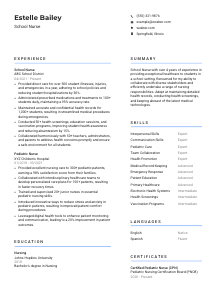
Patching up playground wounds, but your CV feels under the weather? Check out this School Nurse CV example, created with Wozber free CV builder. Learn how to present your healthcare expertise and compassion in a way that matches school criteria, taking your nursing career to the top of the class!
School nursing sits at the point where clinical judgment meets a fast-moving student environment. Hiring teams look for nurses who can handle everyday illnesses, medication administration, screenings, emergency response, and confidential record-keeping without losing the calm, parent-facing communication a school setting requires. Your CV should make that range of care visible quickly, especially where student volume, documentation standards, and collaboration with teachers or families are part of the job.
A tailored CV changes how your background is read in both ATS screening and human review. When your wording reflects the posting's priorities, such as student care, electronic health systems, immunization records, and school-based coordination, Wozber's free CV builder helps shape that experience into an ATS-compliant CV that is easy to scan and easy to trust. The result is a clearer picture of whether you can step into a school health office and manage care safely from day one.
For a School Nurse, the top of the CV should remove basic questions before the reader reaches your experience. If the posting names a target title, requires English fluency, or includes a location condition, your contact section should reflect those details cleanly and professionally.
Use your full name in a slightly larger font than the rest of the page so it is easy to spot at a glance. In healthcare hiring, clarity matters more than styling. Keep it simple, readable, and consistent with the professional tone of the rest of the CV.
Place "School Nurse" directly beneath your name if that is the role you are targeting. Matching the posting's title helps with ATS alignment and immediately tells the reviewer that your nursing background is being presented for student care rather than a general clinical or hospital role.
List one reliable phone number and a professional email address you check regularly. Schools move quickly when scheduling interviews, especially before term starts, so this section should make it easy to reach you without any extra searching.
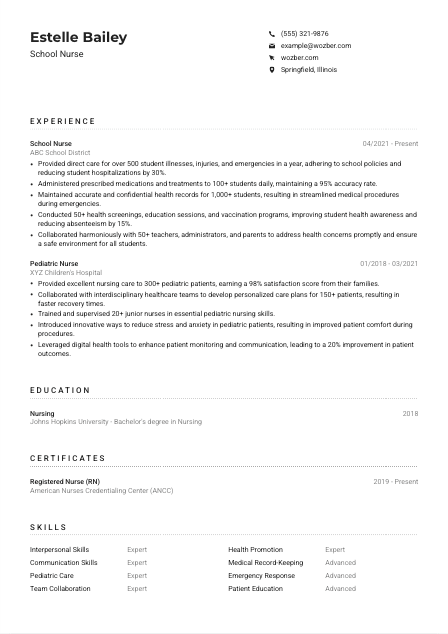
If the job requires you to be in Springfield, Illinois, or willing to relocate there, say so in your location line. The sample CV handles this well by listing Springfield, Illinois upfront. For school-based roles, location can affect licensure, commute reliability, and start-date flexibility, so removing doubt here helps.
Include a LinkedIn profile or professional website only if it supports your nursing candidacy with useful information, such as credentials, clinical background, or community health work. Skip links that do not add value to school health, pediatric care, or nursing practice.
This section should confirm who you are, which role you want, and whether you meet practical requirements such as location and contact availability. Once that is settled, the reader can focus on your clinical work with students and families.




School Nurse hiring decisions often turn on applied experience, not broad nursing claims. Your work history should show how you handled care delivery, documentation, medication routines, screenings, parent communication, and urgent situations in settings where accuracy and judgment matter every day.
Read the job description closely and mark the care tasks that appear repeatedly. For this role, that includes direct care for illnesses and injuries, medication administration, health records, screenings, vaccination work, and collaboration with staff and parents. Those are the duties your bullets should mirror when they reflect your actual background.
List your most recent nursing position first so the reader sees your current level of responsibility right away. For school nursing, recent experience carries extra weight because procedures, documentation systems, and student health protocols need to be current.
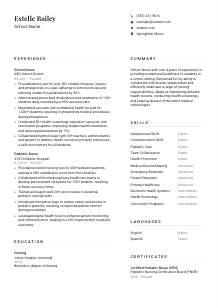
Write accomplishment bullets that show what you handled and what changed because of your work. The sample CV does this well with points such as providing direct care for more than 500 student cases in a year and administering medications to 100+ students daily with a 95% accuracy rate. Numbers like student volume, error reduction, response outcomes, or absenteeism changes make your nursing work more concrete.
Use metrics that fit school health practice. You might show how many students were on your caseload, how many screenings you ran, how immunization compliance improved, how quickly health records were updated, or how health education reduced absenteeism or avoidable escalations. In this field, scale and accuracy both matter.
Trim accomplishments that do not support your target role. Pediatric hospital experience can still be highly relevant if you frame it around child assessment, family communication, treatment coordination, or digital charting, as the sample CV does with pediatric nursing. Focus on experience that strengthens your case for safe, organised student care in an educational setting.
Your experience section should leave no doubt that you can manage day-to-day student health needs, document care properly, and work across a school community. When those points are backed by scope and results, your background becomes much easier to shortlist.
Education is usually straightforward for a School Nurse CV, but it still needs to match the posting precisely. When a school asks for a Bachelor's degree in Nursing from an accredited institution, your degree details should be easy to find and easy to read.
If the role asks for a Bachelor's degree in Nursing, make sure that appears clearly in your education section. This is one of the first qualification checks, so do not bury it under unrelated training or extra details.
List your degree, field of study, school, and graduation year in a consistent structure. Straightforward formatting helps both ATS parsing and human review, especially when a school or district is screening many licensed candidates at once.
Use the same terminology as the posting when it reflects your actual credential. For example, writing "Bachelor's degree in Nursing" aligns neatly with the requirement and removes ambiguity about whether your education meets the role's baseline expectation.
Most experienced nurses do not need to list coursework. Add it only if it helps connect your background to school health, pediatric care, community health, or public health nursing, especially if you are earlier in your career.
Academic honors, nursing associations, or public health involvement can add value if they support your professional profile. Prioritise items that connect to pediatric care, preventive health, or clinical leadership rather than general campus activities.
For this section, simplicity works in your favor. A clearly listed nursing degree gives the reader fast confirmation that your academic preparation meets the role's requirement and supports the clinical experience that follows.
Licensure is essential in nursing, so this section needs to be precise. For school-based roles, the reader should be able to confirm your legal ability to practice, then see any added credentials that strengthen your work with children, preventive care, or student health programs.
Lead with the nursing license the posting requires, whether that is RN or LPN. It is the most important item in this section because it establishes immediate eligibility for the role.
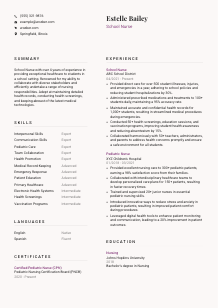
After your license, list credentials that reinforce your ability to work with children or in health education settings. The sample CV includes Certified Pediatric Nurse, which supports the candidate's pediatric background well, though that kind of certification is a bonus rather than a universal requirement for every School Nurse opening.
Include issue dates, expiration dates, or "Present" where appropriate so the status of your credentials is clear. Schools do not want to guess whether a license is current, especially when student safety and compliance are involved.
Recent certifications in pediatric emergency care, immunization practice, student mental health, or related school health topics can strengthen your application. They show that your practice stays current in areas that often come up in a school clinic.
A well-organised certification section should show current licensure first and then any added training that supports school-based nursing. That combination tells the reader you meet the formal requirement and bring relevant depth to the role.
A School Nurse skills section should sound like the job, not like a generic nursing checklist. The strongest lists balance clinical ability, documentation accuracy, and the communication skills needed to work with students, families, teachers, and administrators throughout the school day.
Start with the skills the posting names directly, then add closely related nursing abilities you genuinely use. Here, that includes medical record-keeping, electronic health systems, communication, interpersonal skills, direct care, screenings, medication administration, and collaboration.
Lead with the skills most tied to safe and effective student care. Emergency response, pediatric assessment, medication administration, immunization tracking, patient education, and collaboration across school staff all speak to the day-to-day reality of the role. The sample CV's mix of pediatric care, health promotion, record-keeping, and emergency response is a useful model.
Do not overload this section with every nursing skill you have ever used. Choose the abilities that support the target role and that you can back up in your experience section. A shorter list with clear relevance is stronger than a broad list with weak connection to school nursing.
When this section is tailored well, the reader can quickly see the blend of clinical care, documentation discipline, and communication needed in a school environment. Every skill listed should support that picture.
In school health, language ability can affect how clearly you explain symptoms, medications, care instructions, and follow-up steps. If the posting names English fluency, meet that requirement directly, then include additional languages that could help you communicate with students and families in your community.
If fluent English is listed in the posting, include English in your languages section with an accurate proficiency level. This is a direct requirement, so it should be easy to find.
List your strongest language first, followed by any others you can use professionally. In the sample CV, English is shown as Native and Spanish as Fluent, which gives a quick sense of communication range in student and family interactions.
Extra languages are especially useful in schools serving multilingual families. They can support clearer health education, parent communication, and follow-up on medication or immunization instructions. Include them when they are genuine strengths, not filler.
Choose honest ratings such as Native, Fluent, Advanced, or Conversational based on what you can actually handle in care discussions. In a school setting, overstating language ability can create real communication risks.
If you know a language commonly spoken by students and caregivers in the district, that can be a meaningful advantage. It will not replace licensure or clinical skill, but it can strengthen your ability to build trust and deliver clear guidance.
This section works best when it supports how you communicate in practice. Clear English proficiency is essential here, and additional languages can reinforce your ability to serve students and families well.
Your summary should quickly establish the kind of nursing professional you are and why your background fits a school setting. Focus on your clinical scope, your experience with students or pediatric populations, and the parts of your work that match the posting most closely.
Before writing, identify the two or three responsibilities that define the job most clearly. For this posting, student care, medication and treatment support, health records, screenings, and collaboration are central. Your summary should reflect that mix rather than offering a vague nursing profile.
Start with your title, years of experience, and most relevant practice area. A line such as "School Nurse with 4+ years of experience supporting student health" works because it places your background in the correct setting immediately.
Choose strengths that matter in school nursing and that are supported elsewhere on the CV. The sample summary points to detailed health records, health screenings, and collaboration with diverse stakeholders, all of which map well to the job description. You could also mention pediatric care, emergency response, medication administration, or electronic health systems if those are genuine strengths.
Aim for 3 to 5 sentences with concrete language. Skip broad traits unless they are tied to practice, such as compassionate communication with students and parents or accurate health documentation across a large student population. The summary should read like a concise clinical profile, not a generic objective statement.
A well-written summary gives the reader a fast, accurate view of your nursing background and how it translates to a school environment. Once it reflects student care, documentation, and collaboration clearly, the rest of your CV has a strong frame around it. Wozber's AI CV builder and ATS CV scanner can help refine that language so your final CV stays closely aligned with the posting and easy to read in an ATS-friendly CV format.
A School Nurse CV works best when it shows more than compassion alone. It should present the practical side of the role as well: student case volume, medication accuracy, health record management, screenings, family communication, and coordination with school staff.
Use the job description to guide what you emphasize, then make sure every section supports the same story. With Wozber's free CV builder, ATS optimisation tools, and ATS-friendly CV templates, you can shape that experience into a CV that makes your school-based nursing value easy to recognize.
The finished CV should make one thing clear. You can step into a school health office and manage student care with confidence, accuracy, and sound clinical judgment.