



Use Wozber and land your dream job
Create CV
No registration required
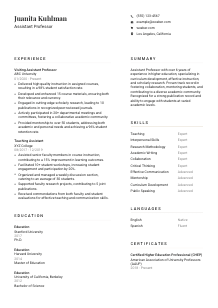
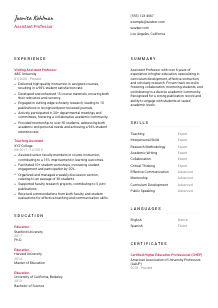
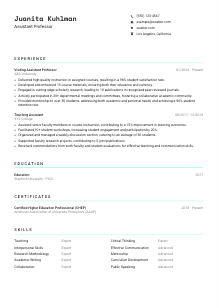
Molding minds, but your CV isn't getting graded? Learn from this Assistant Professor CV example, created with Wozber free CV builder. It shows how to align your academic expertise with job requirements, setting your career trajectory toward the top of the class!
Faculty hiring rarely turns on one dimension alone. Committees are reading for a credible mix of classroom performance, active scholarship, and department-level contribution. Your CV needs to make that balance visible fast, especially when many applicants hold advanced degrees but differ in publication output, course ownership, and student mentorship.
A tailored CV changes how quickly that academic profile comes into focus. Wozber's free CV builder helps you align your language with the posting and shape an ATS-compliant CV around the teaching, research, and service work that matters most, so reviewers can immediately see whether your record supports the department's courses, scholarly expectations, and student-facing responsibilities.
In faculty hiring, the header does quiet but important work. It identifies you, confirms how to reach you, and can resolve practical requirements before a committee spends time on the rest of the file. Keep this section clean, professional, and easy to scan.
Use your full name as the most prominent text on the page. Keep the styling simple and readable. Search committees often move between CVs, CVs, publication lists, and teaching materials, so your name should be easy to identify across documents.
Place "Assistant Professor" directly under your name when that is the position you are pursuing. This immediately aligns your CV with the opening and avoids ambiguity if your recent title was Visiting Assistant Professor, Lecturer, Postdoctoral Researcher, or Teaching Assistant.
Include a phone number you answer reliably and a professional email address. In academic hiring, interview coordination can involve department staff, committee members, and HR, so accuracy matters as much here as it does in a publication citation.
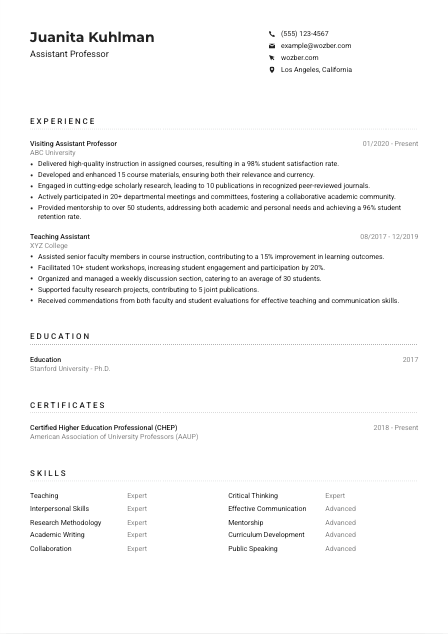
If a posting includes a location or work authorization condition, reflect that in your header when appropriate. In the example, listing "Los Angeles, California" helps answer a stated requirement early. Treat this as role-specific tailoring, not a universal rule for every Assistant Professor application.
A personal faculty page, Google Scholar profile, LinkedIn page, or research website can help committees quickly review publications, conference activity, teaching interests, or current projects. Only include links that are updated and consistent with the rest of your application materials.
Do not include age, marital status, photo, or other personal identifiers unless a specific institution or country requires them. Faculty selection should centre on teaching record, scholarly contributions, and collegial service, not irrelevant personal details.
This section does not need personality flourishes. It needs to remove friction. When your name, role, contact details, and any stated location requirement are immediately clear, the committee can move straight to your teaching, research, and service record.




For an Assistant Professor CV, experience has to do more than list appointments. It should show how you performed in the classroom, how your scholarship progressed, and how you contributed to academic life beyond your own courses. That combination is what makes prior university work persuasive.
Read the posting closely and note the work the department is actually hiring for. Here, that includes course delivery, course development, research output, committee participation, and student mentorship. Use those priorities to decide which bullets stay, which get rewritten, and which outcomes deserve numbers.
List positions in reverse chronological order. For each entry, include your title, institution, and dates. This lets reviewers quickly trace your movement from teaching support or research support roles into more independent faculty responsibilities.
Focus on the parts of your work that map to how Assistant Professors are evaluated. That usually means courses taught, syllabi or materials updated, publications produced, grants supported or won, student advising, and departmental service. The example CV does this well by pairing teaching, curriculum development, publication output, committee work, and mentorship in the most recent university role.
Numbers are especially helpful when they describe teaching scope or scholarly output. Student satisfaction, retention, number of courses revised, workshops led, publications, conference presentations, or committee participation all help readers understand scale. Metrics such as a 98% student satisfaction rate, 15 course materials updated, or 10 peer-reviewed publications give the committee a clearer picture than broad claims about excellence.
Every bullet should support one of the department's likely questions. Can you handle assigned courses well? Can you sustain research? Will you contribute as a colleague and mentor? If a line does not help answer one of those, replace it with teaching outcomes, research contributions, service activity, or student support work that does.
Search committees want to see the pattern of your work, not just the chronology. When your experience section shows effective instruction, active scholarship, and meaningful service in concrete terms, your candidacy reads as a ready contribution to department life.
Academic hiring pays close attention to degrees because they establish subject expertise and often determine baseline eligibility. For an Assistant Professor role, the education section should confirm that you meet the terminal-degree requirement and show the field in which your scholarship was built.
If the posting asks for a Ph.D. or equivalent terminal degree, make that credential easy to find. List it first, with the degree name, field, and institution. In this example, the Ph.D. in Education should lead the section because it directly answers the job requirement.
Start with the highest degree earned and work backward. Include the degree, field of study, institution, and graduation date if appropriate for your stage. This straightforward structure helps committees quickly confirm academic preparation without searching through the section.
Most experienced faculty candidates do not need to list coursework. It becomes useful when you are early in your career, changing subfields, or applying to a department that values a narrow teaching or research area. If included, choose courses that connect directly to the subjects you would teach or the methods you use in research.
Honors, dissertation topics, fellowships, or major research projects can strengthen this section when they reinforce your scholarly identity. A dissertation title, for example, can help show alignment with the department's subject area if your publication record is still developing.
Do not overload education with minor details that belong elsewhere. The section should quickly establish that your training fits the field, meets the credential threshold, and supports the teaching and research claims made in the rest of the CV.
For faculty hiring, this section is not a formality. It confirms that you meet the degree standard and shows where your expertise was developed. Make that easy to see in the first few seconds of review.
Certificates are usually secondary to your degree, teaching history, and publication record, but they can still strengthen an Assistant Professor CV when they add relevant professional development. Use this section selectively and keep the focus on credentials that support faculty work.
Many Assistant Professor roles do not require formal certifications, so do not force this section if it adds little. Use it when a certificate supports teaching practice, online instruction, assessment design, academic leadership, or another area that the department clearly values.
Prioritise credentials that complement your university work. A certificate related to higher education practice, pedagogy, learning design, or discipline-specific training can add value. In the example, the Certified Higher Education Professional credential supports the candidate's teaching-focused profile more than a generic short course would.
List the issuing organisation and the date earned, plus renewal or validity details if relevant. This helps readers understand whether the credential reflects current practice, especially in areas such as digital instruction, accessibility, or student support.
As your career develops, add certificates that support where you want to contribute next. That might mean inclusive teaching, grant writing, academic leadership, or a specialised method used in your field. The strongest additions are the ones that connect naturally to your teaching load, research agenda, or service work.
A certificate will not replace a terminal degree or publication record in faculty hiring. It can, however, add a useful layer of credibility when it strengthens how your CV presents teaching practice, current methods, or continuing professional development.
The skills section should read like a compact map of how you operate as an academic. For Assistant Professor roles, that usually means a mix of teaching capability, research ability, written communication, collaboration, and student-facing strengths that support classroom and departmental work.
Start with the competencies the department names directly. In this job description, those include expertise in the subject area, effective communication, collaboration, and strong English writing. Then add closely related skills you genuinely use in teaching, research, advising, and service.
Do not make this section all soft skills or all technical methods. A faculty profile should usually combine items such as research methodology, academic writing, curriculum development, mentorship, public speaking, and collaboration. The example CV handles this balance well by pairing research and teaching skills with communication and mentoring strengths.
Choose skills you can back up elsewhere in the document. If you list curriculum development, your experience section should show course design or revision. If you list mentorship, include advising, retention, or student support results. Skills work best when they echo real faculty outputs rather than broad personality traits.
This list should reinforce your teaching record, research activity, and departmental contribution, not repeat generic strengths. When the skills section matches the language of the posting and the evidence in your experience, it adds useful academic focus.
Language matters in academia because it affects teaching, writing, advising, and collaboration. On an Assistant Professor CV, list languages in a way that helps a department understand whether you can teach effectively, publish clearly, and communicate with students and colleagues.
If the role specifies English proficiency, make that explicit. This posting requires effective writing in English, so English should appear prominently with a level that matches your actual ability to teach, write feedback, publish, and communicate professionally.
Other languages can strengthen your profile when they support student engagement, international collaboration, field research, or service in a diverse campus environment. They are especially relevant if they connect to your discipline, community outreach, or multilingual student populations.
Choose terms such as native, fluent, proficient, or conversational and apply them honestly. Search committees do not need inflated wording here. They need a practical sense of what language tasks you can perform with confidence.
Multiple languages can matter in faculty roles beyond simple communication. They may support conference participation, archival research, cross-border scholarship, or advising students from varied backgrounds. Include them when they strengthen the academic story your CV is telling.
Frame language proficiency as something you actively use or could use in teaching, research, or campus contribution. For example, Spanish fluency may be relevant in student-facing contexts or community-engaged work, but only if it reflects genuine capability and useful context.
For this kind of role, language skills should clarify communication capacity, not simply add variety to the page. Lead with required English proficiency, then include other languages that support the kind of teaching, research, or service you can offer.
The summary is your opening academic snapshot. In a few lines, it should place you in the field, show the level of your higher education experience, and point to the mix of teaching, scholarship, and student support that defines your candidacy.
Before writing, identify the main themes in the posting. Here, the clearest ones are university-level teaching, subject expertise, peer-reviewed publication, collaboration, and mentoring. Those themes should shape the content and order of your summary.
Start with a direct statement that covers your discipline, role level, and relevant years in higher education. This gives the committee immediate context and helps distinguish you from candidates whose background is more narrowly research-only or teaching-only.
Include the strengths that matter most for the target department, such as publication record, course development, student mentorship, conference activity, or collaborative service. The example summary works because it combines curriculum development, effective instruction, scholarly research, and mentoring in a compact, faculty-relevant way.
Aim for a short paragraph, not a biography. Avoid broad claims about passion or excellence unless you immediately support them with real academic substance. A strong summary makes it clear what kind of Assistant Professor you are and what parts of your record deserve attention first.
Your summary should steer the rest of the CV toward the areas where you are strongest. When it clearly establishes your teaching experience, scholarly output, and student-facing contribution, the rest of the document lands with more context and less guesswork.
You now have a clear structure for presenting an Assistant Professor profile around the work that matters most in faculty hiring: teaching results, research output, academic service, and student mentorship. Wozber's free CV builder helps turn those elements into an ATS-optimised CV that stays aligned with the language and priorities of the posting.
Whether you start from an ATS-friendly CV template or revise an existing draft with an ATS CV scanner, keep the focus on accurate tailoring. Match the department's terminology, surface your strongest university-level outcomes, and make your degree, publications, and teaching record easy to review. That gives a hiring committee a much clearer read on your readiness to contribute as a faculty member.




