



Use Wozber and land your dream job
Create CV
No registration required
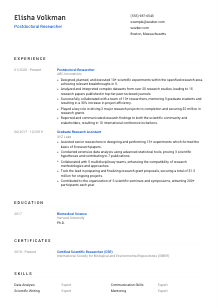
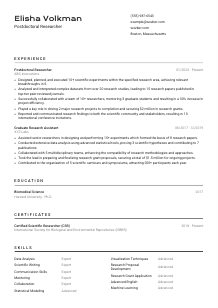
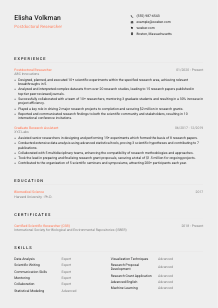
Working through experiments, but your CV still seems theoretical? Check out this Postdoctoral Researcher CV example, created with Wozber free CV builder. It shows how to present your scientific strengths to match career criteria, making sure your research journey stays as vibrant as the molecules you study!
Postdoctoral hiring turns quickly on whether your CV shows independent research momentum. Committees want to see that you can design studies, handle complex analysis, publish credible findings, and move a project forward without needing constant direction. If those points are buried under generic academic language, your record can look thinner than it is.
A tailored CV changes how your research profile is read in both faculty review and ATS screening. Wozber's free CV builder helps you align section wording with the posting, keep an ATS-friendly CV format, and surface details such as publication volume, grant work, mentoring, and analytical methods so the hiring team can quickly see where your background matches the lab's priorities.
For postdoctoral applications, the header does more than identify you. It sets the professional frame immediately, especially when a lab is hiring for a defined research area, a specific location, or a candidate who will collaborate across departments. Keep this section clean, accurate, and directly relevant to the role.
Place your full name at the top in the clearest formatting on the page, then use the exact job title you are pursuing: "Postdoctoral Researcher." That small alignment matters in academic hiring because it removes ambiguity about whether you are applying for a postdoc, a staff scientist role, or a broader research position.
Include a reliable phone number and a professional email address, ideally one based on your name. Hiring teams may reach out for interviews, seminar talks, or follow-up questions on publications and funding work, so accuracy here matters as much as anywhere else on the CV.
If the employer names a location requirement, include your city and state clearly. In the example, listing "Boston, Massachusetts" directly addresses the stated need to be based there and removes an avoidable screening question. If a different postdoctoral opening does not require local presence, keep the location line simple and factual.
A personal academic site, Google Scholar profile, ORCID, or a well-maintained LinkedIn page can strengthen your application when it supports the CV with publications, conference activity, and project scope. Make sure the publications, affiliations, and dates match the CV exactly.
Do not include age, marital status, photo, or other personal data unrelated to research performance. For a postdoctoral role, the focus should stay on your publication record, methods expertise, grants, and collaboration history.
A precise header makes it easy to place you in the right candidate pool and removes distractions before the committee reaches your research experience.




This section carries the most weight in a postdoctoral CV. Hiring teams look for proof that you can run studies, produce interpretable results, contribute to publications and grants, and work effectively with principal investigators, students, and collaborators. Your bullets should make the scale and outcome of your research work easy to understand.
Read the job description like a checklist of research functions. Here, the essentials include designing studies, analysing and visualizing data, reporting findings, contributing to grant applications, and mentoring students. Build bullets that answer those points directly instead of relying on broad phrases like "involved in research" or "supported lab projects."
List positions in reverse chronological order with title, institution or employer, and dates. For academic readers, chronology helps them see how your independence developed from graduate research into postdoctoral-level work. The example does this well by separating postdoctoral work from earlier graduate research assistance.
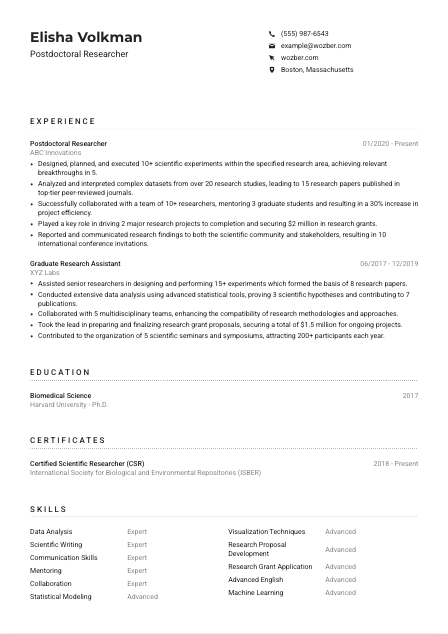
For a postdoc, results matter more than duty lists. Focus bullets on experiments designed, datasets analysed, papers published, grants supported, collaborators coordinated, or trainees mentored. The sample bullet about analysing data from more than 20 studies and contributing to 15 published papers works because it ties method-heavy work to visible scholarly output.
Not every project belongs on the page with equal weight. Feature work that best matches the opening's research area, analytical methods, publication expectations, and team structure. If the posting emphasizes multidisciplinary collaboration and proposal development, give more space to projects where you coordinated with different specialists or helped secure funding.
Numbers help committees understand pace and scale. Use counts of experiments, publications, conference presentations, grant dollars, student mentees, collaborations, cohorts, or study samples where appropriate. In the example, metrics like "$2 million in research grants," "10+ experiments," and "3 graduate students mentored" quickly communicate both output and responsibility.
Your experience section should leave no doubt that you can generate publishable results, contribute to funding efforts, and move a research program forward with increasing independence.
For postdoctoral roles, education is a qualification screen first and a credibility marker second. Reviewers need to see the doctoral degree, the field, and the institutional context quickly, especially when the posting calls for a Ph.D. tied to a specific research area. Keep the section direct, relevant, and easy to verify.
Put your Ph.D. first and make the field of study explicit. If the role calls for a relevant discipline, use wording that clearly maps to the employer's research focus. In the example, "Ph.D. in Biomedical Science" immediately addresses the degree requirement for a research-intensive postdoctoral post.
For each degree, include institution, degree, field, and completion year. Reverse chronological order is the clearest choice because it surfaces the doctoral training first, which is what most postdoctoral reviewers want to confirm within seconds.
Include degrees that help explain your research preparation. If your master's or bachelor's work added useful depth in biotechnology, biology, computational methods, or another related area, keep them. If older education does not support your research trajectory, do not let it take space from stronger sections.
Thesis topics, dissertation focus, honors, fellowships, or highly relevant lab rotations can add value when they reinforce subject-matter alignment or methodological depth. This is especially useful early in a postdoctoral career when advanced training details still help explain your niche expertise.
A postdoctoral CV does not need long descriptions under each degree unless the training itself is central to the match. Use the section to confirm qualification, then let experience, publications, and research outcomes carry the heavier argument.
When your education section clearly shows the right Ph.D. background and supporting training, reviewers can move quickly to the parts of the CV that show how you apply that training in live research.
Certifications are usually secondary in postdoctoral hiring, but they can still strengthen your profile when they reinforce technical methods, compliance knowledge, or specialised research practice. Include them selectively and only when they add context beyond your degree and publications.
Check whether the role names any required or preferred certifications. If it does not, choose certificates that support the actual work, such as advanced analysis methods, responsible conduct of research, imaging, clinical research compliance, or field-specific laboratory practice. The point is relevance, not volume.
If a posting emphasizes data analysis, statistical modeling, or a specialised methodology, include certifications that reinforce those capabilities. In the example, a research-focused certification adds weight because it complements the candidate's lab and publication record rather than trying to replace it.
List the certificate name, issuing organisation, and date or validity period. That gives the reviewer enough information to understand whether the credential is recent, active, and professionally recognized.
Postdoctoral work often evolves with new tools, analytical methods, and reporting standards. A current certificate can show that you have kept pace with developments in your area, especially if your target lab relies on newer workflows or regulated research practices.
Relevant certifications can sharpen your profile, especially around methods or compliance, but they work best when they reinforce a research record already grounded in doctoral training, publications, and project execution.
A postdoctoral skills section should read like the operating toolkit behind your publications and projects. That means analytical methods, research communication, mentoring, and collaboration should appear in language that matches the posting and reflects how scientific work actually gets done.
Use the posting to identify the terms the hiring team is likely to scan for. Here, that includes data analysis, statistical modeling, visualization techniques, communication, and multidisciplinary collaboration. Then keep only the ones you can support elsewhere in the CV through experiments, papers, presentations, or grant work.
Lead with the capabilities most central to the target lab's work. For this example, analytical and research communication skills belong near the top because the role stresses data interpretation, reporting findings, and publication output. Secondary tools or adjacent strengths can follow after the core research methods.
Group skills in a way that reads cleanly to both people and systems. Wozber can help you align terminology with the posting and maintain an ATS-friendly CV format, which is useful when the employer's screening process looks for method terms, collaboration language, and grant-related experience before the file reaches the full review stage.
When the skills list matches your methods, writing, mentoring, and analytical output, it supports the rest of the CV instead of repeating generic strengths.
Language ability matters in postdoctoral work because the job often involves writing manuscripts, presenting findings, discussing methods with collaborators, and contributing to grant materials. This section should reflect the communication demands of research rather than serving as a generic profile add-on.
If the posting specifies language proficiency, list that first with an accurate level. Here, advanced English is required, so English should appear at the top. For a postdoc, that matters across manuscripts, conference talks, internal reporting, and cross-disciplinary collaboration.
After the required language, list additional languages that could support collaboration, international research networks, fieldwork, or conference participation. Use clear proficiency labels such as Native, Fluent, or Advanced rather than vague descriptions.
Additional languages can help in international collaborations, multi-site studies, or reading literature across regions. They are especially worth listing if they connect to your field's research network or stakeholder communication needs.
Do not overstate your ability. If you can publish, present, or conduct technical discussion in a language, say so accurately. If your level is conversational only, label it honestly. Research environments quickly reveal whether a claimed proficiency is usable.
For postdoctoral applications, language skills are most useful when they support manuscript preparation, conference visibility, student supervision, or collaboration across institutions. That is the angle to keep in mind when deciding what belongs in this section.
Clear language listings help the hiring team understand how well you can publish, present, and collaborate in the environments the role requires.
The summary should give a hiring committee or principal investigator a fast read on your research maturity. In a few lines, it needs to establish your field, your level of experience, and the outputs or capabilities that matter most for the opening, whether that is publications, analysis depth, grant contribution, or cross-functional collaboration.
Start with who you are professionally, your area of specialization, and your experience level. For example, stating that you are a Postdoctoral Researcher with 4+ years in biotechnology or biomedical science immediately frames your background in terms relevant to a research appointment.
Choose two or three high-yield points, such as peer-reviewed publications, funded proposals, advanced modeling work, or leadership in experimental design. The sample summary works best where it highlights data analysis, statistical modeling, and a published research track record instead of broad personal traits.
Avoid generic claims about passion or excellence unless they are backed by concrete research outputs. Use the space to connect your expertise to the posting's priorities, such as study execution, collaboration with multidisciplinary teams, mentoring, or grant development.
Aim for a short paragraph that makes the reader want to inspect the evidence in the rest of the CV. A strong summary previews your niche, your scale of contribution, and your likely value to the lab without trying to tell your full academic story.
A focused summary should quickly position you as a researcher who can publish, collaborate, and contribute to the lab's next set of studies from day one.
When a postdoctoral CV is tailored well, the reader can trace a clear line from doctoral training to independent research output, analytical depth, publication history, and grant contribution. That is the line your application needs to make obvious.
Use Wozber's free CV builder to sharpen that alignment, keep your CV ATS-compliant, and refine the wording around methods, publications, mentoring, and funding work. The final document should make it easy to judge whether you can step into the research program and produce results quickly.