



Use Wozber and land your dream job
Create CV
No registration required
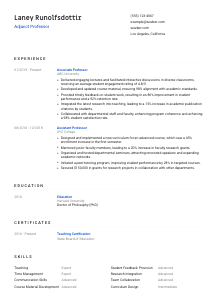
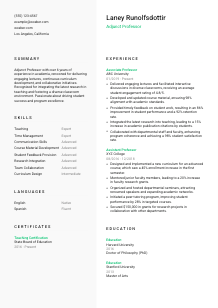
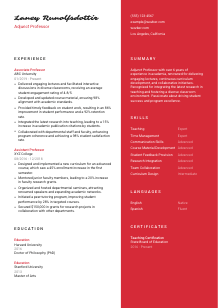
Delivering knowledge, but your CV isn't making the dean's list? Smarten it up with this Adjunct Professor CV example, created with Wozber free CV builder. Learn how to blend your academic expertise with job requirements, ensuring your teaching career doesn't end up in a syllabus limbo!
Adjunct faculty hiring moves quickly, but the standard is high. Colleges want instructors who can step into the classroom, hold student attention, keep course content aligned with academic standards, and work smoothly with a department's existing curriculum. Your CV should make that teaching record visible through concrete classroom results, course development work, and evidence that you stay current in your discipline.
A tailored CV changes how your teaching background is read, especially when committees or HR teams screen for collegiate teaching, degree level, licensure, and English proficiency before a department review. Wozber's free CV builder helps you shape that information into an ATS-compliant CV, so core qualifications such as student engagement, syllabus design, and curriculum collaboration are easy to identify from the first pass.
Academic CVs still start with practical basics. For adjunct hiring, this section should immediately confirm who you are, how to reach you, and whether you meet straightforward posting requirements such as location without distracting from your teaching credentials.
Lead with your full name in a clear header, then use the exact role title when it matches your target posting. Writing "Adjunct Professor" directly under your name helps place your background in the right context, especially if your recent title was Assistant Professor, Lecturer, or Associate Professor.
List one reliable phone number and a professional email address that looks appropriate in a faculty search. Hiring teams scheduling interviews, teaching demonstrations, or follow-up conversations should not have to search for your contact information or guess which address to use.
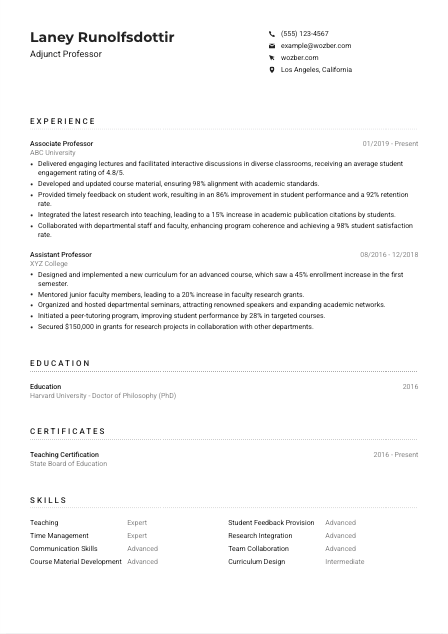
Some adjunct openings have immediate scheduling and campus availability constraints. If the employer specifies a location, include your city and state exactly as relevant. In the example, "Los Angeles, California" directly supports a stated requirement, but use this only when geography matters in the posting you are targeting.
If you have a faculty profile, LinkedIn page, personal academic site, or portfolio with publications, conference activity, syllabi, or teaching philosophy, include it here. For adjunct roles, an online profile can reinforce your subject expertise and show continued involvement in scholarship or higher education work.
Do not crowd this section with details that do not help a department evaluate your candidacy. Age, marital status, photo, and other nonessential information add nothing to your ability to teach, develop assessments, hold office hours, or contribute to curriculum coherence.
Keep the header clean, complete, and job-relevant. It should confirm basic eligibility quickly and move the reader straight to your teaching record.




This section usually decides whether an adjunct application moves forward. Departments want to see evidence that you have already taught at the collegiate level, managed classroom engagement, built or updated course content, and supported student performance in ways that fit their program needs.
Before you write or revise bullets, isolate the responsibilities the school repeats or emphasizes. For this role, that includes delivering engaging lectures, facilitating discussion, updating syllabi and assessments, providing timely feedback, integrating current research, and collaborating with faculty. Your experience bullets should answer those points directly rather than describing academic work in broad terms.
Start with your most recent teaching appointment and work backward. For each entry, include your title, institution, and dates so a reviewer can quickly confirm collegiate teaching continuity and see whether your background is recent enough for an active adjunct assignment.
Use accomplishment-focused bullets that show how you taught and what changed because of your work. The example does this well by pairing core adjunct functions with outcomes, such as delivering engaging lectures and earning a 4.8/5 student engagement rating, or updating course material and reaching 98% alignment with academic standards. That kind of phrasing gives substance to familiar faculty responsibilities.
Numbers can strengthen academic experience when they reflect real teaching performance. Student engagement scores, retention, course enrollment growth, improvement in student performance, curriculum adoption, grant funding, or satisfaction measures all work when they are accurate. A bullet such as improving retention to 92% or increasing enrollment in a redesigned course by 45% tells a committee far more than "responsible for student success."
Prioritise experience that supports adjunct hiring decisions: classroom instruction, assessment design, office hours, advising, curriculum updates, research integration, and departmental collaboration. Service work, speaking engagements, or grants can stay when they strengthen your teaching profile, as in the sample's seminar leadership and cross-department grants, but they should not push core classroom work into the background.
Your experience section should show that you can enter a college classroom, teach effectively, support students consistently, and contribute to a department without a long ramp-up period.
For adjunct positions, education is a screening point as much as a credential section. Institutions often need to confirm that you meet minimum degree standards for accreditation, departmental policy, and subject-area coverage before they look more closely at teaching style or student outcomes.
If the posting asks for a master's degree in the field, make that easy to find. If you also hold a PhD, list it clearly and prominently because it can strengthen your candidacy for departments that prefer terminal degrees. In the example, the PhD and master's degree together align well with both the minimum and preferred education requirements.
Present each degree with the degree name, field, institution, and graduation year. This structure helps a department confirm subject alignment quickly, especially when they are checking whether your graduate study supports the courses you would be assigned to teach.
Where possible, name your field in a way that mirrors the posting and reflects the subject you teach. If your degree is in Education, Biology, English, Business, or another directly relevant area, use that exact wording. Clear field naming matters when institutions need to document instructor qualifications by discipline.
Most experienced adjunct candidates do not need to list courses, but it can help if your degree title is broad, your teaching area is specialised, or you are moving into a closely related subject area. In those cases, a short note on graduate coursework can clarify academic preparation without overloading the section.
Honors, dissertation focus, research projects, assistantships, or academic memberships can support your profile when they reinforce subject expertise or teaching preparation. Keep them brief and relevant. The section should still read first as proof that you meet the institution's educational requirements.
A department should be able to verify your degree level, field alignment, and academic credibility within seconds. If those essentials are clear, the rest of your CV has room to do its work.
Teaching credentials matter when a posting names licensure, certification, or another formal requirement. For adjunct roles, this section can also show that you keep instructional methods and professional standards current, especially in regulated or practice-based disciplines.
Start with any credential that affects your ability to teach the subject or satisfy institutional requirements. Here, a valid teaching certification or equivalent licensure is explicitly requested, so that item belongs near the top and should be impossible to miss.
Choose certificates that strengthen your case as an instructor, not just as a general professional. Teaching certification, discipline-specific licensure, online instruction training, assessment design coursework, or recognized higher education teaching programs are all stronger choices than unrelated short courses.
If a certificate is current, renewable, or time-bound, include the dates. The example's "2016 - Present" format works well because it signals active standing. That matters when an institution needs to confirm that your credential is valid at the time of hire.
Adjunct faculty are often hired for both subject expertise and current teaching practice. Ongoing certification work in pedagogy, digital learning platforms, accessibility, or field-specific compliance can reinforce that you are maintaining professional standards rather than relying only on older qualifications.
Use this section to remove doubt around licensure and to show continued professional development that supports your teaching assignments.
A skills section works best when it reflects how adjunct faculty actually operate. Focus on abilities that affect instruction, assessment, curriculum quality, student support, and collaboration with faculty rather than filling the space with broad descriptors.
Look at the language used to describe the job, then convert it into accurate skill labels. For this opening, that includes communication, subject matter expertise, course material development, assessment work, student feedback, research integration, and collaboration. Those terms help both reviewers and ATS tools connect your CV to the role.
Adjunct teaching depends on both technical and human skills. Include the hard skills that shape course delivery, such as curriculum design or assessment development, alongside classroom-facing abilities such as discussion facilitation, communication, and time management. The example's mix reflects this balance well.
Trim anything that does not support the courses you would teach or the department environment you would join. A compact list of relevant teaching skills says more than a long list of generic traits. If you claim a skill here, the rest of the CV should back it up through course design, student outcomes, or departmental work.
Your skills should read like the toolkit of someone who can teach, evaluate student work, and contribute to a coordinated academic program from day one.
Language proficiency can matter in adjunct hiring for practical classroom reasons. Institutions may need proof that you can lecture clearly, write feedback well, and communicate with students and colleagues in the language of instruction, while additional languages may support diverse student populations.
If the posting specifies strong English language competence, list English clearly with an honest proficiency level. For a role centered on lectures, written feedback, office hours, and academic discussion, this is a core qualification rather than a minor detail.
Extra language ability can be useful when working with multilingual students, community-facing programs, or internationally diverse classrooms. In the example, fluent Spanish adds value, but secondary languages should stay secondary to the main teaching requirement unless the department specifically emphasizes them.
Choose straightforward terms such as Native, Fluent, Advanced, Intermediate, or Basic. These give a department a quick, usable sense of how you can communicate in class, in writing, and during student consultations.
Do not overstate your ability. If a committee shifts into that language during an interview or expects you to support students in it, inflated proficiency will become obvious. Accurate language ratings help set the right expectations from the start.
Include languages that strengthen your usefulness in the academic setting you are targeting. If you teach in programs with diverse enrollment, outreach components, or international student populations, multilingual ability can support advising, classroom rapport, and accessibility.
Handled well, your language section confirms communication readiness for the classroom and can also highlight added range in student-facing settings.
The summary should quickly position you as a credible college-level instructor. It needs to combine teaching tenure, subject credibility, and the kind of classroom or curriculum impact that makes a department want to keep reading.
Use the first lines of your CV to reflect the main hiring criteria. For an adjunct appointment, that often means collegiate teaching experience, student engagement, subject expertise, curriculum work, and current knowledge of the field. Keep the focus on what the department needs immediately.
Start with a direct description such as your title and years of relevant academic experience. The example's "over 6 years of experience in academia" gives quick context, though you can tighten this further by specifying collegiate teaching if that is the strongest match to the posting.
Choose points that reflect how you teach and what results you produce. Engaging lectures, curriculum development, strong student outcomes, research-informed instruction, or departmental collaboration all work well when they are grounded in your actual record. Avoid broad claims that are not supported elsewhere on the page.
Aim for a short paragraph of about 3 to 5 lines. This section should summarise your value quickly, not repeat every achievement. If your summary mentions student engagement, assessment work, or course design, the experience section should provide the fuller detail and metrics behind it.
By the end of these opening lines, a reviewer should already understand your teaching level, your academic focus, and the classroom contribution you are most likely to bring.
An effective adjunct professor CV makes the essentials easy to confirm: graduate-level academic preparation, college teaching experience, classroom results, current subject knowledge, and any required certification or location detail. Each section should support that picture with direct language and concrete outcomes.
Use Wozber's free CV builder, ATS-friendly CV templates, and ATS CV scanner to align your CV with the posting, strengthen wording around teaching and curriculum work, and present your experience in an ATS-friendly CV format. The finished document should make it easy for a department to see that you can step into the classroom and contribute with confidence.




