



Use Wozber and land your dream job
Create CV
No registration required
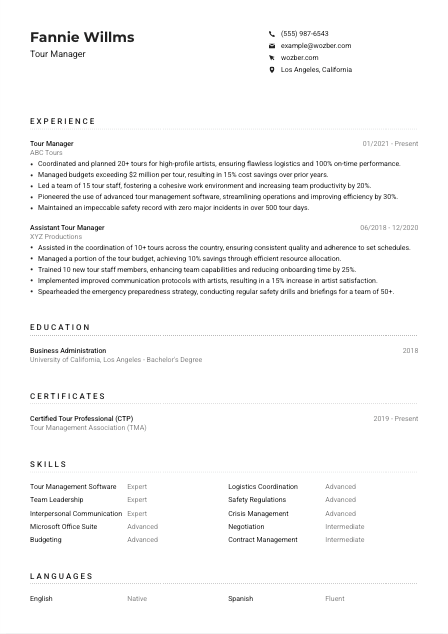
Navigating exotic destinations, but your CV feels lost in translation? Check out this Tour Manager CV example, created with Wozber free CV builder. Learn how to present your organizational prowess and people skills to match the job landscape, ensuring your career journey is as seamless as a well-guided excursion!
Tour management is operational work under pressure. Hiring teams want to see that you can keep travel, venue coordination, crew schedules, artist needs, and last-minute changes moving without dropping the budget or the safety plan. Your CV should make that control visible, especially through examples of tours managed, staff led, incidents handled, and financial scope.
A tailored CV helps separate hands-on tour managers from candidates whose experience sits closer to general event support or travel coordination. Using Wozber's free CV builder with an ATS-friendly CV format makes it easier to match the job's language around tour logistics, contracts, budgets, and safety procedures, so the hiring team can quickly see that you can run a tour, not just assist one.
This section is straightforward, but it still does important work. For a Tour Manager, clean contact details and the right location signal matter because employers often need someone who can step into planning conversations, vendor coordination, and tour prep without delay.
Use your full name as the most prominent text on the page. Keep the formatting simple and readable so the CV feels organised from the first line, which matters in a role built on coordination and detail management.
Place "Tour Manager" directly under your name when that is the role you are pursuing. It immediately aligns your CV with the opening and avoids confusion with adjacent titles such as Event Coordinator, Production Coordinator, or Assistant Tour Manager.
List one phone number and one professional email address that you check regularly. Tour hiring often moves quickly, especially when schedules shift or a team needs support fast, so accuracy here matters more than extra detail.
If the job calls for a specific base, show it clearly. In the example posting, Los Angeles, California is a stated requirement, so listing that location removes an immediate question about availability and local readiness.
Include a LinkedIn profile when it reflects the same roles, dates, and achievements shown on your CV. For Tour Managers, that profile can add useful context through tour history, artist-facing work, venue coordination, or recommendations from production and operations partners.
Keep Personal Details clean, accurate, and aligned with the posting. It should confirm that you are easy to contact, professionally presented, and available where the job needs you.




Experience carries the most weight in a Tour Manager CV because the work is judged through execution. Employers want to see whether you have handled travel logistics, vendor relationships, staffing, budget control, and tour-day issues in real operating conditions.
Focus your bullets on the work that mirrors the role: coordinating itineraries, booking logistics, managing budgets, handling contracts, supervising staff, and resolving problems on the road. If you have held adjacent roles, pull forward the parts that show operational ownership rather than general event support.
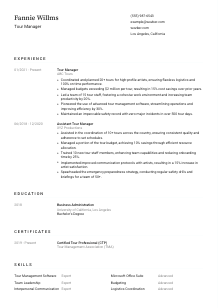
List jobs in reverse chronological order and make the basics easy to scan: employer, title, and dates. For this field, progression matters. Moving from Assistant Tour Manager to Tour Manager, as the example CV does, shows increased responsibility across planning, team oversight, and decision-making.
Do not stop at "responsible for tour logistics." Show what that work produced. The sample does this well by tying logistics coordination to 20+ tours and 100% on-time performance, and by linking software adoption to a 30% efficiency gain. Those are the kinds of results that tell hiring teams you can manage moving parts at scale.
Metrics are especially useful in this profession because they show complexity. Include tour count, crew size, budget size, number of tour days, supplier volume, cost savings, schedule adherence, safety record, or artist satisfaction when you can support them. Budgets over $2 million, teams of 15, or zero major incidents over 500 tour days all give concrete shape to your experience.
Prioritise experience that strengthens your case for managing tours. Entertainment, live events, travel operations, artist logistics, hospitality coordination, and production support usually belong. Unrelated achievements should only stay if they prove something directly useful, such as negotiation, high-pressure problem solving, or team leadership.
Your Experience section should show that you can keep a tour on schedule, on budget, and safe for artists and crew. If those three points are easy to spot, the section is doing its job.
Education is rarely the main deciding factor for experienced Tour Managers, but it still helps frame your professional foundation. In this field, degrees connected to business, tourism, hospitality, or event operations make practical sense because they support budgeting, coordination, and service delivery.
If the employer asks for a bachelor's degree in Business, Tourism, or a related field, make that match easy to see. A degree in Business Administration, Hospitality, Tourism, or Event Management can all support the commercial and logistical side of tour work.
Use a simple format with institution name, degree, field of study, and graduation year or date. Keep this section easy to scan so the reader can confirm the requirement quickly and move back to your tour management experience.
If your degree title is not an exact wording match, the field can still be clearly relevant. The example's Bachelor's Degree in Business Administration aligns well because tour managers regularly deal with budgets, vendors, contracts, and operational planning.
Relevant coursework can help if you are earlier in your career or if your degree is less directly related. Subjects such as event management, hospitality operations, finance, risk management, or business communication can reinforce your preparation for tour coordination work.
Honors, scholarships, or leadership roles are worth listing when they add substance, especially for newer candidates. Once you have several years of tour experience, keep the focus on the operational results and team responsibility from your work history.
Education should confirm that you meet the baseline requirement and have training relevant to planning, coordination, or business operations. Keep it concise and let it support the stronger proof in your experience section.
Certifications are not always required for Tour Manager roles, but the right ones can add useful professional weight. They work best when they reinforce areas employers care about in practice, such as safety awareness, logistics, touring operations, or industry-specific standards.
Choose credentials that strengthen your ability to manage live operations, teams, or safety procedures. In this profession, a certificate should point to practical knowledge, not just attendance at a general training session.
Lead with the certification most closely tied to touring or entertainment operations. The example's "Certified Tour Professional (CTP)" stands out because it directly supports the candidate's positioning as someone who understands the touring environment.
Add the issue date and, if relevant, the active period or renewal status. That matters most for certifications tied to current practices, safety expectations, or ongoing professional membership.
As your career grows, look for certifications that deepen your value in areas such as crowd safety, emergency response, contract administration, or event operations. They are especially useful when targeting larger tours, higher-risk environments, or more complex vendor networks.
A focused Certificates section can reinforce your professionalism and show continued investment in the field. Keep it relevant to tour delivery, safety, and operations rather than listing every course you have taken.
For Tour Managers, the skills section should read like a working toolkit. Employers look for a mix of logistics control, people management, financial discipline, software use, and calm decision-making when travel plans, venues, or artist needs change quickly.
Start with the posting and identify the technical and interpersonal capabilities it calls for. Here, that includes tour management software, Microsoft Office, communication, negotiation, and safety awareness. Add only the ones you can support through your work history.
Put the most relevant skills near the top. Tour management software, logistics coordination, budgeting, team leadership, contract management, crisis handling, and interpersonal communication are stronger lead items than broad terms such as "organised" or "hardworking." The example CV gets this right by emphasizing software, leadership, budgeting, and safety.
Group or order skills so they are easy to scan. You can separate operational tools from management capabilities if helpful, but avoid a long, uneven list. Clean structure helps both ATS parsing and human review, especially when a recruiter wants to confirm software proficiency and operational strengths quickly.
Your Skills section should show that you can run the mechanics of a tour while managing people and pressure. If the list supports the responsibilities already proven in your experience bullets, it is working.
Language skills matter in tour work when they improve communication with artists, crew members, venues, transport partners, or local teams. Even when English is the only stated requirement, additional languages can strengthen your profile for diverse touring environments and multi-region coordination.
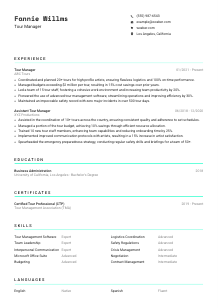
If the posting asks for English proficiency, include it clearly with an honest level such as Native or Fluent. That is a direct requirement in the example job description, so it should never be left implied.
Extra languages can be valuable when tours involve multilingual crews, varied audiences, or supplier communication across regions. Spanish, for example, can be a practical asset in many U.S. markets because it supports smoother coordination with staff, venues, and service partners.
Choose levels that reflect what you can actually do in a working environment. If you can handle vendor calls, crew briefings, or travel coordination in a second language, say so accurately. Overstating ability creates risk in a role where communication can affect timing and safety.
If you are targeting international or cross-regional touring roles, language range can become a stronger differentiator. In those cases, it helps show that you can manage communication across airports, hotels, venue teams, and local partners without everything routing through one person.
Only list languages that add real communication value. For Tour Managers, the section should suggest stronger coordination capability, not just personal interest in languages.
Use this section to show communication range that supports tour operations. For roles involving varied crews, vendors, or regions, that added range can strengthen your application.
The summary should establish your level, scope, and operating style within a few lines. For a Tour Manager, that usually means showing how much touring experience you have, what environments you have handled, and how you manage logistics, budgets, staff, and safety under live conditions.
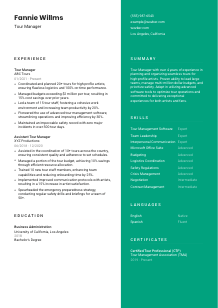
Start with a direct line that identifies you as a Tour Manager and states your years of experience. "Tour Manager with over 4 years of experience" works because it quickly confirms seniority and role alignment for a job asking for at least 3 years in tour coordination or management.
Choose highlights that reflect the scale of your work. Strong examples include managing multi-million-dollar budgets, coordinating dozens of tours, leading tour staff, or maintaining a strong safety record. The sample summary uses all three areas effectively without becoming too long.
Mention role-specific capabilities such as tour management software, contract handling, artist logistics, team leadership, or emergency preparedness when those are central to the target role. This helps your summary connect with both ATS screening and human readers scanning for operational fit.
Aim for 3 to 5 lines with no filler. Every phrase should earn its place by clarifying scope, responsibility, or results. A concise summary works best when it leads naturally into experience that proves the claims.
The summary should quickly position you as someone who can manage the moving parts of a tour with discipline and sound judgment. When done well, it sets up the rest of the CV to confirm that impression with detail.
A Tour Manager CV needs to show operational control, financial responsibility, team leadership, and a steady approach to safety and unexpected issues. When those points are clear across your summary, experience, skills, and supporting sections, the hiring team can picture you running the tour rather than learning on the job.
Use Wozber's free CV builder to shape that story into an ATS-compliant CV, refine the wording with role-specific terminology, and check alignment with an ATS CV scanner. The final result should make one thing easy to judge: you can keep artists, crew, schedules, and budgets moving smoothly from the first booking call to the last show.




