



Use Wozber and land your dream job
Create CV
No registration required
Juggling parties, but your CV feels like it's stuck at coat check? Unpack this Event Coordinator CV example, created with Wozber free CV builder. Learn how to present your seamless planning skills in line with job requirements, so your career gets top billing at every event!
Event coordination looks glamorous from the outside, but hiring teams know the job is built on logistics, vendor follow-through, budget control, and calm decision-making when timelines shift. Your CV needs to make those operating strengths visible fast, especially across conferences, launches, and corporate events where execution quality shows up in turnout, attendee satisfaction, and how smoothly the day runs.
A tailored CV helps separate event coordinators who have managed the full delivery cycle from candidates who mostly supported isolated tasks. Using Wozber's free CV builder to align your wording with the posting and keep an ATS-friendly CV format clean makes it easier to surface the right details first, such as event scope, contract work, cross-functional coordination, and post-event reporting.
This section should read like the front page of a well-run event brief. Keep it clean, accurate, and easy to scan so nothing slows down communication when a hiring manager wants to move quickly.
Use your full name in the most prominent text on the page. Event coordination is a client-facing profession, so your header should feel polished and straightforward, with no distracting nicknames or decorative formatting.
Place "Event Coordinator" directly below your name if that is the role you are pursuing. This keeps your positioning clear and immediately connects your CV to the opening, especially when employers are sorting candidates across event planners, coordinators, and marketing-focused roles.
Hiring moves quickly for event roles, especially when teams are filling positions tied to active calendars or upcoming programs. Use contact details that make scheduling easy and remove any doubt about how to reach you.
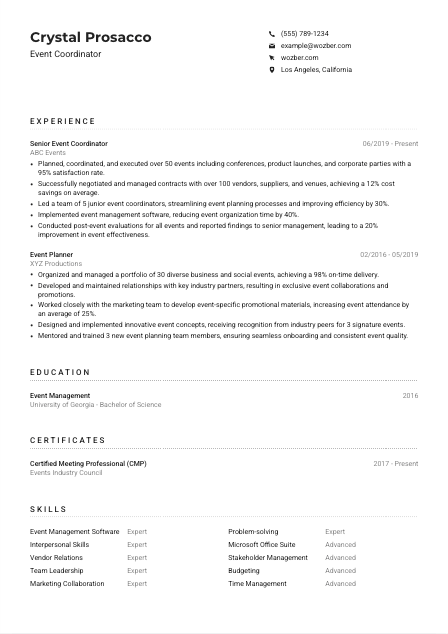
If the posting specifies a city or region, include it clearly. Here, listing "Los Angeles, California" directly supports the stated location requirement and tells the employer you are already based where the events are being managed.
A LinkedIn profile, portfolio site, or event page collection can strengthen your application if it reflects real work. Include it when it shows event types, scale, brand collaborations, photos, testimonials, or other proof of execution quality that a CV bullet cannot fully capture.
Your contact section should make you easy to reach and immediately recognizable as an event professional. If this top block is accurate and role-aligned, the rest of the CV can stay focused on delivery, coordination, and results.




For event coordinators, experience is where hiring teams look for proof that you can move from planning to live execution without losing control of vendors, budgets, or stakeholder expectations. Generic bullets about "helping with events" are weak. Specifics about event volume, cost management, timelines, and cross-functional work are what carry weight here.
Start by marking the work the employer emphasizes most. In this case, that includes planning and executing varied events, negotiating with vendors and venues, partnering with marketing, managing budgets, and reporting outcomes after the event. Those priorities should shape which bullets rise to the top of each role.
List positions in reverse chronological order so the employer sees your current event scope first. Recent experience usually carries the most weight in this field because tools, venue practices, sponsorship formats, and attendee expectations change quickly.
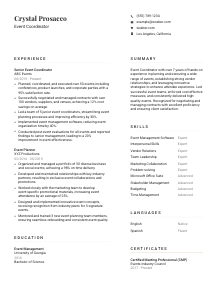
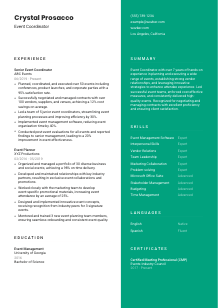
Rewrite each bullet to show what you owned and what happened because of your work. A line like "Successfully negotiated and managed contracts with over 100 vendors, suppliers, and venues, achieving a 12% cost savings on average" is effective because it shows procurement responsibility, negotiation skill, and budget impact in one sentence.
Metrics make event experience easier to trust when they reflect how the work is actually measured. Good examples include number of events delivered, attendance growth, satisfaction scores, budget savings, on-time execution, vendor volume, or process improvements. The sample CV does this well with details like 50+ events, a 95% satisfaction rate, and a 20% improvement in event effectiveness after post-event evaluation.
Choose experience that supports the target role, even if your background includes broader marketing, hospitality, or operations work. Prioritise bullets about venue coordination, client communication, vendor management, promotional collaboration, timelines, run-of-show execution, and reporting. Remove achievements that do not help explain how you deliver successful events.
A strong experience section lets the reader picture you handling the moving parts of a real event. By the end of it, they should have a clear sense of your event scope, your operating style, and the outcomes you can deliver under pressure.
Education matters most here when it confirms you meet the baseline and supports your understanding of event operations, hospitality, or related business work. It does not need a lot of space, but it should be clear and directly connected to the posting.
Check the posting for the academic requirement and make sure your degree is easy to find. This role asks for a bachelor's degree in event management, hospitality, or a related field, so place that information in a straightforward format without burying it under extra details.
List your degree, field of study, school, and graduation year in a way that can be scanned in seconds. Event hiring often moves quickly, and clarity matters more than design flourishes in this section.
If your degree closely matches the role, make that alignment obvious. "Bachelor of Science in Event Management" is a direct match for this posting and immediately reinforces profession-specific training alongside hands-on event experience.
Relevant coursework, capstones, or student-led event projects can strengthen this section if you are earlier in your career or changing into event coordination from a related field. Include them only when they add something useful, such as budgeting, hospitality operations, event production, sponsorship, or marketing collaboration.
Honors, leadership roles, or association memberships can help when they connect to the profession, such as hospitality societies, campus event boards, or conference planning committees. If you already have several years of event results, keep those additions brief so experience stays dominant.
Your education section should quickly confirm that you meet the role's baseline and, where relevant, that your training connects naturally to event planning work. Clear alignment is enough here.
Certifications carry extra value in event coordination because they point to professional standards, industry knowledge, and commitment to structured event practice. They are especially useful when the employer names them directly, as this posting does with Event Planning certification and CMP.
When a posting names a certification, surface it clearly if you have it. A credential like Certified Meeting Professional, or CMP, immediately supports your credibility for meetings, conferences, and complex stakeholder-managed events.
Only include certifications that support event planning, meeting management, hospitality, vendor coordination, or related operational work. A short, focused list is stronger than a long list of unrelated online courses.
Include the year earned and, if relevant, the active period. This helps employers understand whether the credential is current and gives context for how long you have been working with formal event standards or continuing education.
If you are actively pursuing additional training, choose programs that sharpen practical event work, such as budgeting, risk management, AV coordination, sponsorship activation, or conference logistics. Ongoing development matters in a field where formats, tools, and attendee expectations keep evolving.
Relevant credentials give hiring teams another reason to trust your event judgment, especially for high-visibility programs with multiple vendors and stakeholders. Keep this section tight, current, and connected to the work.
A useful skills section should echo the language of the role and the realities of event execution. For an Event Coordinator, that means balancing software proficiency, stakeholder communication, budget awareness, and the practical coordination skills that keep a live program on track.
Read the posting for both explicit and implied requirements. Here, event management software, Microsoft Office, interpersonal skill, and stakeholder management are named directly, while vendor negotiation, budgeting, scheduling, and cross-team coordination are clearly part of the day-to-day work.
Build your list around capabilities that matter for the role you want, not every skill you have used. For this kind of opening, a focused mix might include event management software, vendor relations, budgeting, marketing collaboration, stakeholder management, and time-sensitive problem solving. The sample CV handles this well by combining technical and interpersonal strengths instead of leaning too hard on either one.
Present skills in a simple format that an employer and an ATS can read cleanly. Grouping them logically or listing them in a compact section works well, especially when the wording matches the job description naturally rather than forcing extra keywords.
Your skills section should confirm that you can manage both the planning side and the live-execution side of events. If the employer can quickly spot the tools, coordination strengths, and business-facing abilities they asked for, this section is doing its job.
Language ability matters in event work when it affects guest experience, vendor communication, or coordination across teams. Even when only one language is required, list it clearly if the posting calls it out.
If the role specifies language proficiency, reflect that directly in this section. This posting makes English proficiency essential, so English should appear first with an honest proficiency level.
Put the language most important to the job at the top, then list any others that may support your work. This gives the employer a quick read on your communication range without making the section feel padded.
Extra languages can be valuable in event environments that involve diverse attendees, vendors, sponsors, or guest speakers. For example, Spanish can be an asset in many client-facing settings, but it should support your application rather than distract from the core requirement.
Choose straightforward labels such as Native, Fluent, Advanced, Intermediate, or Basic. Clear language matters in a profession built on communication, guest direction, and vendor coordination.
If your background includes international conferences, multicultural audiences, or bilingual vendor management, your language section can reinforce that experience. If not, keep the section simple and factual.
Language skills should clarify how you communicate in real event settings, not just decorate the page. List what you can genuinely use on the job and keep the emphasis on practical coordination value.
The summary is your quickest chance to frame the kind of event professional you are. For this role, that means giving a concise read on your years of experience, event types, coordination strengths, and the business results you tend to influence.
Start from the responsibilities that define the opening. Here, that means planning and executing events, managing vendors and venues, collaborating with marketing, controlling budgets, and reporting outcomes. Your summary should touch the areas where your background most closely overlaps.
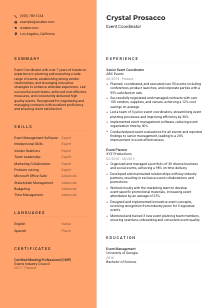
Lead with a direct description of your professional profile, such as your title and years of experience. "Event Coordinator with over 7 years of hands-on experience" works because it establishes seniority and role alignment immediately.
Use the rest of the summary to highlight the kind of value you bring. Strong examples include managing a wide range of events, improving attendee satisfaction, reducing costs through vendor negotiation, or coordinating effective promotions with marketing teams. The sample summary works well because it combines event breadth, relationship management, and cost control in a few lines.
Aim for a short paragraph that sounds like a hiring-ready introduction, not a personal statement. Focus on concrete event strengths and outcomes instead of broad claims about passion, creativity, or being results-driven.
A well-written summary helps the employer understand your event scope before they read a single bullet in detail. When it is specific and role-aligned, the rest of the CV lands faster.
An Event Coordinator CV works best when every section supports the same picture: you can organise the moving parts, manage people and vendors professionally, keep spending under control, and deliver events that meet their goals. That is the throughline hiring teams want to see.
Use Wozber's free CV builder to tighten structure, strengthen ATS optimisation, and tailor your wording to each posting with help from its ATS CV scanner and AI-powered tools. The final result should make it easy to judge your readiness to run successful events from planning through post-event reporting.




