



Use Wozber and land your dream job
Create CV
No registration required
Crafting events but feel your CV lacks the sparkle? Check out this Event Planner CV example, created with Wozber free CV builder. Learn how to blend your flair for festivities with job specifics, making your career as memorable as that one party where the confetti cannon misfired!
Event planning work is judged in the real world by how well you keep moving parts under control. Budgets, venue logistics, vendor contracts, guest experience, timelines, and client expectations all have to hold together at once. A CV for this field needs to show that you can run that operation from concept through post-event follow-up, not just that you have been around events.
When your CV is tailored to the posting, the hiring team can quickly connect your background to the kind of events, tools, and coordination work they need. Wozber's free CV builder helps you align your wording with the job description and produce an ATS-compliant CV that surfaces event software, budget ownership, vendor management, and client-facing results early, so your ability to execute is clear from the first scan.
Event planners are expected to be organised before the first call ever happens. Your Personal Details section should reflect that same standard by making your identity, role, contact information, and location easy to confirm without clutter or missing basics.
Use your full name in a clean, readable format at the top of the page. Keep it slightly more prominent than the rest of the text so the CV feels structured right away, the same way a well-run event starts with clear signage and direction.
Place "Event Planner" directly below your name if that is the role you are applying for. Matching the title used in the posting helps frame the rest of your CV correctly, especially when your background includes adjacent titles such as Event Coordinator, Meeting Planner, or Assistant Event Planner.
List a phone number you actively answer and a professional email address. Accuracy matters here. Event planning roles rely on fast communication with clients, venues, and vendors, so small errors in your contact section can create the wrong impression before anyone reads your experience.
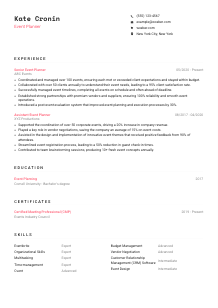
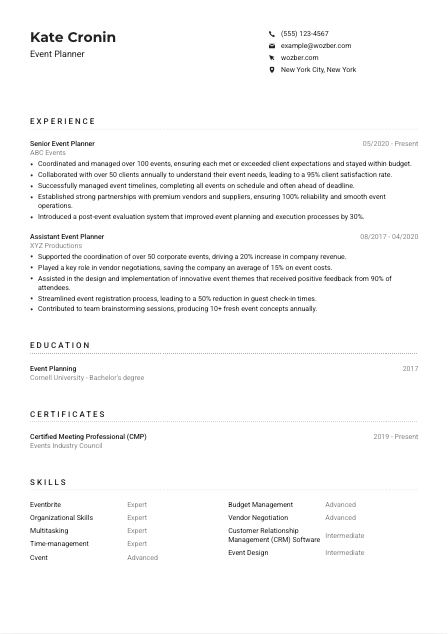
If the job calls for a specific city, include your city and state. In this example, "New York City, New York" immediately answers a stated requirement and removes doubt about local availability for site visits, vendor meetings, and event-day execution.
Include a LinkedIn profile or personal website only if it supports your candidacy with consistent job history, portfolio material, or event highlights. For event planners, that might mean a profile showing industries served, event scale, or client-facing work rather than a generic online presence.
Keep this section precise and complete. It should tell an employer exactly who you are, how to reach you, and whether you already meet practical requirements such as location for on-site event work.




Hiring managers look to the Experience section for operational proof. They want to see who handled budgets, timelines, client communication, vendor coordination, contract discussions, and post-event improvement, and whether that work was done at a scale that matches their needs.
Before you write or revise bullets, identify the work themes in the job description. For an Event Planner, that usually includes budgeting, scheduling, venue selection, vendor management, contract negotiation, stakeholder communication, and post-event evaluation. Build your bullets around those functions so the match is visible without forcing keywords.
List your most recent role first and work backward. In event planning, recent experience often shows your current event scale, software exposure, and level of client ownership, so the hiring team should not have to search for that context.
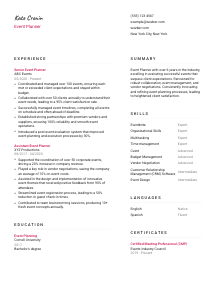
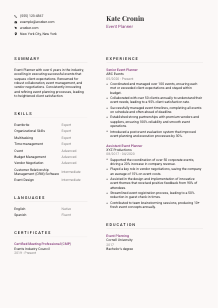
Generic statements like "planned events" do not say enough. Show the scope and result of the work. The sample CV does this well with bullets such as coordinating more than 100 events, managing over 50 clients annually, and improving planning processes by 30%. Those details make the candidate's event volume, client interaction, and process impact easy to understand.
Event planning has clear performance measures, so use them. Mention number of events, budget size, attendee count, client satisfaction, cost savings from negotiations, check-in time improvements, on-time delivery, repeat business, or vendor reliability. Metrics like a 15% cost reduction or a 95% client satisfaction rate carry more weight than broad claims about being organised.
Prioritise bullets that match the target role's operational demands. If you have experience in marketing, hospitality, or production support, keep only the parts that connect directly to event execution, client service, logistics, or supplier coordination. Every bullet should help the reader picture you managing a live event environment.
Your experience section should make your event planning range easy to judge. By the end of it, the employer should be able to see the kinds of events you handled, the moving parts you owned, and the results you delivered under deadline.
Education matters most here when it confirms relevant training in event planning, hospitality, communications, or a related business field. For experienced planners, this section is usually brief, but it still helps establish the foundation behind your coordination and client-service work.
If the posting asks for a bachelor's degree in Event Planning, Hospitality, or a related field, present that information directly. In the example, a Bachelor's degree in Event Planning from Cornell University aligns neatly with the stated requirement and removes the need for guesswork.
List the school name, degree, field of study, and graduation year or date. That is usually enough. Employers reviewing event planner CVs are looking for easy confirmation, not a long academic profile.
Include your major or concentration when it strengthens alignment with the job. Event Planning, Hospitality Management, Tourism, Communications, and Business can all be relevant depending on the employer's event mix and client expectations.
If you are earlier in your career, selected coursework can help bridge limited experience. Prioritise classes tied to event operations, hospitality management, budgeting, marketing, project management, or venue logistics. Skip this if you already have several years of event work and measurable results.
Honors, student leadership, or campus event roles can strengthen this section if they relate to planning or execution. For example, organising university conferences, fundraising events, or guest programs can show early experience with scheduling, coordination, and stakeholder management.
Use education to confirm that your background supports the role's baseline requirements. Keep it concise, relevant, and focused on the training that connects most directly to event planning work.
Certifications matter in event planning when they show recognized training in meeting management, operations, or industry standards. They are especially useful when a posting names a preferred credential or when you want to show commitment beyond day-to-day experience.
If a job mentions a preferred credential such as Certified Meeting Professional (CMP), place it prominently. That direct alignment can quickly strengthen your profile, especially for roles involving complex logistics, corporate events, or higher client expectations.
Choose certifications tied to event planning, hospitality, meeting management, project coordination, or relevant software platforms. A short, relevant list works better than padding this section with unrelated learning that does not support venue coordination, budgeting, or client delivery.
Show the issue date or active period when the credential is current, renewable, or still in effect. In the sample CV, listing the CMP as "2019 - Present" signals that the certification remains active and relevant.
Review certificates regularly and add new ones that reflect where your event work is going. If you are moving toward larger conferences, executive meetings, or specialised event formats, updated credentials can show progression in the same way expanded event scope does in your experience section.
This section should show focused professional development, not extra decoration. Relevant certifications tell employers that you take event standards, logistics, and client delivery seriously enough to formalize your expertise.
Event planning skills need to balance logistics, communication, and execution tools. This section should show that you can manage the planning workflow, keep stakeholders aligned, and handle the software and coordination work that sits behind a successful event.
Start with the exact capabilities the employer names, then add closely related strengths you genuinely use. In this example, that includes event planning software such as Eventbrite or Cvent, along with organizational skills, multitasking, time management, budgeting, and vendor coordination.
If you have used the same platforms or handled the same planning tasks, use the posting's wording. That helps with ATS optimisation and gives hiring teams a familiar read. The sample CV does this effectively by listing Eventbrite, Cvent, Budget Management, and Vendor Negotiation instead of vague alternatives.
Order matters. Lead with the skills most relevant to the role's day-to-day work, especially event software, schedule management, budgeting, vendor relations, client communication, and on-site coordination. Save broader or secondary skills for the lower half of the list.
Your skills list should read like the toolkit of someone who can actually deliver an event. The employer should be able to spot your systems knowledge, planning discipline, and operational strengths in a few seconds.
Language ability can matter in event planning because the work is communication-heavy. Client meetings, vendor calls, guest-facing coordination, and on-site issue handling all depend on clear language skills, especially when events involve diverse audiences or international attendees.
Check the posting for explicit language expectations and list those first. Here, clear English communication is essential, so English should appear at the top with an accurate proficiency level.
Use standard labels such as Native, Fluent, Intermediate, or Basic. Event planning depends on clear communication under pressure, so avoid inflated claims. The wording should set realistic expectations for client conversations, written updates, and event-day coordination.
Additional languages can strengthen your profile when the employer serves multilingual guests, international clients, or culturally diverse attendee groups. In the sample, Spanish adds useful versatility without distracting from the core requirement of English fluency.
Only include languages you can actually use in a work setting. If you could handle vendor communication, guest assistance, or basic event logistics in that language, list it. If not, leave it out.
The value of extra languages depends on the event environment. Corporate meetings, community events, destination events, and public-facing programs may all use language skills differently. Include them when they support the type of planning work you want next.
Present languages as a practical communication asset. For event planning, that means showing where you can support smoother coordination, stronger client interaction, or a better attendee experience.
The summary sits at the top of the CV, so it should quickly establish your event planning level, your operating strengths, and the kind of results you deliver. A hiring manager should be able to tell within a few lines whether your background fits their event scope and coordination needs.
Read the job description closely and identify the few themes that matter most. For this role, those include end-to-end event management, client collaboration, timeline control, vendor coordination, and continuous improvement after events. Use those themes to decide what belongs in the summary.
Start with a direct line that names your profession and years of experience. The sample's opening, "Event Planner with over 6 years in the industry," works because it establishes level immediately and gives context for the achievements that follow.
After the opening, mention capabilities that match the role and show business value. Strong options include managing high event volume, improving client satisfaction, controlling budgets, negotiating with vendors, or refining planning processes. Keep these claims grounded in work you can support elsewhere on the CV.
Aim for a concise paragraph of about 3 to 5 lines. Avoid generic descriptors like "passionate" or "dynamic" unless they are backed by actual event results. A short summary with real planning terms and measurable context will do more than a longer paragraph filled with broad claims.
This section should give the employer a quick, accurate picture of your event planning scope and strengths. If it is working, the reader will immediately understand what kinds of events you can manage and where you create value.
A tailored Event Planner CV should show more than creativity. It should show command of budgets, timelines, client needs, venue decisions, vendor relationships, and post-event improvement. When those details are clear, your CV reads like someone who can take ownership of a live event operation.
Use Wozber's free CV builder to shape that story into an ATS-friendly CV template with strong ATS optimisation and role-aligned language. With the right details in the right sections, your CV will make it easier for employers to judge your planning range, execution discipline, and client-facing reliability.




