



Use Wozber and land your dream job
Create CV
No registration required
Leading adventurers, but your CV feels off the map? Follow this Tour Guide CV example, built with Wozber free CV builder. Learn how to map out your storytelling skills to match job landmarks, making your career journey as thrilling as that unexpected detour to a hidden gem!
Tour guiding work is judged in real time. You are expected to keep a group engaged, explain local history and culture accurately, manage timing and logistics, and stay calm if weather, crowd flow, or a guest issue changes the plan. A Tour Guide CV should make that range visible quickly, especially your ability to lead people through a safe, memorable experience rather than simply list public-facing jobs.
Hiring teams often need to separate candidates who are personable from those who can actually run tours smoothly and represent a place well. Tailoring your CV to the posting helps surface the right details first, including route knowledge, guest satisfaction, booking coordination, and safety preparation, while Wozber's free CV builder helps you shape an ATS-compliant CV that makes your experience easier to read in the context of guided tours.
Tour companies usually review this section fast, but it still carries practical value. For a Tour Guide, your contact details should confirm that you are reachable, professionally presented, and, when relevant to the posting, already based where the tours operate.
Use your full name as the clearest visual element at the top of the CV. Keep it easy to spot and easy to read. Tour guiding is a people-facing role, so the document should feel organised and approachable from the first line.
Place "Tour Guide" under your name when that is the role you are applying for. This removes ambiguity, especially if your background includes adjacent work such as hospitality, museum support, event staffing, or assistant guide positions.
Include a current phone number and a professional email address. Avoid casual handles. If a hiring manager needs to confirm availability for weekend tours, seasonal schedules, or group bookings, your contact information should be effortless to use.
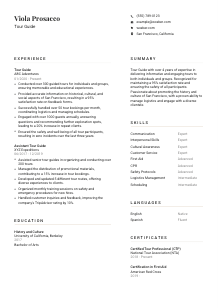
If the employer wants candidates already based in the tour area, include your city and state clearly. In this example, listing San Francisco, California directly supports a stated requirement and helps remove a practical screening obstacle early.
Include a website or LinkedIn profile only if it strengthens your application. A profile with hospitality experience, tourism work, local history projects, or customer-facing achievements can add value. If it is sparse or outdated, leave it off.
Keep this section clean and factual. It should confirm who you are, how to reach you, and, when relevant, that you are positioned to start guiding in the area without extra questions.




This section carries the most weight because tour guiding is hired through visible performance. Employers want to see how you handle groups, share information, manage logistics, and protect the guest experience when conditions shift.
Read the posting for the responsibilities that shape the day-to-day work. For tour guide roles, that usually means leading groups, presenting local history and culture accurately, answering questions, managing bookings or schedules, and maintaining participant safety. Use those priorities to decide which achievements deserve space.
Start with your most recent position and include job title, employer, and dates. If you moved from Assistant Tour Guide to Tour Guide, that progression matters. It shows growing responsibility with guest groups, route delivery, and on-the-ground coordination.
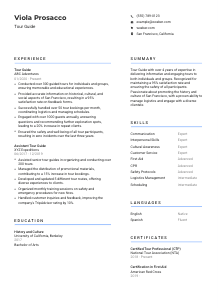
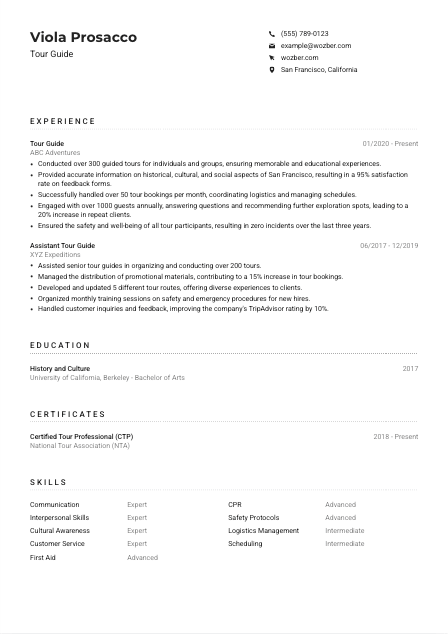
Do not stop at "gave tours" or "worked with customers." Show scope, setting, and outcome. Good bullets mention group tours, historical or cultural interpretation, guest questions, booking volume, route planning, or safety performance. The sample does this well by showing tours conducted, guest engagement, and recommendations that increased repeat clients.
Tour guiding has clear performance markers, so quantify where you can. Include tours led, satisfaction scores, repeat bookings, TripAdvisor improvements, monthly booking volume, or incident-free records. "Conducted over 300 guided tours" and "95% satisfaction rate" are strong because they show both scale and quality.
Prioritise experience that shows storytelling, local knowledge, customer interaction, logistics, and safety judgment. If you have broader experience in tourism, education, or hospitality, keep the bullets that connect most directly to running a smooth tour. Relevance is especially important when an ATS or hiring manager is scanning for guiding experience within a few seconds.
Your experience should show that you can do more than speak to a group. It should show that you can run a tour, answer for the place you represent, and keep guests engaged and safe from start to finish.
Education is rarely the main deciding factor for a Tour Guide, but it can add useful context. A degree or coursework tied to history, culture, communications, tourism, or education can strengthen how your experience is read, especially when the role involves interpretation and public interaction.
If the posting does not require a degree, use this section to reinforce relevant knowledge rather than to fill space. A background in history, culture, anthropology, communications, or hospitality can support your credibility. In the example, a degree in History and Culture fits naturally with interpretive tour work.
List the institution, degree, field of study, and graduation date. Keep the formatting consistent and easy to scan. This section should support the rest of the CV, not compete with your experience.
If your degree or diploma connects directly to the tours you lead, name that connection clearly through the field of study. A hiring manager will immediately understand why a background in local history, art history, culture, or tourism matters in a guest-education role.
Relevant coursework can help if your degree title is broad or your guiding experience is still growing. Subjects such as regional history, public speaking, cultural studies, heritage interpretation, or tourism management can give extra context without taking over the section.
Honors, research projects, clubs, or capstone work are worth mentioning when they connect to public communication, local heritage, language ability, or community engagement. Keep the focus on details that support your work as a guide, not general student activity.
Use education to reinforce your authority and interest in the stories, places, and communities you guide people through. It works best when it clearly supports the content of your tours.
Certifications matter in tour guiding when they reflect safety preparation, professional standards, or specialised subject knowledge. They are especially useful when the role involves public responsibility, outdoor activity, or groups with varied needs.
Put the most relevant credentials first. For this type of role, First Aid and CPR deserve attention because the employer explicitly prefers them and they speak to guest safety. If you hold a tour-specific credential, include that as well.
Skip unrelated short courses and old certificates that do not support the work. Prioritise safety training, tourism credentials, interpretation programs, local heritage certifications, or licenses tied to the environments where you guide.
Many certifications, especially CPR and First Aid, need to be current to carry weight. Listing dates helps the employer see that your training is active. The example handles this well by showing ongoing validity.
Tour guides often refresh safety training, local knowledge, and professional certifications over time. Updating this section tells employers you treat guest care and operational readiness seriously, not as one-time requirements.
A focused certification section strengthens trust. It shows that you are prepared for the practical side of guiding, including safety response, professional conduct, and the standards expected in public-facing tourism work.
Tour Guide skills need to reflect both performance in front of guests and control behind the scenes. Employers look for a mix of communication, local knowledge, group handling, scheduling awareness, and calm decision-making during live tours.
Pull out the skills the employer names directly, then add the ones the work clearly requires. In this posting, communication, interpersonal ability, historical and cultural knowledge, and emergency poise are explicit. Booking coordination, crowd awareness, route pacing, and problem-solving are also part of the actual job.
Choose skills you can support elsewhere in the CV. For a Tour Guide, that might include public speaking, guest engagement, cultural interpretation, customer service, First Aid, CPR, safety protocols, logistics management, and multilingual communication. The sample skill list works because it balances people skills with operational ones.
Put the skills most connected to the target role near the top. A long skill list loses value if the essentials are buried. Lead with the abilities that affect the guest experience and tour execution first, then include supporting administrative or technical skills after that.
Your skills section should make it easy to see how you guide, how you manage the flow of a tour, and how you respond when guest needs or logistics change on the spot.
Language ability can be a real advantage in tour guiding because it affects guest comfort, clarity, and the overall quality of the experience. In destinations with international visitors, even one additional language can broaden the kinds of groups you can serve.
If the posting specifies a language, list it first with an accurate proficiency level. Here, fluent English is essential, so it should appear clearly and credibly on the CV.
Extra languages can set you apart when you guide mixed groups, answer traveller questions, or support guests beyond the formal tour. In a major tourism market, a second language such as Spanish can be a practical asset rather than a bonus line.
Use realistic proficiency labels such as Native, Fluent, Advanced, or Conversational. Tour guiding puts language skills under direct pressure during live interaction, so overstating your level can create problems quickly.
If you speak more than one language, remember what that means operationally. It can help you welcome international visitors, explain local context more clearly, and handle questions with less friction during the tour.
Only include languages you would be comfortable using with actual guests. When genuine, multilingual ability supports the cross-cultural side of tour guiding and can expand the types of tours or audiences you can handle.
This section should show whether you can communicate confidently with the groups you are likely to guide. For many tour employers, that has direct value in guest satisfaction and repeat business.
The summary should quickly frame the kind of Tour Guide you are. In a few lines, show your experience level, what you guide well, and the results or strengths that matter most in guest-facing tourism work.
Pull together the parts of your background that match the job most closely. For a Tour Guide, that usually means years of guiding experience, strength in historical or cultural storytelling, guest interaction, and steady handling of safety or logistics.
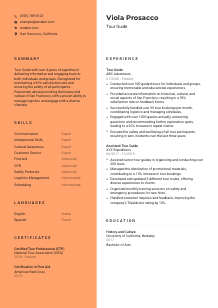
Your first line should state who you are and how long you have been doing the work. A phrase such as "Tour Guide with 4+ years of experience" works because it anchors the rest of the summary immediately.
Use brief, high-value proof points that show the quality of your work. In the example, a 95% satisfaction rate and an incident-free record give the reader immediate confidence in both guest experience and safety awareness.
Aim for a short paragraph that reflects the posting rather than your whole career history. Mention local knowledge, audience engagement, or booking coordination only if those are real strengths for you and relevant to the role you want now.
By the time someone finishes your summary, they should already understand your experience level, your style with guests, and the kind of tour environment you can handle well.
A Tour Guide CV works best when it shows real tour delivery, not just enthusiasm for travel or local culture. Focus on the details that hiring teams can use right away: groups led, stories interpreted, logistics handled, guest feedback, and safety performance.
Use Wozber to build an ATS-friendly CV template, align your language with the job description, and check key requirements with the ATS CV scanner. The final CV should make it easy to judge whether you can lead engaging, informed, and well-managed tours.