



Use Wozber and land your dream job
Create CV
No registration required
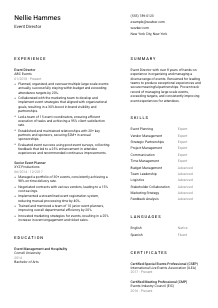
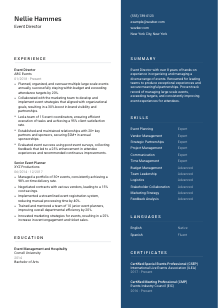
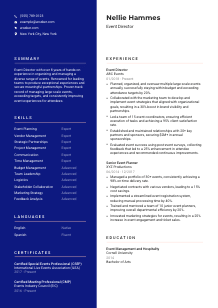
Masterminding events, but your CV feels like a no-show? Command the spotlight with this Event Director CV example, created with Wozber free CV builder. Learn how to align your event production prowess with job criteria, propelling your career to centre stage!

Event Directors are trusted with budgets, vendor contracts, sponsor relationships, attendee experience, and the kind of on-site decisions that leave no room for vague execution. Your CV needs to show that you can run complex events from strategy through post-event review, while keeping teams aligned and outcomes measurable.
When that story is tailored to the opening, the first scan becomes much clearer: hiring teams can quickly see event scale, leadership scope, and operational control instead of digging through generic planning language. Wozber's free CV builder helps you shape that into an ATS-compliant CV with the right phrasing and structure, so the document reflects the same coordination and clarity the role itself demands.
This section should read like the front page of a well-run event brief. Keep it clean, professional, and aligned with any practical requirement the employer has already stated.
Your name should be the most visible element in the header, using a larger font than the rest of the contact details. For an Event Director, that top line functions like a byline on a major production plan: clear, easy to find, and professional from the first glance.
Use the job title "Event Director" directly beneath your name when that is the role you are pursuing. This creates immediate alignment with the posting and helps ATS optimisation by connecting your CV to the same role language the employer is using.
Include a reliable phone number and a professional email address. If you add LinkedIn or a portfolio site, make sure it supports your candidacy with conference photos, event case studies, sponsor work, or other proof of event leadership rather than a generic profile.
If the employer specifies a location requirement, reflect it clearly in your header. Here, listing New York City, New York immediately answers a practical filter and avoids unnecessary hesitation about local availability for venue visits, partner meetings, and event-day presence.
A personal website can help if it shows the right material: event portfolios, brand activations, production highlights, testimonials, or press coverage. For a senior events role, a useful link reinforces scope and credibility. A weak or outdated link does the opposite, so include it only if it adds substance.
Your header should confirm who you are, what role you are targeting, and whether you meet practical requirements such as location and professional accessibility. Keep it brief, accurate, and easy to scan.




This is where Event Director candidates separate themselves. Hiring teams are looking for proof that you can lead high-stakes events, control budgets, manage vendors, and deliver a polished attendee experience at scale.
Prioritise roles and bullets that reflect event ownership, team leadership, cross-functional collaboration, and post-event improvement. If the opening asks for large-scale event management and leadership experience, your strongest material should show exactly that, not early-career administrative tasks or unrelated coordination work.
List positions in reverse chronological order with employer, title, and dates presented consistently. Event hiring often involves reviewing multiple candidate profiles quickly, so a clear work history helps the reader track your progression from planner or senior planner roles into full event leadership. Wozber's ATS-friendly CV template supports that clean structure.
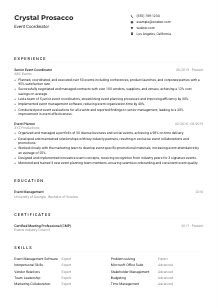
Replace general task language with outcomes tied to event performance. The sample CV does this well by showing attendance gains, sponsorship revenue, client satisfaction, and stronger attendee experience. That is far more convincing than saying you were "responsible for event execution." Show what improved under your direction.
Quantify the parts of the job that matter in this field: event volume, attendance, budget size, sponsorship dollars, on-time delivery, cost savings, client satisfaction, or team size. Metrics such as "led a team of 15," "secured $2M+ in sponsorships," or "cut processing time by 40%" give the reader a concrete sense of your scale and control.
At senior level, every bullet should strengthen your case for directing events, not just participating in them. Keep experience that shows venue selection, contract negotiation, marketing collaboration, stakeholder management, logistics oversight, and measurable event outcomes. If a detail does not help prove that level of ownership, leave it out.
Your experience section should make it easy to see the size of events you handled, the teams you led, the partners you managed, and the business results your events delivered.
Education carries less weight than your event record at this level, but it still helps confirm subject grounding and can support role alignment when the employer asks for a related degree.
If you hold a bachelor's degree in event management, hospitality, marketing, or a related area, present it clearly. In the example, a degree in Event Management and Hospitality aligns neatly with the posting's requirement and reinforces formal preparation for planning, guest experience, and operational coordination.
List degree, field of study, school, and graduation year in a clean order. This is not the place for heavy design treatment. The information should be easy for both recruiters and ATS systems to read without effort.
If your degree title is broader, your field of study can do useful work. A marketing degree with event-focused coursework, or a hospitality degree with production and operations emphasis, can still support your candidacy when framed clearly and honestly.
At Event Director level, honors, student leadership, or event-related projects are optional. Include them only if they add credible relevance, such as leading major campus events, coordinating conferences, or managing sponsorships during your studies.
If you have recent coursework in event technology, sponsorship strategy, hospitality operations, or team leadership, it can complement your degree and show that your knowledge keeps pace with the industry. Keep it relevant and concise.
This section should confirm that your background meets the stated education requirement and supports your progression into senior event leadership.
Certifications are especially useful in event leadership roles because they show continued professional development in production standards, meeting management, and industry best practices.
Prioritise certifications that hiring teams in the events industry will recognize, such as CMP or CSEP. In the sample CV, both credentials reinforce senior-level commitment to the profession and support the candidate's leadership profile.
A short, focused certification list carries more weight than a long list of unrelated courses. For an Event Director, the best credentials connect to event operations, meetings, live experiences, hospitality, sponsorship, or project leadership.
List the certifying body and dates so the credential is easy to verify and current status is visible. That matters when a posting mentions certification as preferred or expected.
At this level, certificates should support the broader message that you lead complex events with professional discipline. Renewed or active certifications can help underline that you stay current with evolving standards, supplier practices, and event delivery expectations.
Relevant certifications add another layer of credibility, especially when they support the exact kind of event leadership, operational rigor, and industry knowledge the employer is seeking.
Event Director skills should reflect how events are actually run: planning, negotiation, budgeting, team leadership, vendor coordination, stakeholder communication, and follow-through after the event closes.
Start with the capabilities the employer has already highlighted, then match them only where you have real experience. In this case, event planning, budget management, team leadership, vendor management, stakeholder collaboration, and communication all belong near the top because they are central to the job.
For a director-level CV, lead with skills tied to execution and ownership. "Event Planning," "Strategic Partnerships," "Budget Management," and "Team Leadership" say more about your senior scope than broad terms like "organised" or "people person." Use language that reflects how the work is measured.
Group the most relevant skills and avoid padding the list with every tool or trait you have ever used. Wozber's ATS-friendly CV templates help present this section in a clean layout, so both ATS systems and hiring teams can quickly identify the capabilities that support large-scale event delivery.
Your skills section should quickly confirm that you can direct events strategically, manage execution reliably, and lead the relationships and teams that make complex programs run well.
Language skills matter in event leadership when the role involves client communication, sponsor relations, vendor negotiation, or international attendees. List them with the same accuracy you would use in a production schedule or contract review.
When fluent English is specified, list English at the top with an honest proficiency level such as "Native" or "Fluent." That directly answers a stated requirement and shows you can manage written communication, live stakeholder conversations, and event-day coordination in the language the role requires.
Additional languages can be valuable in events, especially for multicultural audiences, international vendors, travelling speakers, or sponsor outreach. A second language like Spanish can strengthen your profile when it reflects real business use, not just classroom familiarity.
Choose levels that a hiring team can understand quickly, such as Native, Fluent, Conversational, or Basic. Event work depends on real-time communication, so overstating proficiency can become obvious fast during interviews or client-facing situations.
If a language has helped you support attendee experience, manage diverse suppliers, or work with global partners, it becomes more than a personal detail. It becomes part of your operating range as an event leader.
Languages are helpful, but they should stay proportional to the role. Include them when they support communication demands or add clear value to the events you lead, not simply to fill space.
List languages that strengthen your ability to communicate with clients, partners, vendors, and attendees, starting with the fluency level the employer has explicitly requested.
The summary should sound like an experienced Event Director speaking in business terms, not like a generic profile statement. Give the reader a quick view of your level, your scope, and the kind of outcomes you deliver.
Start with your title or specialization and your years of experience. For this role, language like "Event Director with 8+ years in large-scale event planning and leadership" sets the level immediately and aligns with the requirement for deep experience in the field.
Choose two or three strengths that matter most for the target role, such as budget ownership, cross-functional planning, sponsor development, team leadership, or high-volume event execution. Keep the wording specific enough that it sounds rooted in actual event operations.
Bring in measurable proof from your background. The example summary works because it points to exceeding targets, managing diverse events, and improving attendee experience. You do not need a long list, just enough to show that your leadership produces results.
Aim for three to five lines. Every sentence should help answer the same question: why are you credible for this Event Director opening? Skip broad personality claims and keep the focus on event scale, leadership, and business impact.
Your summary should quickly establish your level, your event leadership range, and the outcomes you are known for, so the rest of the CV reads with that context in place.
An Event Director CV works when it shows more than enthusiasm for events. It needs to make your leadership scope, operational discipline, stakeholder management, and event results easy to recognize from the first page.
Use Wozber's free CV builder, ATS-friendly CV templates, and ATS CV scanner to tailor each section around the language and priorities of the role. That helps you build an ATS-compliant CV that presents your experience with the same control and clarity employers expect from the person running the event.
When your CV clearly shows event scale, budget ownership, team leadership, and measurable outcomes, hiring teams can judge your readiness for the role quickly and with confidence.




