



Use Wozber and land your dream job
Create CV
No registration required
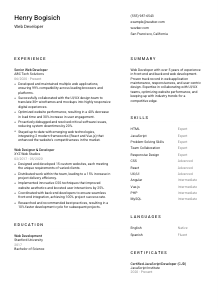
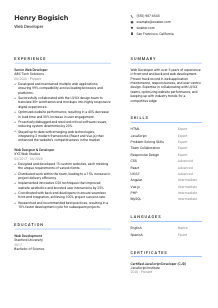
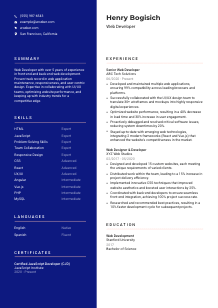
Coding websites, but your CV's HTML seems outdated? Check out this Web Developer CV example, created with Wozber free CV builder. It shows how to translate your digital craftsmanship to match job specs, keeping your career as sleek and responsive as the sites you create!
Web development CVs get weak fast when they read like a stack of technologies instead of proof that you can ship, maintain, and improve working products. Hiring teams want to see how you handle browser compatibility, responsive behaviour, performance, debugging, and design handoff, because those are the day-to-day pressures behind a solid web application.
A tailored CV changes the first read from
For a Web Developer, the header does more than identify you. It should quickly confirm where you are, what role you are targeting, and where someone can review your work.
Use your full name as the most visible text on the page. Keep it easy to scan and professional. In technical hiring, clutter at the top of the CV can already suggest weak attention to structure, so make the layout clean from the first line.
Place "Web Developer" directly under your name if that is the role you are applying for. Matching the title used in the posting helps frame the rest of the CV around front-end and back-end web work rather than adjacent roles like designer, software engineer, or content manager.
If the employer asks for local candidates, include your city and state in the header. Here, San Francisco, California matters because the posting explicitly requires it. When location is not part of the filter, city and state are usually enough without a full street address.
A website, portfolio, or GitHub profile is especially valuable in web development because it gives hiring teams a direct look at code quality, interface work, and project range. Make sure the link works and that the projects reflect skills relevant to the job, such as responsive layouts, JavaScript frameworks, API integration, or performance improvements.
Keep the top of the CV practical and job-focused. When your contact details, title, location, and portfolio are easy to scan, a hiring manager can move straight to your technical value.




This section carries the most weight for most Web Developer roles. Hiring teams are looking for shipped work, technical scope, measurable improvements, and signs that you collaborate well with designers, developers, and stakeholders.
Before editing your bullets, identify the operating priorities in the posting. Here, the clearest themes are full-stack web development, cross-browser compatibility, responsive design, UI handoff, performance optimisation, debugging, and teamwork. Use those themes to decide which accomplishments stay, which get rewritten, and which can be cut.
List jobs in reverse chronological order with company name, job title, and dates. For Web Developer positions, clear chronology helps reviewers quickly see your level, progression, and recency with modern stacks. It also makes ATS parsing more reliable.
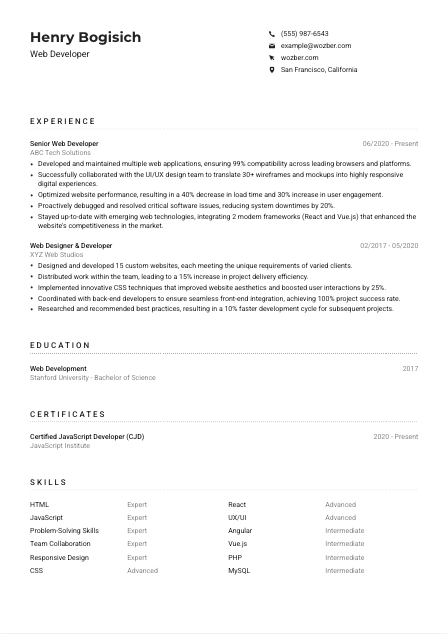
Focus each bullet on work that produced a usable result. Good Web Developer bullets often show what you built, what technical problem you solved, or what improved after your work. The example CV does this well with points like reducing load time by 40% and translating 30+ wireframes into responsive digital experiences, both of which connect directly to performance and collaboration requirements.
Use numbers that reflect how web work is actually judged: load time, browser compatibility, engagement, downtime reduction, release speed, conversion lift, defect reduction, or number of applications delivered. Metrics make technical contributions easier to understand, especially when the work spans front-end polish and back-end maintenance.
Prioritise bullets that show you can build and maintain modern web applications. HTML, CSS, JavaScript, responsive behaviour, framework experience, debugging, and collaboration with UX/UI teams should appear through actual work, not just generic claims. If an older bullet does not support your case for web application delivery, remove it in favor of something more relevant.
After reading your experience, a reviewer should be able to picture the kinds of web products you have worked on, the problems you solved, and the results your code produced.
Education is often a straightforward section in web development, but it still matters when the posting asks for a specific degree background. Present it cleanly and use it to reinforce your preparation for professional development work.
When a posting calls for a Bachelor's degree in Computer Science, Web Development, or a related field, place that information clearly. If your degree is adjacent rather than exact, use the full field name so the connection is easy to see. The example CV's Bachelor of Science in Web Development aligns closely with the requirement.
List degree, school, field of study, and graduation year. That is usually enough for an experienced Web Developer. A clean format helps both human readers and ATS systems recognize your credentials without extra clutter.
If you are still building professional experience, coursework can help bridge the gap. Include classes that support web application work, such as front-end development, database systems, algorithms, UI design, software engineering, or human-computer interaction. Once you have several years of experience, this becomes optional.
Honors, awards, capstone projects, or technical clubs can strengthen this section if they relate to development work. A capstone involving a deployed web app, an interface redesign, or API integration is more useful here than a long list of unrelated campus activities.
Web development changes quickly, so employers often look past the degree to see whether your knowledge has stayed current. If you have completed additional training in JavaScript frameworks, accessibility, performance, testing, or backend tools, connect that momentum through this section and your certifications.
For most mid-career Web Developers, this section should confirm the required degree and support the rest of the CV without taking space away from project outcomes and technical achievements.
Certifications are not mandatory for every Web Developer job, but they can help when they reinforce current technical strengths or show continued growth in a fast-moving stack.
Start with the job description. If a certification is required or preferred, mirror that wording exactly. When none are listed, include only certificates that add meaningful support to your candidacy rather than filling space.
The best certificates connect to the work you want to do. For a Web Developer, that usually means JavaScript, front-end frameworks, web performance, cloud deployment, accessibility, testing, or backend technologies. In the example CV, a JavaScript certification supports the role because JavaScript is central to the posting.
Dates matter in technical certifications because tools and standards evolve. Showing when a certification was earned, and whether it is still active, helps reviewers understand how current your knowledge is.
If your stack has expanded over time, certifications can show that progression. A recent credential in React, Vue, testing, or cloud tooling can support experience bullets that mention shipping applications, improving performance, or maintaining production systems.
A short, relevant certification section can strengthen your profile. Keep it focused on credentials that reinforce the web development work your CV already demonstrates.
The skills section should read like the toolkit behind your experience. It needs to reflect the languages, frameworks, and working habits that the role actually depends on.
Pull both explicit and implied skills from the posting. Here, that includes HTML, CSS, JavaScript, responsive design, modern JavaScript frameworks, problem-solving, and collaboration. Also consider adjacent skills that support those requirements, such as browser testing, debugging, API integration, version control, or performance tuning, if you genuinely use them.
Lead with the stack named in the posting, then add supporting tools and collaboration strengths. For this role, HTML, CSS, JavaScript, responsive design, and a framework like React, Angular, or Vue should appear before less central tools. The sample CV handles this well by giving the core web technologies top billing.
Group skills in a way that mirrors how teams evaluate developers. One practical approach is to separate core languages and front-end tools from frameworks, backend technologies, and team-facing strengths. That makes it easier to scan for stack fit without turning the section into a long, mixed list.
Your skills should confirm the experience section, not compete with it. When the stack, frameworks, and collaboration abilities line up across both sections, your CV reads as technically credible and well targeted.
Language requirements are easy to overlook, but they matter when a role includes collaboration, design reviews, debugging discussions, and written communication across a team.
If the posting specifies fluent English, state your level directly in the languages section. This role does, so English should be listed in a way that leaves no ambiguity, such as "Native" or "Fluent."
Put English first when it is a stated requirement, then list additional languages after it. That ordering helps a recruiter confirm a key filter quickly before moving on to the rest of your profile.
Additional languages are useful when you work with distributed teams, international clients, multilingual user bases, or cross-functional groups across regions. They are a bonus, not a substitute for technical strength, but they can support collaborative roles.
Use honest levels such as Native, Fluent, Professional, Conversational, or Basic. In interviews, language ability shows up quickly during technical discussion, stakeholder calls, and documentation review, so precision matters.
For many Web Developer roles, language supports teamwork more than it serves as a standalone qualification. Mention it clearly, then let the rest of the CV demonstrate that you can collaborate on wireframes, technical issues, and delivery work in a professional environment.
This section should answer one practical question fast: can you communicate effectively in the environment the role requires. For this posting, fluent English needs to be unmistakable.
Your summary should quickly establish the kind of Web Developer you are, the scope of your experience, and the strengths that matter most for the target opening. Keep it compact, but make every phrase earn its place.
Review the posting and identify the few strengths that deserve top billing. In this case, years of front-end and back-end experience, modern web technologies, responsive design, collaboration with UX/UI, performance improvement, and debugging are the main themes. Your summary should pull those into a coherent professional snapshot.
Start with your title, years of experience, and primary development scope. A line similar to the example CV works well because it immediately establishes both front-end and back-end experience, which is central to the job description.
Name the core technologies only if they are part of your real working background, then connect them to outcomes. HTML, CSS, JavaScript, responsive design, and modern frameworks are stronger when paired with results like performance gains, browser compatibility, or smooth design implementation.
Aim for three to five sentences. That is enough space to cover experience level, technical focus, and a few high-value strengths without repeating the skills section. Avoid vague claims about passion or innovation unless you attach them to actual web delivery work.
A well-shaped summary tells a hiring team, within a few lines, whether you belong in the interview pile for the kind of web development work they need covered.
A Web Developer CV works best when it shows how you build, troubleshoot, optimise, and collaborate, not when it simply lists tools. If you tailor each section around delivered web applications, responsive implementation, performance improvements, and framework experience, the hiring team can quickly understand your value.
Wozber's free CV builder helps turn that experience into an ATS-compliant CV with clean structure and stronger keyword alignment. With Wozber's ATS CV scanner and AI CV builder features, you can match your wording to the job description, surface missing requirements, and tighten each section around the work the role actually requires.
The final read should make one thing easy to judge: you can step into the web stack, work across teams, and ship reliable digital experiences.




