



Use Wozber and land your dream job
Create CV
No registration required
Juggling production timelines, but your CV still feels like a beta version? Gear up with this Software Product Manager CV example, created with Wozber free CV builder. Learn how to shape your software strategy around job requirements, so your career roadmap leads to the next big launch!
Software Product Managers are expected to connect customer problems, business priorities, and engineering execution without losing momentum on delivery. A CV for this role needs to make that operating range visible quickly, especially through shipped products, roadmap decisions, cross-functional leadership, and measurable product results such as adoption, retention, release speed, or usability gains.
When those details are tailored to the target role, the hiring team can see whether your background is rooted in software delivery rather than general project coordination or marketing work. Wozber's free CV builder helps shape that story into an ATS-compliant CV by aligning your language with the posting and keeping core product signals easy to scan, so your experience reads clearly as product leadership.
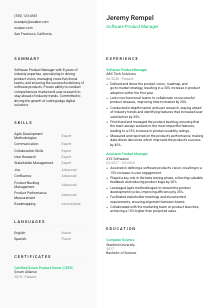
This section is simple, but it still carries hiring value. For a Software Product Manager, the header should immediately confirm who you are, what role you are targeting, and whether there are any practical blockers to moving forward, such as location or unclear contact details.
Use your full name in a clean, readable format at the top of the page. Keep it more prominent than the rest of the header so it anchors the document without distracting from your experience. In product roles, where clarity and prioritization matter, even the first line of the CV should feel organised and deliberate.
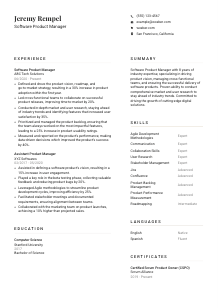
Place the job title directly under your name if it accurately reflects your background and the role you are pursuing. Using "Software Product Manager" here helps frame the rest of the CV around product vision, backlog ownership, release planning, and product performance. It also reinforces the exact phrasing the employer and ATS are already using.
Include a professional email address and a phone number you actually answer. Double-check both. Product managers spend a lot of time coordinating across engineering, design, marketing, and leadership, so basic communication details should look dependable from the start.
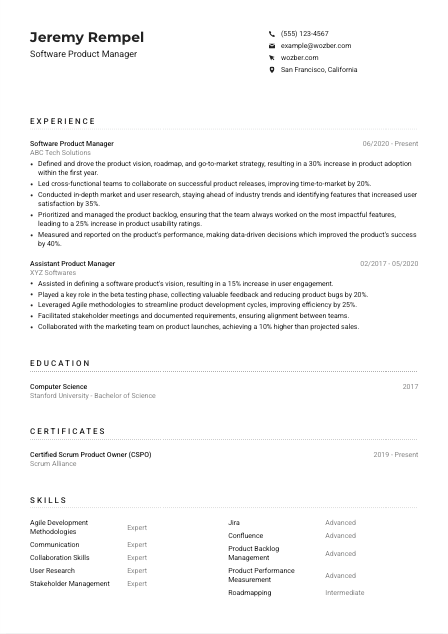
If a role specifies location, relocation, or hybrid expectations, reflect that plainly in your header. Here, listing "San Francisco, California" works because the job explicitly asks for candidates based there or willing to relocate. Treat that as tailoring to the posting, not a standard requirement for every Software Product Manager CV.
If you have a polished LinkedIn profile, portfolio, or personal site with product launches, case studies, or thought leadership, include it. For product roles, a strong profile can add context around roadmap ownership, market insight, or launch outcomes that do not fully fit in CV bullets.
Your header should remove friction, not create it. When your title, contact details, and any location requirement are handled cleanly, the hiring team can move straight to the product work you have led.




This is the section most hiring teams read first for a Software Product Manager. They want to see how you have shaped product direction, worked with cross-functional teams, prioritised tradeoffs, and moved a software product toward better market and business outcomes.
Read the responsibilities closely, then align your bullets to the work that matters most. For this role, that includes product vision, roadmap ownership, go-to-market coordination, market and user research, backlog prioritization, and performance reporting. If you have done that work under a slightly different title, make the overlap obvious through the bullet content rather than leaving the hiring team to infer it.
List your job title, company, and dates in reverse chronological order, then use bullets to show the scope of your contribution. For product roles, scope often means the product area you owned, the teams you worked with, the stage of the product lifecycle, or the market problem you were solving. A progression from Assistant Product Manager to Software Product Manager, like in the example, also helps show growth in ownership.
Prioritise bullets that show decisions and results, not just participation. Strong product bullets often connect an action to a measurable outcome, such as increased adoption, faster time-to-market, improved satisfaction, stronger usability, or better revenue performance. The example does this well with lines like a 30% increase in product adoption and a 20% improvement in time-to-market, both of which translate product work into business impact.
Quantify where the numbers genuinely reflect your contribution. Product managers are often measured through adoption, engagement, release cadence, churn reduction, feature usage, NPS, backlog throughput, beta feedback quality, or launch success. Metrics like improved usability ratings by 25% or product success by 40% are much more persuasive than vague claims about leadership or collaboration.
Keep the experience section focused on software product management rather than trying to preserve every accomplishment from your career. If a bullet does not strengthen your case around roadmap decisions, customer insight, Agile delivery, stakeholder management, or product performance, trim it. Relevance matters more than volume, especially when the posting is clearly looking for product delivery experience in a software environment.
A Software Product Manager CV earns attention when the experience section shows what you owned, how you worked with teams, and what changed because of your decisions. Make the product outcomes easy to follow.
Education is rarely the most persuasive section for an experienced Software Product Manager, but it still matters when the posting asks for a technical foundation. A clearly presented degree can quickly confirm that you meet an expected baseline for working closely with engineering teams and technical products.
If the job asks for a bachelor's degree in Computer Science, Engineering, or a related technical field, make sure your education section states that plainly. In the example, "Bachelor of Science" and "Computer Science" are visible immediately, which lines up well with the employer's requirement and supports credibility in a software-focused product role.
Keep the structure simple: degree, field of study, school, and graduation year or date. This helps both ATS parsing and fast human review. Product hiring teams do not need a dense academic narrative here. They need to confirm the credential and move on to how you have applied that technical grounding in product decisions.
When the field of study is relevant, do not bury it. Computer Science, Software Engineering, Information Systems, or another related discipline should be visible at a glance. That matters for roles where you are expected to work closely with developers, understand technical constraints, and prioritise features with engineering tradeoffs in mind.
If you are early in your career, relevant coursework, senior projects, or research can help show product thinking, technical literacy, or user-focused problem solving. If you already have several years of product experience, those details usually matter less than shipped products, launch results, and backlog ownership.
Additional courses, workshops, or product training can be valuable, but formal certifications usually belong in the certificates section unless your CV format combines them. Keep the education section focused so the hiring team can quickly confirm the degree requirement without digging.
For this role, education supports the story rather than carrying it. Present the degree cleanly, match the technical field when relevant, and let your experience do the heavier product-management work.
Certifications are most useful when they strengthen a hiring requirement already present in the role. For Software Product Managers, that often means Agile fluency, product ownership methods, or evidence that you stay current with the way software teams plan and ship work.
Choose certifications that support the actual operating model of the job. Here, Agile experience is called out directly, so a credential like Certified Scrum Product Owner aligns well because it reinforces backlog management, sprint planning participation, and product ownership in an Agile environment.
Lead with certifications that connect directly to the posting instead of listing everything you have earned. A hiring manager scanning for product delivery discipline will care more about Scrum, Agile, product ownership, or analytics-related learning than a generic professional development course.
Certification dates help show recency and continued relevance, especially in software teams where tooling and delivery practices evolve. Listing something like "2019 - Present" can signal that the credential remains active and current rather than being a one-time course from years ago.
A short, focused list is stronger than a long inventory of loosely related badges. If you continue to build your skills in areas like Agile product ownership, user research, analytics, or go-to-market strategy, keep the selection tight and relevant to the work you want next.
Certifications help when they confirm how you work, not just what you studied. For Software Product Manager roles, the best ones support delivery methods, prioritization discipline, and current product practice.
The skills section should read like a product manager's working toolkit, not a generic list of business buzzwords. Employers are looking for a blend of product execution, technical fluency, research ability, and cross-functional leadership that matches how software products are actually built and improved.
Start with the exact capabilities the employer names, then add closely related skills you genuinely use. In this job description, Agile development methodologies, Jira, Confluence, communication, leadership, collaboration, backlog management, and product performance measurement all deserve attention because they describe how the work gets done day to day.
A Software Product Manager needs both execution tools and people-facing strengths. Pair skills like Jira, Confluence, roadmapping, backlog prioritization, user research, and product analytics with communication, stakeholder management, and cross-functional collaboration. That combination better reflects the role than leaning too far into either pure tooling or soft-skill language alone.
Do not try to capture your full professional vocabulary in one section. Prioritise the skills most relevant to the role and place the strongest ones first. The example list works because it combines Agile methods, research, stakeholder management, and specific software like Jira and Confluence without becoming a keyword dump.
A useful skills section helps the reader picture how you run product work. Keep it focused on the methods, tools, and collaboration strengths that support software delivery and product decisions.
Language skills are usually a supporting detail for Software Product Managers, but they can still matter. Clear English is often essential for writing requirements, leading discussions, and translating user needs into decisions that engineering, design, and marketing can act on.
If the posting explicitly requires English, list it first with an honest proficiency level. That immediately confirms you can handle the written and verbal communication a product role demands, from backlog refinement and release notes to stakeholder meetings and customer interviews.
Additional languages can be useful when products serve international users, distributed teams, or regional markets. They are not a substitute for product experience, but they can support user research, partner communication, or market understanding when relevant to the company and product.
Terms like "Native," "Fluent," "Intermediate," and "Basic" are enough. They give the hiring team a practical sense of how confidently you can communicate without forcing them to interpret vague claims.
If another language has helped you work with overseas teams, gather customer feedback, or understand a specific market segment, that can be worth highlighting elsewhere in your CV or interview. In the language section itself, keep the presentation brief and factual.
For most Software Product Manager roles, languages are secondary to shipped outcomes, product strategy, and delivery leadership. Include them accurately, but keep the emphasis of the CV on roadmap ownership, research, launch execution, and measurable product performance.
List languages clearly and honestly. When they matter for customer insight or cross-regional collaboration, they strengthen the profile without distracting from your product management track record.
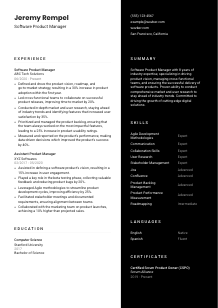
The summary sets the lens for the rest of the CV. For a Software Product Manager, it should quickly establish your level of experience, the kind of software products you have led, and the results or operating strengths that match the role.
Pull from the posting's highest-value themes rather than trying to summarise your entire career. For this job, that means product vision, roadmap leadership, Agile execution, cross-functional collaboration, user and market research, and data-driven product improvement. Those are the ideas your opening lines should foreground if they reflect your actual experience.
Start with a direct line that identifies you as a Software Product Manager and states your experience level. A phrase like "Software Product Manager with 8 years of industry expertise" works because it immediately tells the reader both seniority and function, which matters when the role asks for at least 5 years in product management or related work.
Use the next lines to show how you operate and what results you produce. Mention strengths such as driving product vision, leading cross-functional releases, using market and user research to shape priorities, or improving adoption and product success through data-informed decisions. The example summary does this effectively by combining product leadership, research, and delivery focus.
Aim for three to five lines with no filler. Avoid broad claims like "results-driven professional" unless you immediately ground them in software product work. Every sentence should help the hiring team understand what kind of product leader you are and what business or user outcomes usually follow from your work.
A well-written summary gives the rest of the CV context. When it clearly frames your product management experience, delivery style, and software outcomes, the hiring team can read every later section through the right lens.
A Software Product Manager CV should show far more than job titles. It should make your product judgment visible through roadmap ownership, cross-functional execution, user insight, Agile delivery, and measurable outcomes tied to software releases and product performance.
Use Wozber's free CV builder to organise those details in an ATS-friendly CV format, then strengthen the wording with role-specific tailoring and ATS optimisation so the final version reflects the work you have actually led. The result should make it easy to judge your readiness to own a software product from strategy through release.