



Use Wozber and land your dream job
Create CV
No registration required
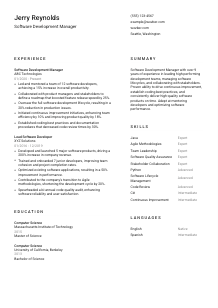
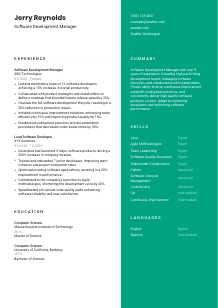
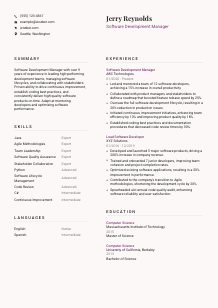
Leading dev teams, but your CV doesn't command attention? Check out this Software Development Manager CV example, built with Wozber free CV builder. It shows how to highlight your leadership and project prowess in line with job goals, moving your career forward as confidently as you merge pull requests!
Software Development Managers are hired to keep engineering work moving without letting code quality, team health, or delivery discipline slip. A CV for this role needs to show more than years in software. It should make clear that you can lead developers, shape execution through the full development lifecycle, and improve how a team plans, builds, tests, and ships.
The fastest way to get screened into the right pile is to make leadership scope and delivery results easy to read in both human review and ATS parsing. Wozber's free CV builder helps structure that into an ATS-friendly CV format, so hiring teams can quickly see whether you've managed engineers, worked effectively in Agile environments, and delivered reliable software with measurable improvements.
For engineering leadership roles, the header should confirm that you are easy to contact and already aligned with the position. Keep it clean, professional, and accurate. This section will not win the interview on its own, but it can remove friction immediately, especially when a posting includes a location requirement or a clearly defined management title.
Use your full name in a clear, readable format. You want instant recognition, not styling that competes with the rest of the page. For a Software Development Manager, the header should feel as polished as the systems and teams you are trusted to run.
Place "Software Development Manager" directly under your name when that is the role you are pursuing. Matching the title helps frame your experience correctly from the first line, especially if your recent background includes adjacent titles such as Engineering Manager, Technical Lead, or Lead Software Developer.
Recruiters and hiring managers should be able to reach you without digging or second-guessing.
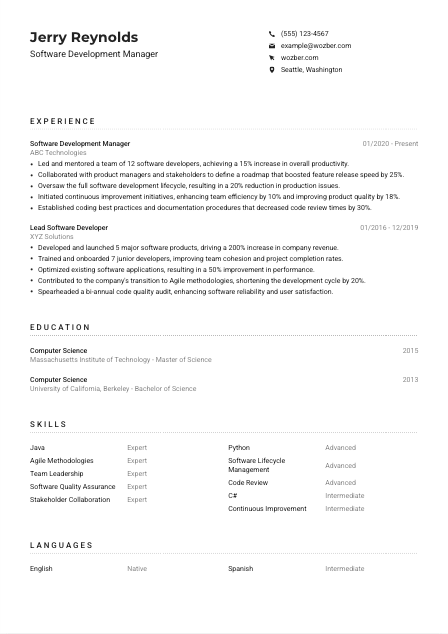
If the job requires you to be in a specific city or state, reflect that clearly in your header. In the example, listing Seattle, Washington directly supports the posting's location requirement. When a role is remote or flexible, city and state are usually enough without adding a full street address.
Include LinkedIn, a portfolio, GitHub, or a personal site only if it reinforces your management and technical credibility. For this level, that might mean a profile with leadership progression, shipped products, architecture work, speaking engagements, or engineering blog posts. Make sure the content matches the CV's dates, titles, and achievements.
A focused header tells the employer that you are reachable, correctly positioned for the role, and already aligned with practical requirements such as title and location. That keeps attention on your engineering leadership experience where it belongs.




This section carries the most weight for a Software Development Manager. Hiring teams look for proof that you have led developers, improved execution, partnered with product stakeholders, and owned delivery across design, development, testing, and release. Your bullets should show how you influenced output, process, and product quality, not just what sat in your job description.
Before rewriting your experience, identify the operating themes in the job description. Here, they include leading developers, running Agile teams, collaborating with product managers, improving quality and efficiency, and enforcing coding standards. Those themes should show up in your bullets through concrete examples, tools, and outcomes rather than copied wording.
List roles in reverse chronological order with title, company, and dates presented consistently. That structure helps reviewers quickly trace your move from hands-on development into people leadership, delivery ownership, and broader engineering management. It also supports ATS readability without extra formatting tricks.
Each role should answer three questions. What did you own. How did you lead. What changed because of your work. For this profession, useful bullets often cover team size, release cadence, process improvements, quality outcomes, stakeholder alignment, or engineering standards. The example does this well by showing leadership of 12 developers, roadmap collaboration, lifecycle oversight, and reduced production issues.
Quantify achievements with numbers that reflect software delivery and team performance. Productivity gains, release speed, defect reduction, code review time, performance improvements, onboarding results, and reliability outcomes all carry weight. In the sample CV, a 25% faster feature release cycle and a 30% drop in code review time tell a much clearer story than vague claims about leadership.
Prioritise experience that connects to engineering leadership, SDLC ownership, Agile execution, technical decision-making, and cross-functional delivery. If an older bullet does not help prove that you can manage developers and ship quality software, trim it or rewrite it. Your experience section should read like a progression toward stronger team and delivery ownership.
By the end of the experience section, a reader should understand the scale of teams you have led, the delivery outcomes you improved, and how you operated across planning, development, testing, and deployment. Wozber's ATS-friendly CV template helps keep that story clear and easy to parse.
Education matters here because many Software Development Manager postings still set a formal baseline in Computer Science, Engineering, or a related field. For experienced candidates, this section is usually brief, but it still needs to confirm that you meet the requirement and support the technical credibility behind your leadership background.
If the posting asks for a bachelor's degree in Computer Science, Engineering, or a related field, make that easy to spot. A master's degree can follow above or alongside it, but the key is to remove doubt about the required educational foundation. The example makes that clear with both bachelor's and master's credentials in Computer Science.
List degree, field of study, school, and graduation year in a consistent order. That is enough for most senior engineering management CVs. Straightforward formatting improves scanability for both recruiters and ATS systems.
Well-known universities can strengthen the section, but school name alone does not carry a management application. What matters first is whether your degree supports the technical expectations of the role. If your background lines up with the requirement, show it clearly and move on without overplaying the institution.
For candidates with 8+ years of experience, coursework is rarely necessary unless it directly supports a specialised domain such as distributed systems, machine learning, security, or embedded engineering. Most Software Development Manager CVs gain more value from stronger experience bullets than from long academic detail.
Honors, major projects, or leadership activities can be useful when they connect to software engineering or team leadership, especially for earlier-career managers. For a seasoned candidate, keep extras only if they add something distinct, such as a notable systems project or sustained technical leadership.
This section only needs to confirm the academic foundation behind your technical and managerial work. Once that requirement is covered, let your delivery record and leadership results carry the application.
A Software Development Manager is rarely hired on people skills alone. Employers want enough technical range to guide architectural discussions, review tradeoffs, and coach developers, along with the leadership skills to run an effective team. Your skills section should show that balance without becoming a long inventory of every tool you have touched.
Start with the required and implied capabilities in the posting. For this role, that includes Agile methodologies, software development lifecycle oversight, team leadership, stakeholder collaboration, coding standards, and proficiency in at least one modern programming language such as Java, Python, or C#. Build from there using skills you genuinely use.
Show both sides of the job. Leadership skills might include mentoring, sprint planning, cross-functional collaboration, hiring, performance management, and continuous improvement. Technical skills can include programming languages, code review, software architecture, testing practices, CI/CD, or quality assurance. The example strikes this balance with Java, Agile Methodologies, Team Leadership, Stakeholder Collaboration, and Software Lifecycle Management.
Do not overload the section with frameworks, libraries, and tools that are peripheral to the target job. Choose the skills that best support the kind of engineering team you want to lead. A tighter list makes it easier for reviewers and ATS tools to connect your background to the role's core needs.
This section should quickly confirm that you can lead developers, speak the team's technical language, and manage the work around delivery and quality. Keep every skill tied to how you operate as an engineering leader.
For a Software Development Manager, language proficiency matters most when it affects leadership communication. Team meetings, stakeholder updates, roadmap discussions, incident reviews, and documentation all depend on clear communication. If a posting specifically asks for fluent English, your language section should make that visible without overcomplicating it.
When fluent English is stated in the job description, include English with an honest proficiency level such as Native or Fluent. This directly addresses a communication requirement that matters in team leadership, cross-functional planning, and written documentation.
Additional languages can help when you work with distributed teams, global stakeholders, or multilingual customer environments. They are usually secondary for this role, but they can still support your profile if they reflect the realities of the teams or products you have worked with.
Keep proficiency ratings simple and believable. Terms such as Native, Fluent, Intermediate, and Basic are enough. Overstated language claims can become obvious very quickly in interviews for leadership roles, where communication is tested throughout the process.
If your target role involves offshore engineering teams, international product groups, or client-facing technical leadership, language skills can become more relevant. In those cases, the section supports your ability to operate smoothly across time zones, functions, and cultures.
A second or third language will not replace engineering leadership results, but it can add useful context about how you collaborate. In the example, Spanish at an intermediate level expands the profile without distracting from the core management qualifications.
For this role, the main purpose is to confirm that you can communicate clearly in the working language of the team and organisation. Any additional languages should support that broader leadership picture.
The summary is where you frame your management profile before the reader reaches the details. For Software Development Managers, that usually means combining leadership tenure, engineering context, delivery ownership, and a few concrete outcomes in a compact paragraph. It should sound like a leader who has run teams and improved software delivery, not like a generic executive bio.
Focus on the capabilities that matter most for the target job. In this case, that means leading software teams, working in Agile environments, managing the software lifecycle, collaborating with product stakeholders, and improving quality and efficiency. Let those themes guide what you include in the opening lines.
Start by stating your current professional level in a direct way, such as years of software experience and time spent leading teams. That gives immediate context for a role that asks for 8+ years in development and at least 3 years in management or leadership.
Use the middle of the summary to highlight the kinds of results that matter in engineering leadership. Good examples include faster release cycles, fewer production issues, stronger team productivity, improved code quality, or better stakeholder alignment. The sample summary works because it combines leadership scope with lifecycle management and continuous improvement rather than relying on broad claims.
Aim for a short paragraph that can be read in a few seconds. Avoid buzzwords and avoid turning the summary into a list of every skill you have. A concise summary with real engineering management language will do more for you than a longer paragraph full of abstractions.
After reading your summary, the employer should already understand that you can lead developers, guide delivery, and raise software quality in a structured engineering environment. Wozber's ATS optimisation tools can help tighten that message so the right terms and results surface early.
A Software Development Manager CV works when it shows how you lead engineers, improve execution, and deliver reliable software with measurable results. Keep the emphasis on team scope, Agile leadership, SDLC ownership, technical credibility, and the business impact of the products you helped ship.
Use Wozber's free CV builder, ATS CV scanner, and ATS-friendly CV template to tailor each section around the job description and strengthen ATS optimisation. The finished CV should make it easy to judge one thing quickly: whether you can lead a development team and deliver high-quality software on schedule.




