



Use Wozber and land your dream job
Create CV
No registration required
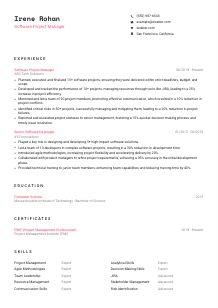
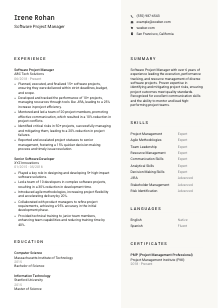
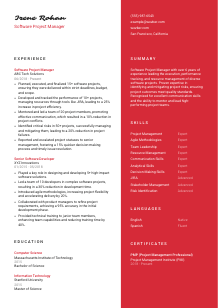
Juggling code and deadlines, but your CV's version control feels off? Browse this Software Project Manager CV example, created with Wozber free CV builder. It shows how to smoothly sync your software management prowess with job requirements, making sure your career milestones are regularly committed to success!
Software Project Managers are hired to bring order to moving targets. Delivery plans shift, requirements evolve, risks surface late, and engineering teams still need someone who can keep scope, timelines, budget, and communication under control. Your CV should make that operating reality visible quickly by showing how you ran software projects, led cross-functional teams, and kept execution on track when pressure increased.
Hiring teams often separate software project managers from adjacent profiles, such as delivery leads or senior developers, by looking for clear ownership of planning, reporting, resource tracking, and risk management. Wozber's free CV builder helps you shape that experience into an ATS-compliant CV that uses the right project language and structure, so your application reads as someone who has already managed delivery, not someone hoping to grow into it.
This section is simple, but it still does real work in a Software Project Manager application. It should confirm who you are, how to reach you, and whether you meet any practical screening requirements without forcing a recruiter or ATS to hunt for basics.
Use your full name as the most prominent line on the page. Skip nicknames, extra labels, or decorative formatting. In a role centered on organisation and clarity, even the header should read like someone who manages details well.
Place "Software Project Manager" directly under your name if that is the role you are pursuing and your experience supports it. Matching the posted title helps ATS parsing and immediately frames your background around software delivery, planning, and team leadership rather than a broader project or technical profile.
Include a reliable phone number, a professional email address, and relevant links only if they add value, such as LinkedIn. For this profession, recruiters usually care more about fast, accurate contact information than personal branding extras. Make sure every item works, especially if you are applying into time-sensitive hiring processes.
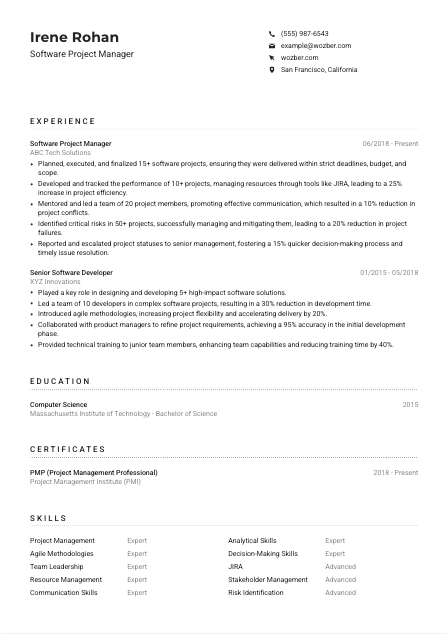
If a role has a stated location requirement, include your city and state clearly. Here, San Francisco, California is part of the screening criteria, so showing it in the header removes early uncertainty. Irene Rohan's example does this well by stating San Francisco, California without overexplaining it.
Do not include age, marital status, photo, or other personal data that has no bearing on software project execution. Keep the focus on information tied to logistics and candidacy. That gives more room to show delivery history, tools, certifications, and leadership experience elsewhere in the CV.
Your header should answer the practical questions fast: who you are, what role you are targeting, how to contact you, and whether a location requirement is already covered.




For Software Project Managers, the experience section carries most of the hiring decision. Employers want to see whether you have actually run software projects, handled competing constraints, and guided teams through execution, reporting, and risk control.
Before writing bullets, identify the actions the employer repeats. In this posting, that includes planning and finalizing software projects, tracking schedule and resources, mentoring teams, mitigating risk, and escalating status to senior management. Those are not generic keywords. They are the core delivery functions your experience bullets should reflect if you have done that work.
Start with your most recent position and include company name, title, and dates. That timeline matters because hiring teams often want to see whether your project management responsibility has grown over time, for example from technical leadership into full project ownership. The sample CV does this effectively by moving from Senior Software Developer into Software Project Manager, which makes the transition into delivery leadership easy to follow.
Replace broad statements like "managed projects" with results tied to delivery. Strong bullets show what you planned, what you improved, and what changed because of your decisions. The example bullet about managing 10+ projects in JIRA and increasing project efficiency by 25% works because it connects tool usage, oversight, and outcome in one line.
Metrics are especially useful in software project management because they show scale and control. Include numbers such as project count, budget range, team size, delivery time reduction, defect or failure reduction, escalation speed, or reporting cadence when they are true to your work. Figures like 15+ projects delivered, a team of 20, or a 20% reduction in project failures give hiring teams a much clearer sense of your range than generic claims about leadership.
Earlier technical roles still belong on the CV when they strengthen your project management profile. A software development background can show that you understand engineering workflows, agile ceremonies, estimation, and requirement translation. In the example, the developer role earns its place because it includes leading developers, introducing agile practices, and working with product managers, all of which support the later move into software project management.
By the end of this section, a reader should understand the scale of projects you handled, how you managed execution, and what improved under your direction.
Education matters here because many software project management roles still expect a technical academic foundation. A degree in computer science, information technology, or a related discipline helps confirm that you can work credibly with engineering teams, technical requirements, and software delivery constraints.
If the posting calls for a bachelor's degree in Computer Science, Information Technology, or a related field, present that information clearly and in standard format. Do not bury the field of study. This role explicitly asks for that background, so the degree should be immediately visible to both recruiters and ATS systems.
List degree, field, school, and graduation year in a clean structure. This is one of the easiest sections for ATS to read when it is formatted simply. Avoid long descriptions unless you are early in your career or the coursework directly strengthens your project management profile.
If you hold more than one degree that supports your candidacy, include both. A bachelor's in Computer Science plus advanced study in Information Technology, as shown in the example, reinforces both technical grounding and continued development. Just make sure the most role-relevant credentials remain easy to scan.
Most experienced Software Project Managers do not need to list classes, but there are exceptions. If you are earlier in your career, coursework in software engineering, systems analysis, database design, or project management can help connect your education to the role. Use this selectively so the section stays concise.
Technology delivery changes fast, especially around agile frameworks, cloud platforms, DevOps workflows, and security expectations. If you have recent formal study, workshops, or university-backed programs that strengthen your project leadership in software environments, they can sit here or alongside certifications depending on format.
Your education should confirm the technical baseline the role asks for and support your credibility with software teams, without taking attention away from your delivery record.
Certifications are particularly useful in software project management because they show formal command of project frameworks, risk control, and delivery discipline. They are rarely the whole story, but they can tip a shortlist when experience levels are similar.
When a job description mentions a specific credential, put it front and centre if you have it. Here, PMP is preferred, so it should be highly visible. That matters because it aligns your CV with the employer's stated project management standard and often improves ATS matching at the same time.
List the credentials that support your ability to manage software projects, teams, and delivery processes. PMP, Agile, Scrum, SAFe, or similar certifications can all be relevant depending on the environment. Do not crowd the section with unrelated courses that add little to your project leadership profile.
Name the issuing organisation and include the date earned or validity period where appropriate. That helps a reviewer understand whether the certification is current and from a recognized source. In the sample, listing PMP with PMI and an active date range gives the credential proper context.
If your target roles are moving toward scaled agile, cloud-heavy delivery, enterprise governance, or more formal stakeholder reporting, choose certifications that support those realities. The best additions are the ones that reinforce how you already run projects and where you are heading next professionally.
A well-chosen certification section tells employers that your project practices are grounded in recognized methods and current standards.
A Software Project Manager skills section should do more than list broad strengths. It should show the operating toolkit behind your work, including planning methods, delivery tools, team leadership, and the judgment needed to keep software projects moving when constraints change.
Read the job description for explicit skills and the abilities implied by the responsibilities. Here, project management software, methodologies, analytical thinking, decision-making, communication, mentoring, and risk management all appear clearly. Those should shape your skills section because they describe how the role is actually performed.
Add skills that are backed up by bullets in your experience section. If you list JIRA, Agile Methodologies, Resource Management, Stakeholder Management, or Risk Identification, make sure your work history shows where you used them. The example CV handles this well by pairing skills like JIRA and Agile with measurable delivery improvements in the experience section.
Put core project delivery skills first, then supporting tools and interpersonal strengths. For this profession, capabilities such as project planning, agile delivery, resource management, risk mitigation, stakeholder communication, and team leadership usually belong near the top. A clean order helps both ATS systems and human reviewers read your profile as a software project manager rather than a general operations candidate.
Choose skills that reflect the way software projects are planned, tracked, communicated, and delivered, then make sure the rest of the CV proves them.
Software Project Managers spend a large part of the job translating between technical teams, business stakeholders, and senior leadership. Language skills matter most when they affect reporting, coordination, documentation, or client communication, not as a decorative extra.
If the role calls for high-level English communication, state your English proficiency clearly. This posting makes English a must, so it should not be left implied. A simple rating such as Native or Fluent is enough when it accurately reflects your ability to lead meetings, write status updates, and handle escalation clearly.
Additional languages can strengthen your profile when you work with distributed engineering teams, international stakeholders, or multilingual customers. They are usually a bonus rather than a deciding factor, but they can widen the kinds of software environments where you can lead effectively.
Be precise about what you can actually do in each language. There is a big difference between being able to exchange greetings and being able to run a project status call or negotiate scope changes. Clear labels such as Native, Fluent, Intermediate, or Basic set the right expectation.
Not every Software Project Manager role needs multiple languages. If the team, product, or client base is local, English alone may be sufficient. If the position involves offshore development teams or global releases, extra language ability becomes more relevant and worth surfacing higher.
This role often depends on writing concise updates, running standups, documenting risks, and presenting project status to leadership. When you choose which languages to list, consider where they would genuinely help you operate across those communication channels.
For this role, language proficiency matters when it helps you lead discussions, manage expectations, and keep software delivery aligned across teams.
Your summary should quickly establish that you manage software projects, not just participate in them. In a few lines, it should connect your years of experience, delivery scope, leadership style, and core strengths in planning, execution, and risk control.
Return to the job description and pick out the themes that define the role. For this one, that means project execution, tracking performance and resources, leading teams, managing risks, and reporting to senior management. Use those ideas to shape the summary so the opening lines already sound aligned with the actual work.
Start with a direct statement such as "Software Project Manager with 6+ years of experience" if that reflects your background. This immediately tells the reader both your professional lane and your tenure. It also helps distinguish you from technical candidates who have leadership exposure but not full project management ownership.
Include one or two specifics that anchor your profile in real software project work. That might be the number of projects delivered, the size of teams led, experience with tools like JIRA, or a clear result such as faster delivery or reduced project failure rates. The sample summary works because it references execution, resource management, risk mitigation, and team leadership rather than staying generic.
Aim for a short paragraph that can be scanned in seconds. Three to five lines is usually enough. Focus on what you bring now as a Software Project Manager instead of using the summary to recount your entire career history.
When the summary is doing its job, a hiring manager can immediately place you in software delivery leadership and expects the experience section to confirm that scope.
A Software Project Manager CV should make one thing easy to judge: can you plan, drive, report on, and de-risk software delivery in a real production environment. If your sections consistently show project scope, tools, team leadership, and measurable outcomes, you are presenting the right profile.
Use Wozber's AI CV builder to align your wording with the job description, strengthen ATS optimisation, and organise your experience in an ATS-friendly CV format that highlights delivery ownership clearly. The final version should show that you can manage software projects with structure, judgment, and steady communication.




