



Use Wozber and land your dream job
Create CV
No registration required
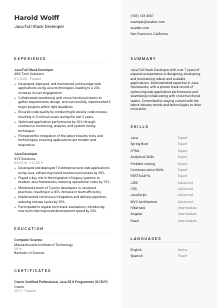
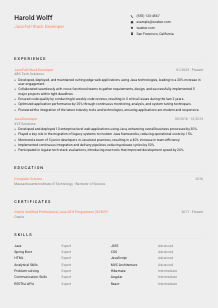
Writing front-end and back-end code, but your CV feels like it's stuck in a loop? Check out this Java Full-Stack Developer CV example, created with Wozber free CV builder. It shows how to bring together your full skill set to match job criteria, so your career can compile new successes at every stack frame!
Java full-stack hiring usually turns on one practical question: can you build and support production software across the stack without slowing the team down? That means your CV needs to show more than familiarity with Java and a frontend framework. It should make your backend depth, UI contribution, code review habits, and performance work visible through shipped features, architecture choices, and measurable results.
A tailored CV changes how quickly reviewers can place you at the right level. When the summary, skills, and experience all reflect the stack in the posting, an engineering lead can tell whether your background is centered on enterprise Java, Spring Boot services, Hibernate-backed data layers, and modern frontend delivery rather than general web development. Wozber's free CV builder helps organise that alignment in an ATS-compliant CV, so the technical picture comes through clearly to both the scanner and the hiring team.
For a Java Full-Stack Developer, the header should remove friction immediately. Hiring teams do not need a creative introduction here. They need accurate contact details, the target role, and any practical information that affects whether you can move forward in the process.
Use your full name as the most prominent text in the header. Keep the styling clean and readable so it works well in an ATS-friendly CV format and still looks polished to a technical hiring manager scanning quickly between candidates.
Place "Java Full-Stack Developer" directly under your name when that is the role you are applying for. This helps frame the rest of the CV around the right stack and level. If your current title is slightly different, such as "Java Developer," you can still use the target title when your experience genuinely covers both backend and frontend responsibilities.
List a reliable phone number and a professional email address. If you include a website, GitHub, or portfolio, make sure it supports your application with relevant code samples, project work, or technical writing. For this kind of role, a link to active work with APIs, UI components, or full-stack applications adds more value than a generic personal page.
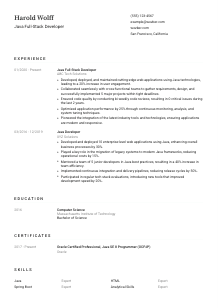
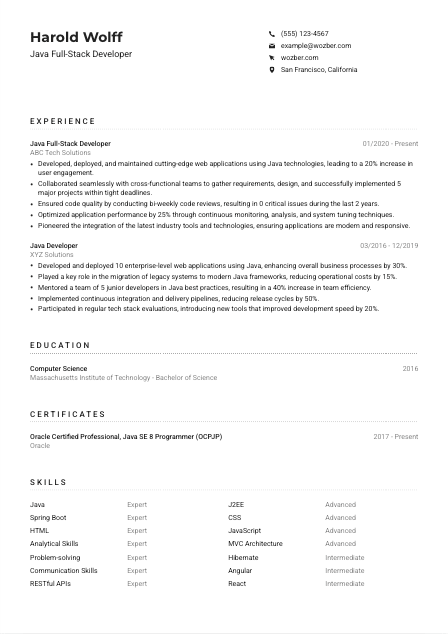
Some openings include a location filter before technical review even starts. In the provided example, listing "San Francisco, California" directly supports a stated local requirement. Use this approach when location matters for the role, especially for onsite or hybrid positions, and avoid leaving recruiters to guess about relocation or commuting plans.
Include LinkedIn or a portfolio only when the content is current and consistent with your CV. For a Java Full-Stack Developer, that means matching job dates, stack details, and project scope. If your profile says Spring Boot and React but your CV highlights J2EE and Angular, the mismatch creates unnecessary doubt.
Your personal details section should answer the practical questions fast: who you are, what role you target, how to reach you, and whether you meet basic logistics. Once that is clear, reviewers can focus on your engineering work.




This is the section where Java full-stack candidates separate themselves. Hiring managers look for evidence that you have built, deployed, improved, and maintained applications in real environments, not just touched a long list of tools. Your bullets should show ownership, technical range, and outcomes that matter in production.
Start by identifying the recurring technical and delivery themes in the job description. Here, the emphasis is on 5+ years in full-stack Java development, Spring Boot, Hibernate, J2EE, frontend technologies, code quality, performance tuning, and collaboration across teams. Those themes should appear across your recent roles if they reflect your actual work, rather than being isolated in a single skills list.
List your most recent position first, then work backward with job title, company name, and dates for each role. This structure helps both ATS systems and engineering reviewers follow your progression from Java development into broader full-stack ownership, technical mentoring, release work, or architecture contribution.
Each bullet should show what you built or improved, how you worked, and what changed because of it. The example does this well with lines such as improving user engagement by 20%, delivering five major projects, and reducing critical issues through regular code reviews. That reads far stronger than saying you were "responsible for developing applications" or "worked with cross-functional teams."
Numbers matter most when they match how software teams judge impact. Use metrics tied to release cycles, response time, throughput, defect reduction, uptime, system performance, cost savings, or team efficiency. In the sample CV, a 25% performance improvement and a 50% reduction in release cycles give hiring teams a concrete sense of engineering value.
Trim accomplishments that do not support your case for a Java full-stack role. Prioritise work with Java services, Spring Boot APIs, Hibernate or ORM layers, frontend frameworks like Angular or React, CI/CD, testing, and production support. Even when a past title was simply "Java Developer," keep the bullets focused on any full-stack, modernization, or deployment work that lines up with the target position.
A well-written experience section lets reviewers picture you inside their development workflow. They should come away seeing a developer who can ship features, improve application performance, work cleanly with others, and maintain code quality in a live environment.
Education is usually a checkpoint section for experienced Java developers, but it still matters. When a posting specifically asks for a bachelor's degree in Computer Science, Information Technology, or a related field, make that qualification easy to find and easy to confirm.
If the role asks for a bachelor's degree, list it plainly with no extra wording around it. A degree such as "Bachelor of Science in Computer Science" directly answers the requirement and removes ambiguity for recruiters or ATS filters scanning for academic qualifications.
Present education as degree, field of study, school, and graduation year. That is enough for most mid-level and senior Java Full-Stack Developer CVs. Clear formatting matters here because this section is usually reviewed quickly unless the employer is screening tightly for a specific academic background.
When your field lines up with software engineering work, let that relevance speak for itself. The sample CV's Computer Science degree from MIT is strong because it is directly connected to the role's foundation in application design, problem-solving, and software development.
Recent graduates or career changers may benefit from listing a few relevant courses such as data structures, databases, web development, distributed systems, or software engineering. For an applicant with several years of production experience, coursework usually adds less value than project and delivery history.
Honors, research, or technical extracurriculars can help early-career candidates, especially if they relate to programming, systems, or team-based development. Once you have solid professional experience, keep this section tight unless an academic achievement is unusually relevant to the employer or industry.
For most experienced candidates, education should confirm the degree requirement without competing with your project history. Keep it clean, accurate, and directly tied to the academic background the employer asked for.
Certifications are not always required for Java full-stack roles, but the right one can strengthen your profile, especially when it supports a core part of the stack. They work best when they reinforce applied expertise rather than padding the page.
Start with credentials that reinforce the technologies the role depends on. For a Java Full-Stack Developer, Java platform certifications, cloud certifications, or framework-related credentials can add weight when they align with your actual work. The Oracle Java certification in the sample CV is a good example because it directly supports the backend focus of the role.
Do not list every course badge or short webinar. Choose certifications that connect to enterprise Java development, web application architecture, cloud deployment, security, or modern delivery practices. A shorter list of respected credentials reads better than a long list with little hiring value.
Add the year earned and, if applicable, the active validity period. In technical fields, dates help employers understand whether the certification reflects current knowledge or older platform experience. This is especially useful when the credential relates to a version-specific technology.
A current certification list can also signal that you keep up with changes in frameworks, deployment models, or platform standards. If your daily work includes modernizing legacy Java systems, moving services into cloud environments, or improving DevOps workflows, supporting certifications can reinforce that direction.
Certifications should sharpen your technical profile, not distract from it. When they align with the role's stack and your real project work, they add another credible layer to your application.
The skills section should read like a focused snapshot of how you work as a Java Full-Stack Developer. That means balancing backend frameworks, frontend technologies, architecture knowledge, and the collaboration skills that matter in feature delivery, code review, and team-based development.
Start with the technologies and capabilities the employer named explicitly. In this posting, that includes Java, J2EE, Spring Boot, Hibernate, HTML, CSS, JavaScript, Angular or React, plus analytical, problem-solving, and communication skills. If these reflect your background, use the same terminology so both ATS matching and human review stay aligned.
Order your skills around the target role, not around everything you have ever used. Lead with the technologies most central to the job, usually Java, Spring Boot, REST APIs, frontend framework experience, database or ORM work, and architecture patterns. The sample CV does this well by placing Java and Spring Boot near the top before broader supporting skills.
Group related skills naturally and avoid turning the section into an exhaustive inventory. A focused list is easier to read and more believable. If you use ratings, make sure they are realistic and supported by your experience bullets. An ATS CV scanner can help you spot missing requirements, but the final list should still reflect tools and strengths you can discuss confidently in an interview.
When this section is tailored well, reviewers can see your technical profile in seconds: where you are strongest, which frameworks you work in, and whether your toolkit matches the demands of the team.
Language ability matters when a role depends on clear collaboration across engineers, product managers, QA, and stakeholders. In this case, English fluency is stated directly, so your CV should make that qualification easy to verify without overexplaining it.
List English first when the role specifically requires fluency. Use a clear level such as "Native" or "Fluent" rather than vague wording. For technical roles, this matters because requirements gathering, code review discussion, documentation, and cross-team communication all depend on precise language.
Additional languages can still be useful, especially in global engineering teams, customer-facing product environments, or distributed organizations. The sample CV includes Spanish, which may not be required here but still broadens the candidate's collaboration profile.
Keep your ratings accurate. "Native," "Fluent," "Intermediate," and "Basic" are usually enough. Overstating language ability can become obvious quickly in interviews, especially when the role involves technical discussion, documentation, or stakeholder communication.
Some Java full-stack roles are heavily internal, while others involve client workshops, offshore coordination, or cross-regional product work. If multilingual communication is relevant to your target employer, include language skills that support that environment and leave out anything too limited to be useful.
Treat languages as a professional capability, not a personality detail. In software teams, the value usually shows up in smoother communication, clearer documentation, and more effective collaboration across locations or functions.
For this role, language details should confirm that you can work effectively in technical discussions and team delivery. Keep the section brief, accurate, and directly tied to how the work gets done.
Your summary needs to establish technical identity fast. For a Java Full-Stack Developer, that usually means years of experience, the core stack you work in, and one or two proof points that show what kind of systems or outcomes you have handled. Skip generic claims and make the opening count.
Before writing the summary, identify the few requirements that matter most for the opening. Here, the most important themes are enterprise Java experience, Spring Boot and Hibernate knowledge, frontend capability, cross-functional collaboration, and performance-minded development. Build your summary around those ideas rather than trying to recap your whole career.
Start with a clear identity statement such as years of experience and your core role. The sample summary works because it immediately presents the candidate as a Java Full-Stack Developer with more than 7 years of experience, which aligns well with a posting asking for at least 5 years.
Include the frameworks and responsibilities that define your work, but keep them tied to outcomes. "Built and optimised scalable Java applications using Spring Boot, Hibernate, and modern JavaScript frameworks" says much more than a generic claim about being passionate or results-driven. If performance tuning, deployment ownership, or code quality are part of your background, this is the place to signal that.
Aim for 3 to 5 lines with no wasted phrases. A hiring manager should be able to read the summary in seconds and understand your level, stack, and value. If Wozber's AI CV builder helps you tighten wording and align terminology with the job description, use that pass to remove broad filler and keep the message technically focused.
A strong summary gives the rest of the CV a clear frame. By the time a reviewer reaches your experience section, they should already understand that you are a Java Full-Stack Developer with the stack depth and delivery record the role calls for.
A Java Full-Stack Developer CV works best when every section points in the same direction: solid backend engineering, credible frontend contribution, and clear evidence that you can ship and maintain production applications. Keep the stack language consistent across your summary, skills, and experience so reviewers do not have to infer where your strengths really are.
Before sending the application, use Wozber's free CV builder to tighten role-specific wording, check ATS optimisation, and present everything in an ATS-friendly CV template. The finished CV should make it easy to judge your Java depth, full-stack scope, and readiness to contribute from day one.