



Use Wozber and land your dream job
Create CV
No registration required
Working in big data but your CV feels too cumbersome? Navigate the terrain with this Hadoop Developer CV example, created with Wozber free CV builder. It shows how to map your Hadoop expertise to job needs, ensuring your career growth is as interconnected as your data clusters!
Hadoop hiring tends to move quickly past vague big data claims. Teams want to see who has actually built and supported distributed data pipelines, worked inside cluster constraints, and improved throughput, reliability, or ingestion speed in production environments. Your CV should make that technical scope visible early, especially if you have handled Hadoop ecosystem tools, Spark jobs, ETL workflows, or cluster maintenance at scale.
A tailored CV also helps separate general data engineers from candidates who can work comfortably in a Hadoop stack. Using Wozber's free CV builder to align your language with the posting and produce an ATS-compliant CV makes it easier to surface the exact mix of Hadoop tools, programming languages, and distributed processing experience the role calls for. That gives hiring teams a faster read on whether you can build, tune, and support the data workloads they need.
For a Hadoop Developer, the top of the CV should be clean, practical, and easy to scan. This section is not where you prove cluster performance or Spark expertise, but it should remove friction right away by confirming your identity, target role, and any basic requirement the employer listed.
Place your name at the top in a clear, readable format. Keep it more prominent than the rest of the header so hiring teams can quickly identify your CV during technical screening and interview scheduling.
If you are applying for a Hadoop Developer role, say so in the header. Matching the title to the posting helps position your background correctly, especially when your past titles include close variants such as Hadoop Engineer, Big Data Developer, or Data Engineer.
Add a phone number you answer, a professional email address, and any link you actively maintain. For technical candidates, a GitHub profile, portfolio, or LinkedIn page can reinforce your work with data pipelines, Spark code, or distributed systems projects if the content is current and relevant.
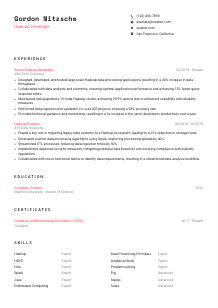
Some roles include location-based filters before a hiring manager even reviews the technical details. Here, the employer asks for San Francisco, CA, so listing San Francisco, California in the header immediately answers that requirement without forcing anyone to search for it.
Only include links that strengthen your case for this kind of role. A profile that shows Hadoop projects, Python or Scala work, data engineering accomplishments, or technical writing about distributed computing adds more value than a generic personal page.
When the personal details are accurate and tailored, the reader can move straight to your Hadoop experience instead of pausing on missing basics. That is exactly what this section should accomplish.




This is where Hadoop CVs usually win or lose attention. Hiring teams want to understand the scale of the data work, the ecosystem tools involved, the business impact of your pipelines, and whether you can keep a cluster stable while delivering usable datasets to analysts and data scientists.
Read the job description for the technical work behind the title. In this case, the emphasis is on building and testing large-scale Hadoop applications, collaborating with analysts and data scientists, maintaining clusters, handling data ingestion and validation, and mentoring junior developers. Those should guide which bullets you move up, rewrite, or expand.
List your jobs in reverse chronological order, but give more space to positions that involve Hadoop ecosystem tools, Spark processing, cluster administration, ETL work, or distributed data architecture. A title like "Senior Hadoop Developer" naturally maps well to the target role, but even adjacent titles can work if the bullet points clearly show Hadoop-specific responsibilities.
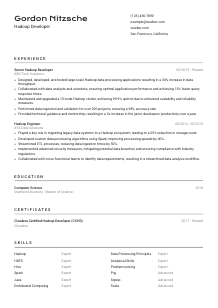
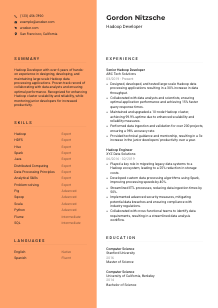
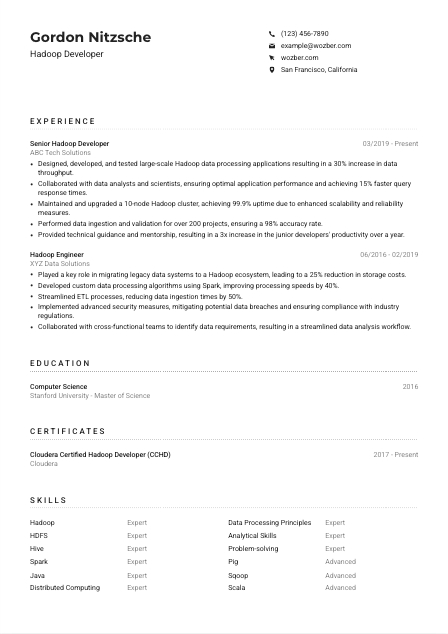
Each bullet should connect what you built or maintained with a result. Strong Hadoop bullets often mention HDFS, Hive, Pig, Sqoop, Flume, Spark, Java, Scala, or Python alongside outcomes such as faster query performance, reduced ingestion time, improved throughput, or better cluster reliability. The sample CV does this well with achievements like increasing data throughput by 30% and improving query response times by 15% through collaboration and performance tuning.
Metrics carry real weight in distributed data roles because they show production impact. Include cluster size, uptime, processing speed, storage savings, project volume, ingestion accuracy, or performance improvements when you can support them. Details like maintaining a 10-node Hadoop cluster at 99.9% uptime or reducing ingestion times by 50% tell a hiring manager far more than "responsible for Hadoop operations."
If an older bullet does not support your case for Hadoop development, distributed processing, data integration, or collaboration with downstream data users, shorten it or remove it. Prioritise work that shows you can build reliable data applications and support the surrounding ecosystem, rather than filling space with generic software tasks.
The strongest experience sections make it easy to picture you working inside a live Hadoop environment. Focus on applications built, clusters maintained, pipelines moved, and measurable gains delivered.
Most Hadoop Developer postings still use education as a quick qualification check, especially when the role involves distributed computing concepts, data processing design, and collaboration with technical teams. This section should confirm the academic baseline without taking attention away from your hands-on experience.
Start by confirming that your degree aligns with the posting. Here, the employer asks for a Bachelor's or Master's degree in Computer Science, Information Technology, or a related field, so those exact details should be easy to find if you have them.
List degree, field of study, school, and graduation year. That is usually enough for experienced Hadoop candidates. The sample CV handles this cleanly with a Master of Science in Computer Science followed by a Bachelor of Science in the same field.
If you hold an advanced degree or your field is especially relevant to distributed systems, databases, or computer science, place that education prominently. It reinforces the technical foundation behind your work with Hadoop, Spark, and large-scale data processing.
If you are early in your career, academic projects in distributed systems, data engineering, ETL architecture, or large-scale processing can strengthen this section. For a more experienced candidate, those details usually belong only if they directly support the role or show unusually relevant technical depth.
Honors, awards, and research can add value, but only if they contribute to your story as a Hadoop Developer. Once you have several years of production experience, the education section should stay concise and let your delivery record carry more of the argument.
Your education should quickly establish that you meet the academic requirement for the role. After that, let your Hadoop delivery experience do the heavier lifting.
Certifications are rarely the main reason a Hadoop Developer gets hired, but they can strengthen your profile when they reflect real platform knowledge. In data infrastructure roles, the best credentials show familiarity with the tools, standards, and operational practices behind production Hadoop environments.
Start with the job description. This opening does not require a certification, so you do not need to force the section. Still, a relevant Hadoop credential can reinforce your specialization if the rest of your CV already shows hands-on delivery.
Choose certifications that connect directly to Hadoop, Spark, big data engineering, cloud data platforms, or distributed processing. A credential such as Cloudera Certified Hadoop Developer fits naturally because it supports the same ecosystem knowledge the role expects.
Certification dates help show recency and continued relevance. If the credential has an active validity window, include it in a clear format, as in the sample's "2017 - Present," so the employer can quickly understand its status.
Hadoop environments evolve through tooling changes, integration patterns, and performance practices. Keeping certifications updated, or adding newer ones in adjacent data engineering technologies, shows that your knowledge has kept moving with the field.
A well-chosen certification adds weight when it supports the technical story already visible in your experience. Keep the section focused and tied to the stack you actually work in.
A Hadoop Developer skills section should read like a practical inventory of tools and capabilities you use in real data workflows. Hiring teams scan this section for stack alignment, so the goal is to show the right ecosystem depth, programming coverage, and distributed processing knowledge without turning it into a keyword dump.
Start with the tools and concepts the employer named, then add the closely related capabilities your background genuinely supports. For this role, that includes Hadoop ecosystem tools such as HDFS, Hive, Pig, Flume, Sqoop, and Spark, along with Java, Scala, Python, distributed computing, and data processing principles.
Lead with the hard skills that define the role, then support them with relevant analytical strengths. Hadoop teams need engineers who can troubleshoot performance bottlenecks, validate data quality, and solve processing issues across large datasets, so analytical and problem-solving skills belong here when they are backed by experience.
Do not crowd the section with every tool you have ever touched. Prioritise the technologies most relevant to Hadoop development and the workflows around it. The sample CV uses a clear mix of Hadoop, HDFS, Hive, Spark, Java, distributed computing, and data processing skills, then adds secondary tools like Pig, Sqoop, Scala, Python, Flume, and SQL.
A focused skills section helps the reader confirm, in seconds, that you speak the same technical language as the role. Keep it accurate, relevant, and grounded in the work you can discuss in depth.
Language skills matter differently in technical roles depending on the team setup. For Hadoop Developers, the key question is usually whether you can communicate clearly about requirements, data issues, and implementation details with analysts, engineers, and stakeholders who work in the team's primary language.
This posting explicitly requires the ability to function in an English-speaking environment, so English should appear first in the section with an accurate proficiency level. That removes doubt about day-to-day collaboration on technical issues and documentation.
Use clear labels such as Native, Fluent, Advanced, or Intermediate. In collaborative data roles, overstating language ability can create problems quickly during meetings, incident response, or handoffs with analysts and data scientists.
Additional languages are useful when you work with global teams, offshore engineering groups, or multilingual business stakeholders. They are secondary to your Hadoop skills, but they can still add context about how you operate in cross-border environments.
This is usually a short supporting section, not a major selling point for the role unless the posting emphasizes multilingual communication. A simple list such as English and Spanish, with accurate levels, is enough.
If a role includes cross-regional collaboration, customer-facing implementation, or support across international teams, language skills can become more relevant. Otherwise, keep the focus on the required working language and let your technical sections lead.
For this role, the main task is simple: show that you can work effectively in English. Any additional languages are a useful bonus, not the core of the application.
The CV summary should give a quick technical snapshot of your Hadoop background before the reader reaches the detailed work history. For this role, that means showing years of experience, the kind of data systems you have built or maintained, and the outcomes you have delivered in distributed processing environments.
Start with the core of the opening, not a generic software profile. A Hadoop Developer summary should point directly to Hadoop ecosystem experience, large-scale data processing, and the kind of collaboration or operational responsibility the role requires.
Your first line should quickly establish who you are. For example, "Hadoop Developer with 6+ years of experience" works because it immediately combines seniority with technical focus and prepares the reader for the stack that follows.
Use one or two lines to highlight the strongest overlap with the job description, such as designing data processing applications, maintaining Hadoop clusters, improving performance, handling ingestion and validation, or mentoring junior developers. The sample summary works well because it covers application development, collaboration with analysts, cluster reliability, and team support without sounding overloaded.
Aim for a short paragraph of about 3 to 5 lines. Use specific language, measurable themes, and role-relevant terms rather than broad claims about passion or innovation. The summary should sound like a technical professional describing production work, not a general career statement.
A sharp summary helps the reader understand your technical lane before they reach the bullet points. Make it easy to see your scale, your stack, and the kind of data problems you solve.
When each section reflects the job's actual demands, your CV starts to sound like someone who has built data pipelines, tuned processing jobs, supported cluster reliability, and worked closely with analysts and data scientists. That is the standard a Hadoop Developer CV needs to meet.
Use Wozber's free CV builder to organise that experience in an ATS-friendly CV format, then sharpen the wording with its ATS CV scanner and AI-powered tailoring features so the right Hadoop tools, languages, and performance outcomes are easy to find.
The final version should make one thing clear within a quick scan: you can contribute in a production Hadoop environment from day one.