



Use Wozber and land your dream job
Create CV
No registration required
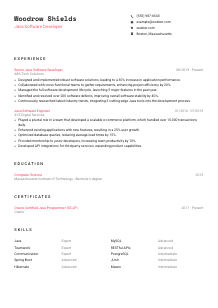
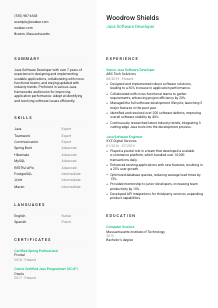
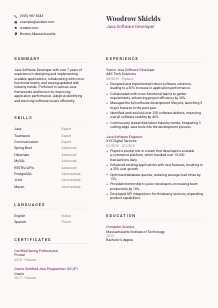
Navigating arrays and objects, but your CV is not compiling correctly? Check out this Java Software Developer CV example, created with Wozber free CV builder. It shows how to thread your programming skills through the job requirements, building a career as robust and versatile as your code!
Java Software Developer hiring usually turns on one practical question: can you build and maintain software that holds up in production? A CV for this field needs to show more than familiarity with Java syntax. It should make your contribution to application performance, defect reduction, database efficiency, API design, and delivery across the software development lifecycle easy to spot.
When that detail is tailored to the target role, the CV reads more clearly to both engineering reviewers and screening systems. Wozber's free CV builder helps organise your experience into an ATS-compliant CV, so frameworks like Spring Boot, Hibernate, and relational database work are connected to actual results rather than buried in generic bullets. That makes it easier to judge how quickly you could contribute to the team's codebase.
For engineering roles, contact information does more than identify you. It confirms basics that can affect hiring speed, including location, role alignment, and where a reviewer can check your work. Keep this section lean, accurate, and relevant to the position.
Use your full name exactly as you want it to appear across your CV, LinkedIn, GitHub, and portfolio links. Clean formatting matters here because recruiters and engineering managers may search for you across repositories, conference profiles, or technical communities.
Place "Java Software Developer" directly under your name when that is the role you are applying for. Matching the job title helps position you correctly in ATS searches and immediately tells the reader whether your background is centered on backend development, enterprise Java work, or adjacent software engineering experience.
A mistyped phone number or email can quietly undo the rest of your application. Use a professional email address and verify that your phone number, portfolio URL, and any developer profile links all work. For technical hiring, broken links send the wrong message about attention to detail.
If the employer requires a specific location, include it clearly. In this example, Boston, Massachusetts matters because the posting asks candidates to be based there. When location is a stated filter, listing city and state removes avoidable uncertainty about availability and logistics.
Include a GitHub, LinkedIn, personal site, or project portfolio if it strengthens your candidacy. For Java developers, this can be especially useful when it shows Spring Boot services, REST API work, test coverage, database design, or deployment-ready side projects that reinforce what appears in the experience section.
This section should answer the basic access questions fast: who you are, what role you target, where you are based if it matters, and where your technical work can be reviewed.




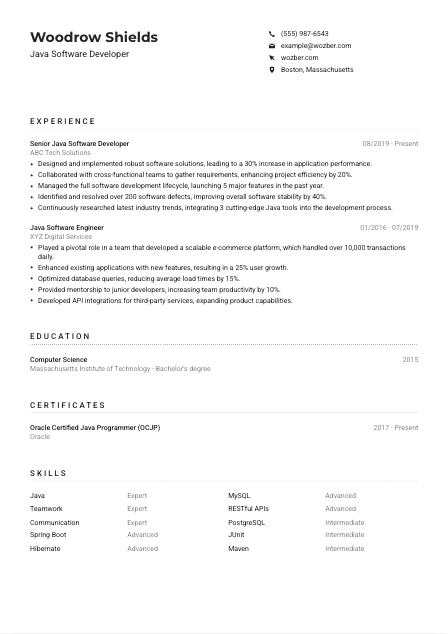
This is the section engineering teams study most closely. They want to see what you built, which Java stack you used, how you worked with others, and what changed because of your code. Strong entries connect architecture or implementation work to performance, stability, release output, or team delivery.
Prioritise positions where Java was central to the work, especially if you used frameworks, persistence layers, databases, and deployment practices close to the target role. If the posting calls for Spring Boot, Hibernate, MySQL, or PostgreSQL, move experience with those tools into prominent bullets rather than leaving them implied in a general software engineer description.
Rewrite broad duties into concrete outcomes. "Worked on backend development" says very little. A stronger bullet shows what you designed, implemented, or improved, along with the business or technical result. The sample CV does this well with lines such as improving application performance by 30% and launching five major features across the development lifecycle.
Numbers carry real weight in software hiring when they reflect engineering work honestly. Use metrics tied to latency, throughput, release volume, transaction scale, uptime, defect counts, or efficiency gains. Query optimisation that cuts load times by 15% or defect resolution that improves stability by 40% tells a hiring manager far more than "improved system performance."
List the Java technologies you actually used inside accomplishment bullets, not only in the skills section. Mentioning Spring Boot for service development, Hibernate for ORM work, or PostgreSQL for query tuning helps reviewers connect your stack knowledge to real implementation experience. That is much stronger than a detached keyword list.
The role asks for collaboration and independent execution, so your bullets should show both. Include examples of gathering requirements with product or QA, mentoring junior developers, resolving production defects, or owning a feature from design through deployment. In the example CV, cross-functional collaboration and defect resolution are especially useful because they map directly to the job's day-to-day work.
A hiring team should be able to scan this section and understand your Java stack, your delivery scope, and the results your work produced in production environments.
For Java development roles, education usually serves one clear purpose. It confirms the academic foundation behind your programming, data structures, software engineering, and systems knowledge. Keep it straightforward unless you are early in your career and need coursework or projects to strengthen the profile.
If the posting asks for a Bachelor's degree in Computer Science, Software Engineering, or a related field, state your degree plainly. That requirement is explicit in this job description, so the education section should make it easy to confirm without extra interpretation.
List the university or college in full. School name adds context, and for early-career developers it can also anchor internships, research, capstone work, or programming-intensive coursework that may support your candidacy.
Include your graduation date or year unless there is a specific reason not to. It helps place the start of your professional timeline and gives reviewers a cleaner sense of how your academic background connects to your years of Java development experience.
If you have several years of professional Java experience, keep education concise. If you are closer to graduation, add courses or academic projects that reflect backend development, object-oriented design, databases, distributed systems, or software engineering practices relevant to the job.
Honors, scholarships, or notable project awards can stay if they add real value, especially for recent graduates. Once your industry experience is established, these details should remain only if they still strengthen the technical story.
For most Java developers, this section is there to confirm the required degree quickly and support the rest of the CV without taking attention away from project delivery and technical experience.
Certifications are useful when they sharpen your technical profile or support a framework, platform, or specialization the employer already values. In Java hiring, they work best as supporting proof, not as a substitute for shipped software and measurable engineering work.
Prioritise certifications tied to the actual stack or ecosystem. Oracle Java credentials and Spring certifications are relevant here because the job specifically asks for Java expertise and framework experience. They reinforce your background instead of sitting off to the side as unrelated extras.
Include the year earned and, if relevant, the active period. Dates help reviewers understand whether your credential is current and whether it reflects recent work with the platform or framework.
Do not overcrowd this section with certificates that have little bearing on backend Java work. If a credential does not support application development, database work, testing, cloud delivery, or the technologies in the posting, it probably does not belong here.
If you are currently studying for a certification in a tool the role emphasizes, that can be worth noting. Used carefully, it shows that your knowledge of the Java ecosystem, testing practices, or framework upgrades is current and still developing.
Good certifications add credibility around the Java ecosystem and frameworks you already use. They should strengthen the story your experience section has already established.
A Java Software Developer skills section should read like a concise map of how you build software. Hiring teams want to see the languages, frameworks, databases, testing tools, and collaboration strengths that match the role's day-to-day work, not a long inventory of every tool you have touched once.
Pull the most important technical requirements directly from the posting and match them with skills you genuinely have. For this role, that includes Java, Spring Boot, Hibernate, and relational databases such as MySQL or PostgreSQL. This supports ATS optimisation while keeping the section accurate and role-specific.
Backend development is collaborative work. Alongside the stack, include communication and teamwork if they are real strengths, especially when the role involves requirement gathering, code reviews, defect triage, and cross-functional development. The job description explicitly asks for interpersonal and communication skills, so they deserve space here.
Organise the list so related tools sit together. For example, place Java, Spring Boot, and Hibernate near each other, followed by databases such as MySQL and PostgreSQL, then testing or build tools like JUnit and Maven. That layout makes your stack easier to read in seconds and translates well into an ATS-friendly CV format.
Every skill listed here should support the kind of Java work you want to be hired for, whether that is service development, persistence-layer work, API design, testing, or production support.
For software roles, spoken language requirements are usually practical rather than decorative. Teams need developers who can discuss requirements, write clear updates, explain tradeoffs, and work through defects without friction. If the posting names a language requirement, address it directly.
When English is essential for the role, include it clearly and rate it honestly as Native or Fluent. This posting makes English ability a stated requirement, so it should not be left for the employer to infer from the rest of the CV.
Additional languages can be useful if the company works across regions or serves multilingual users. They are not usually a deciding factor for Java roles, but they can support collaboration in distributed teams or client-facing engineering environments.
Choose labels such as Native, Fluent, Intermediate, or Basic and keep them believable. Clear proficiency levels are more useful than vague claims because they tell the employer how comfortably you can communicate in meetings, documentation, or written updates.
If the company has international teams, global product operations, or offshore collaboration, extra language ability can be worth keeping. If it does not affect the work, keep the section short and factual.
For engineers, communication is part of delivery. Strong language skills support requirement discussions, debugging handoffs, code review comments, and coordination across product, QA, and operations. That is the practical value this section should imply.
Keep this section honest and concise. It should quickly confirm that you can work in the team's required language and collaborate effectively in day-to-day development.
The summary sets the lens for the rest of the CV. For a Java Software Developer, it should quickly establish your years of experience, the kind of systems you build, the stack you work in, and the outcomes you tend to deliver. Generic adjectives are far less useful than concrete scope and results.
Start with a direct line that identifies your level and specialization. If you have more than 3 years in Java development, say so. The sample summary works because it immediately places the candidate as a developer with 7+ years building scalable applications rather than opening with broad personality traits.
Mention the parts of the stack most relevant to the role, such as Spring Boot, Hibernate, REST APIs, or relational databases. This helps distinguish you from general software engineers whose Java exposure may be partial or outdated.
Use a short metric or result that fits naturally, such as improving application performance, resolving a high volume of defects, or supporting high-transaction systems. Results like these give the summary weight and create a consistent thread into the experience section.
Aim for a short paragraph that can be read in seconds. Focus on what you build, how you work, and what tends to improve under your ownership. Wozber's AI CV builder can help tighten phrasing and align this summary with the posting so the opening lines reflect the same Java technologies and delivery expectations seen later in the CV.
A good summary should tell the reader, within a few lines, whether you are the kind of Java developer who can step into the stack, work across the team, and improve software quality from the start.
Your CV should now present the essentials hiring teams look for in Java development: a clear technical stack, delivery across the software lifecycle, collaboration with cross-functional teams, and results tied to performance, stability, or feature output.
Use Wozber's ATS-friendly CV template, free CV builder, and ATS CV scanner to tighten wording, align the CV with the job description, and improve ATS optimisation without losing technical accuracy. The final version should make it easy to judge your readiness for production-focused Java work.




