



Use Wozber and land your dream job
Create CV
No registration required
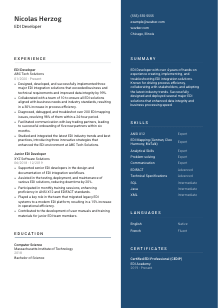
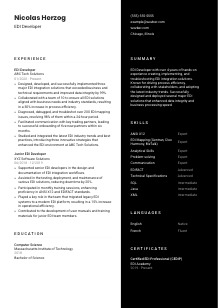
Translating data, but your CV seems unreadable? Decode success with this EDI Developer CV example, created with Wozber free CV builder. Learn how to match your integration talent to job standards, so your career doesn't get lost in translation!
EDI development work is judged in production. Hiring teams want to see whether you can translate partner requirements into reliable mappings, keep transactions flowing across ANSI X12 or EDIFACT standards, and resolve failures before they disrupt orders, invoices, or shipment data. Your CV should make that operational reliability visible, not just list tools and buzzwords.
When the CV is tailored well, reviewers can quickly separate general integration experience from hands-on EDI delivery. Wozber's free CV builder helps you align your wording with the posting, keep the structure ATS-friendly, and surface the exact standards, mapping tools, and troubleshooting work that matter most for an EDI Developer opening. That makes it easier to see where you've built, tested, supported, and improved real EDI processes.
For EDI Developer roles, the personal details section is straightforward, but it still carries practical weight. Hiring teams need to know who you are, how to reach you, and whether location or work eligibility requirements could affect onboarding. Keep it clean, accurate, and aligned with the posting.
Use your full name as the most visible text on the page. Keep the formatting simple and professional so the focus stays on your EDI background, not on decorative styling. This section should feel as structured as the integration work you do.
Place your target title directly under your name and mirror the role you are pursuing when it is accurate, such as "EDI Developer." That immediately tells the reader they are looking at someone with the right specialization, rather than a broader developer or analyst profile.
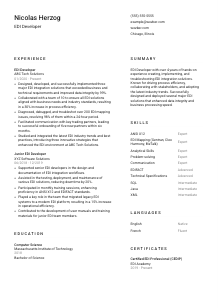
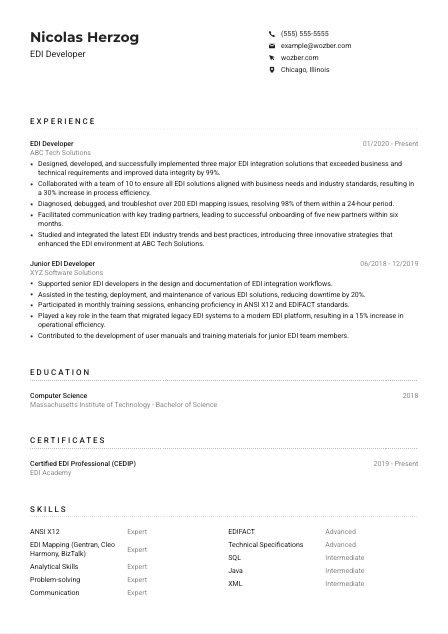
List a reliable phone number, a professional email address, and your city and state when location matters. In the example, Chicago, Illinois supports a posting that requires local presence or relocation. If a role includes a similar location condition, make that easy to confirm without forcing the reader to search for it.
A LinkedIn profile or professional website can help if it reinforces your CV with consistent titles, projects, or technical keywords such as EDI mapping, BizTalk, Cleo Harmony, or trading partner integration. Only include it if it is current and supports your application.
Do not use space on age, marital status, photo, or other details that have no bearing on EDI delivery, system support, or technical collaboration. Keep attention on qualifications, standards experience, and availability for the role.
This section should answer the practical basics fast: who you are, how to contact you, and whether any location requirement is already covered. Once that is clear, the rest of the CV can stay focused on mappings, integrations, and production support.




This is the section most likely to decide whether you move forward. For an EDI Developer, experience should show which standards you worked with, what kinds of integrations you built, how you handled testing and production support, and what business results followed from cleaner mappings or faster issue resolution.
Start by identifying the details that define the role. Here, that includes EDI development, mapping tools such as Gentran, BizTalk, or Cleo Harmony, standards like ANSI X12 and EDIFACT, and the ability to turn business requirements into technical specifications. Those points should reappear naturally in your experience bullets when they reflect work you have actually done.
List positions in reverse chronological order with your job title, employer, and dates. That structure helps reviewers follow your progression from junior support work into full EDI ownership, whether that includes partner onboarding, mapping development, migration work, or production troubleshooting.
Your bullets should describe what you built, supported, fixed, or improved. Strong EDI bullets often mention integration solutions, mapping changes, testing cycles, data accuracy, partner implementation, or issue resolution speed. The sample CV does this well by showing implemented solutions, partner onboarding, and debugging work tied to measurable outcomes.
Quantify impact wherever you can. Useful measures in this field include data integrity, transaction accuracy, turnaround time for production issues, onboarding volume, reduced downtime, processing efficiency, or migration gains. "Resolved 98% of mapping issues within 24 hours" tells a hiring manager much more than "responsible for troubleshooting."
If an older role was only partly relevant, keep the bullets that connect to integration workflows, specifications, testing, XML, SQL, or system support, and trim the rest. Every line should help answer a role-specific question: can you design mappings, support trading partners, and keep transactions running accurately in production?
A strong experience section makes your EDI work concrete. It should show standards, tools, collaboration points, production support, and business impact clearly enough that the reader can picture you handling real transaction flows, not just participating on the edge of them.
Education is usually a qualifying checkpoint for EDI Developer roles rather than the main selling point, but it still matters. A relevant degree helps confirm your technical foundation for integration work, structured problem-solving, and system-oriented development.
If the posting asks for a bachelor's degree in Computer Science, Information Systems, or a related field, make sure that information is easy to spot. In the example, a Bachelor of Science in Computer Science aligns directly with the stated requirement.
List your degree, school, field of study, and graduation year or date. Hiring teams do not need excess detail here unless you are early in your career. Clean formatting lets them confirm the requirement quickly and move back to your technical background.
For technical roles, the subject matters. "Computer Science" or "Information Systems" gives stronger context than listing only the degree level. It helps frame your background in software logic, data structures, systems thinking, or related coursework that supports EDI development.
If you do not yet have much hands-on EDI experience, include coursework or projects tied to databases, systems integration, software development, XML processing, or business systems analysis. Those details can help bridge the gap between education and practical integration work.
Additional coursework in integration platforms, data exchange, SQL, Java, or business systems can strengthen this section when it fills a genuine gap. For more experienced candidates, those details are usually better placed elsewhere unless they are especially relevant to the target role.
This section should confirm that you meet the academic baseline and support the technical story told in your experience. Once that is clear, let your integration work and results carry the most weight.
Certifications are not mandatory in every EDI Developer search, but they can strengthen your profile when they point to standards knowledge, platform familiarity, or continued development in integration work. Use them to reinforce specialization, not to pad the page.
Some EDI jobs list no certification requirement at all. Even then, a relevant credential can still add value if it supports your expertise in trading partner integration, standards interpretation, or mapping work. The sample's Certified EDI Professional is a good example of a credential that complements hands-on experience.
List certifications that relate directly to EDI platforms, data exchange standards, integration architecture, or adjacent technical skills you use on the job. A short, relevant list is more persuasive than a long catalogue of loosely connected courses.
Certification dates help show currency, especially in technical environments where standards, platforms, and implementation practices evolve. If a certification is active or recently renewed, include that detail clearly.
If you are pursuing new certifications, choose ones that match the kinds of systems and standards used in your target roles. For EDI Developers, that usually means deeper knowledge of mapping tools, integration middleware, B2B communication flows, or transaction set implementation.
The best certifications add another layer to your EDI profile. They work best when they support the standards, tools, and production responsibilities already proven in your CV.
The skills section should read like a practical inventory of what you can use on the job. For EDI Developers, that means standards, mapping tools, technical support skills, and a few supporting technologies that help with integrations and troubleshooting.
Pull the most important terms from the posting and include them when they match your experience. In this case, skills such as ANSI X12, EDIFACT, EDI mapping, technical specifications, and tools like Gentran, BizTalk, or Cleo Harmony belong near the top because they define the work.
Do not stop at product names. Pair hard skills such as mapping, SQL, XML, Java, or integration tools with the supporting strengths that matter in EDI environments, including analytical problem-solving, debugging, stakeholder communication, and requirements translation.
Group or order skills so the most relevant ones stand out first. A compact list of standards, platforms, and core technical abilities is easier to scan than a bloated section filled with generic software terms. If you use proficiency labels, make sure they are honest and consistent.
Your skills list should quickly confirm that you can handle the standards, tools, and problem-solving expected in EDI development. If the reader can connect these skills directly to the work in your experience section, the CV is doing its job.
Language skills are usually a secondary section for EDI Developers, but they still matter when the role requires clear written communication with business users, support teams, or trading partners. Include them when they clarify your ability to work in the target environment.
If the posting explicitly requires English, list it first with an accurate proficiency level. That requirement appears in the example job description, so the sample CV correctly makes English easy to verify.
Order languages by relevance to the role, not by preference. For most EDI Developer jobs, the main concern is whether you can document issues, interpret requirements, and communicate implementation updates clearly in the primary business language.
Additional languages can be useful if you work with international vendors, offshore support teams, or global trading partners. They are not essential for every opening, but they can strengthen your profile in organizations with cross-border operations.
Choose plain levels such as Native, Fluent, Intermediate, or Basic. Avoid overstating your ability. In roles that involve requirements clarification, ticket handling, or partner communication, language accuracy matters.
Language skills should complement your integration and troubleshooting background, not distract from it. Include them when they add something useful to the overall picture of how you work with stakeholders and systems.
This section should answer one simple question: can you communicate effectively in the environment where the EDI work happens. If the answer is clear, it has done enough.
Your summary should quickly establish your level, your technical focus, and the kind of EDI work you handle well. A few lines are enough if they point to standards knowledge, mapping experience, production support, and measurable results.
Look at the core requirements before you write. If the role emphasizes EDI development, standards expertise, mapping tools, business requirements translation, and troubleshooting, those themes should shape your opening lines rather than generic software claims.
Start with a direct statement of who you are, such as your title and years of experience. For example, "EDI Developer with 4+ years of experience" is clearer and more useful than a vague introduction about being results-driven or passionate.
Choose specifics that show the kind of EDI work you do well. That might include ANSI X12 and EDIFACT expertise, major integration implementations, production troubleshooting, or partner onboarding. The sample summary works because it combines hands-on delivery with outcomes like stronger data integrity and faster business processing.
Aim for a short paragraph that can be read in a few seconds. Cut filler and keep only details that help a reviewer understand your EDI scope, technical strengths, and business contribution. The summary should sound like the top line of your actual experience, not a motivational statement.
By the time someone finishes these lines, they should know your experience level, your EDI specialization, and the kind of implementation and support work you can own. That gives the rest of the CV a clear frame.
A tailored EDI Developer CV should make three things easy to confirm: which standards and tools you know, what kinds of integrations you have delivered, and how you handle testing, troubleshooting, and partner support in production environments.
Use Wozber to tighten that alignment, improve ATS optimisation, and present your work in an ATS-friendly CV format that keeps the technical story clear. The finished CV should make it easy for a hiring team to picture you building and supporting reliable EDI flows from day one.