



Use Wozber and land your dream job
Create CV
No registration required
Designing data solutions, but your CV structure feels a bit unstructured? Check out this NoSQL Developer CV example, built with Wozber free CV builder. Learn how to showcase your database dexterity, tailor your credentials to match job expectations, and explore the many pathways a career in NoSQL can pave!
NoSQL development gets reviewed through the lens of production reliability. Hiring teams want to see whether you can model data for real application workloads, tune performance under load, and keep distributed systems stable when query patterns, traffic, or product requirements change. Your CV should make that operational work visible, not just list database names.
When the CV mirrors the language of the role, it becomes much easier to separate someone who has merely used MongoDB or DynamoDB from someone who has designed collections, improved latency, handled uptime issues, and worked closely with application engineers. Wozber's free CV builder helps you shape that story in an ATS-compliant CV, so the technical depth behind your NoSQL work is clear from the first scan.
The top of a NoSQL Developer CV should answer a few practical questions immediately: who you are, what role you target, and whether the employer can contact you without friction. Keep this section clean and direct so the reader can move quickly to your database experience.
Place your name prominently at the top using a clear, professional format. In technical hiring, this is simple but important. A clean header keeps the document readable in both human review and ATS parsing.
Add "NoSQL Developer" directly beneath your name when that matches the position you are pursuing. This immediately aligns your profile with the opening and helps frame the rest of your experience around database design, optimisation, and platform support rather than broader software engineering work.
Include a reliable phone number and a professional email address. Check them carefully. If a hiring manager wants to discuss your experience with MongoDB clusters, DynamoDB workloads, or cloud migrations, you do not want a typo to block that next step.
If the job specifies a location requirement, reflect it clearly. In the example, "San Francisco, California" matches the posting and removes doubt about local availability. Use this when relevant, especially for roles with onsite or hybrid expectations, but do not treat location as a profession-wide requirement.
A LinkedIn profile or technical portfolio can strengthen this section if it is current and consistent with your CV. For a NoSQL Developer, that profile should reinforce the same stack, scope, and results, such as cloud database work, data modeling, or performance tuning across production systems.
Keep the header straightforward and accurate. Wozber lets you organise these details in an ATS-friendly CV template so hiring teams can move quickly from your contact information to the database work that matters.




This section carries the most weight for a NoSQL Developer. Employers want to see how you worked with production data stores, what performance or scalability problems you handled, and whether your contributions improved reliability, response times, integration, or operating cost.
Start by identifying the recurring themes in the job description. Here, the emphasis is on NoSQL data modeling, high-performance database solutions, cloud-based platforms, application integration, monitoring, and documentation. Those priorities should shape which accomplishments you feature and what terminology you use for ATS optimisation.
List positions in reverse chronological order with job title, employer, and dates. For technical roles, clean structure matters because reviewers often scan quickly for progression, years of hands-on database work, and whether your recent roles involved production ownership rather than support-only tasks.
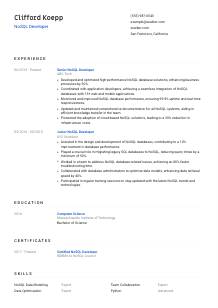
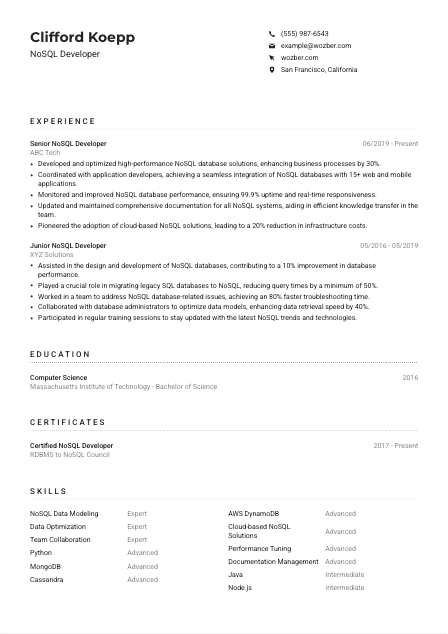
Focus each bullet on what you built, improved, or maintained. Strong NoSQL bullets often mention data modeling decisions, query or throughput improvements, uptime, integration with web or mobile applications, migration work, or cloud adoption. The example bullet about optimising high-performance NoSQL solutions and improving business processes by 30% works because it ties technical work to a business result.
Use numbers where they naturally reflect the work. For this profession, that may include uptime, response time, query speed, troubleshooting time, cost reduction, migration scale, or number of applications supported. The sample's 99.9% uptime, 20% infrastructure cost reduction, and integration with 15+ applications all give the reader a much clearer picture of production impact.
Prioritise accomplishments that show direct relevance to NoSQL engineering. If you also handled unrelated software tasks, keep only the ones that support the case for database design, optimisation, cloud services, troubleshooting, or cross-functional delivery. The goal is a focused record of how you improved data systems, not a broad inventory of everything you have touched.
Your experience should show that you can design, tune, and support NoSQL systems in production. Wozber's ATS CV scanner can help you match your wording to the job description so that skills like data modeling, cloud NoSQL platforms, and performance monitoring are easy to surface.
Education usually plays a supporting role for experienced NoSQL Developers, but it still helps establish your technical base. Keep it concise and relevant, especially if your degree connects clearly to computer science, software engineering, data systems, or cloud infrastructure.
List your highest relevant degree first. For many NoSQL roles, that will be a Computer Science or related technical degree. In the example, a Bachelor of Science in Computer Science gives immediate context for core knowledge in algorithms, systems, and data structures that support database work.
Include degree, field of study, school name, and graduation year. This is enough for most mid-level and senior candidates. A simple structure helps both ATS systems and human reviewers read the section quickly without distracting from your hands-on experience.
Where your academic background directly supports the job, let that connection be obvious. A Computer Science degree fits naturally with responsibilities involving data modeling, application integration, and performance optimisation, which are central to NoSQL development.
If you are early in your career or your experience is still developing, selected coursework can add useful context. Prioritise subjects like distributed systems, database design, cloud computing, data structures, or backend development. Skip generic course lists that do not strengthen your case for the role.
Honors, technical projects, or research can be worth noting when they connect to data engineering or large-scale systems. For example, a project involving document databases, partitioning strategies, or application performance would support a NoSQL profile far better than unrelated extracurriculars.
For most NoSQL Developers, education should confirm technical grounding without taking space from production achievements. Wozber helps format this section cleanly so the CV stays easy to scan and ATS-friendly.
Certifications matter most when they support the exact technical areas the role emphasizes. In NoSQL hiring, that usually means database platforms, cloud services, or architecture knowledge that complements your hands-on work rather than replacing it.
Choose certificates tied to NoSQL platforms, database development, cloud architecture, or related engineering domains. A credential such as "Certified NoSQL Developer" supports the profile because it reinforces specialised knowledge in data modeling and NoSQL practices.
Keep the list focused. If the role mentions MongoDB, Cassandra, DynamoDB, or cloud-based NoSQL solutions such as Azure Cosmos DB or AWS DynamoDB, certifications in those areas deserve more visibility than broad, unrelated IT training.
Certification dates help the reader judge how current your knowledge is. This matters in database work because tooling, managed services, security practices, and scaling patterns change quickly. If a certification is ongoing or renewed regularly, show that clearly, as in "2017 - Present."
NoSQL work evolves with new managed services, replication features, indexing capabilities, and cloud patterns. A short, relevant certification list can show that you stay current with the technology landscape, which supports roles involving architecture decisions and long-term platform maintenance.
Relevant certifications strengthen your technical profile when they line up with the role's database stack and cloud environment. Wozber helps present them in a clear ATS-compliant format that adds credibility without crowding the page.
A NoSQL Developer skills section should read like the toolkit behind your experience. Focus on the technologies, methods, and collaboration abilities that support production database design, tuning, and integration work.
Pull the core requirements from the posting and match them with skills you genuinely use. For this role, that includes NoSQL data modeling, design patterns, MongoDB, Cassandra, DynamoDB, cloud-based NoSQL platforms, and programming languages such as Python, Java, or Node.js. This kind of alignment supports both ATS optimisation and technical review.
Lead with the platform and engineering skills that define your work. Database technologies, performance tuning, cloud services, and programming languages should come before broad soft skills. Collaboration still matters here, especially because the role involves working with application developers, but technical depth should appear first.
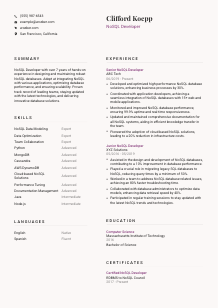
Group and prioritise skills so the section reflects how you operate on the job. A list that starts with NoSQL data modeling, database optimisation, MongoDB, Cassandra, AWS DynamoDB, and performance tuning tells a much sharper story than a mixed list with no hierarchy. The sample does this well by combining core database strengths with supporting languages and teamwork skills.
Your skills section should quickly confirm the databases, languages, and platform knowledge behind your experience. Wozber's ATS-friendly CV format helps you organise those skills so both automated systems and technical reviewers can read your stack at a glance.
Language fluency matters in technical roles because design discussions, incident updates, documentation, and cross-team coordination all depend on clear communication. Keep this section short, accurate, and relevant to the working environment.
If the role explicitly requires English, include it clearly with an honest proficiency level. For a NoSQL Developer, strong English matters in architecture discussions, troubleshooting notes, documentation, and collaboration across engineering teams.
Additional languages can be worth listing, especially in global teams or organizations with distributed stakeholders. They are secondary to technical qualifications, but they can still add practical value in collaborative environments.
Choose direct ratings such as "Native," "Fluent," or "Intermediate." Avoid vague phrasing. Reviewers should be able to understand your communication level immediately, just as they can with your database or programming skills.
For this profession, language ability supports more than conversation. It affects how well you write runbooks, update technical documentation, explain data model tradeoffs, and coordinate fixes with developers during incidents or releases.
Languages are a supporting asset, not the centre of the application. Include them when they add useful context, as in the example where English and Spanish suggest broader communication range, but keep the main emphasis on your database expertise.
List the languages you can actually use in a professional setting, with honest proficiency levels. That gives hiring teams a clearer sense of how you will communicate in documentation, meetings, and technical collaboration.
The summary sets the technical direction of the CV. For a NoSQL Developer, it should quickly establish your years of experience, your database strengths, and the kinds of systems or outcomes you have handled, without drifting into vague profile language.
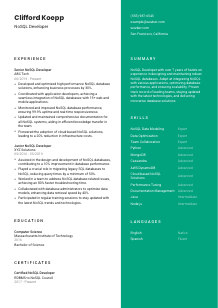
Open with your title and level of experience, then anchor the summary in the work you actually do. A clear line such as having 7+ years in designing and maintaining NoSQL databases immediately positions you for roles centered on database engineering rather than general development.
Use the next lines to name your strongest areas, such as data modeling, application integration, performance tuning, scalability, or cloud-based NoSQL services. In the sample summary, the references to robust NoSQL databases, application integration, and scalability make the profile feel grounded in real engineering work.
Shape the summary around the employer's priorities. If the posting emphasizes high-performance database solutions, uptime, and collaboration with multidisciplinary teams, make sure those themes appear naturally in your wording. This is where tailoring creates immediate relevance.
Aim for 3 to 5 lines. That is enough space to establish your seniority, technical focus, and one or two differentiators. Avoid generic claims about being driven or results-oriented when you could mention concrete strengths like optimising query performance, supporting cloud NoSQL platforms, or maintaining highly available systems.
A well-written summary should make the reader expect strong database experience before they reach the first job entry. With Wozber and its ATS CV scanner, you can align that opening language with the role's key requirements so your NoSQL specialization is clear from the start.
A NoSQL Developer CV works best when every section supports the same message: you know how to model data, keep distributed databases performing well, and collaborate with engineers to ship reliable applications. That means matching the posting's language where it reflects your real work, backing claims with metrics like uptime, query improvements, migration results, or cloud cost savings, and keeping the document focused on database outcomes.
Use Wozber's free CV builder to structure your content, strengthen ATS optimisation, and present your experience in an ATS-friendly CV format that surfaces the right technical details quickly. When the CV is tailored well, hiring teams can tell much faster whether you are ready to own NoSQL systems in production.




