



Use Wozber and land your dream job
Create CV
No registration required
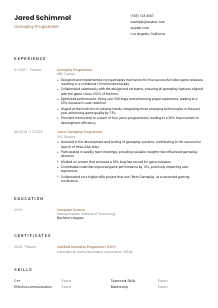
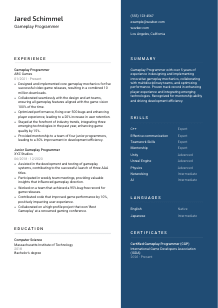
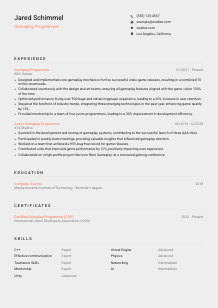
Crafting awesome gaming experiences, but your CV is stuck in sandbox mode? Level up with this Gameplay Programmer CV example, created with Wozber free CV builder. Learn how to match your coding quests with job quests, making your game dev career a constant adventure!
Gameplay programming sits where player feel, engine constraints, and production reality meet. Hiring teams want to see more than general software experience. They need proof that you can turn design intent into responsive mechanics, work comfortably with systems like AI, physics, and networking, and keep performance stable when features move from prototype to shipped content.
A tailored CV changes how quickly that picture comes through, especially when an ATS first scans for C++, engine experience, and gameplay systems work. Wozber's free CV builder helps you line up that language cleanly and present it in an ATS-friendly CV format, so the technical review starts with the right signals: what you built, how you collaborated, and how your code improved the player experience.
Studios rarely spend long on the header, but they do expect it to answer a few practical questions immediately. For a Gameplay Programmer, that means clear identity, direct contact information, and any location detail that affects eligibility for the role. Keep this section clean and functional.
Place your name at the top in a clear, readable format. It should be the easiest element to find on the page, since that is how interviewers will track your application across recruiter screens, coding reviews, and portfolio links.
Use the job title "Gameplay Programmer" if that is the role you are pursuing. This immediately connects your profile to the opening and helps both recruiters and ATS filters classify your CV correctly. If your recent title was different, such as "Game Programmer" or "Software Engineer," the header is still the right place to state the role you are targeting.
Include a phone number and a professional email address that you check regularly. If a studio wants to move quickly from CV review to a technical screen or onsite loop, broken contact details create avoidable friction. A simple address in the format of your name works best.
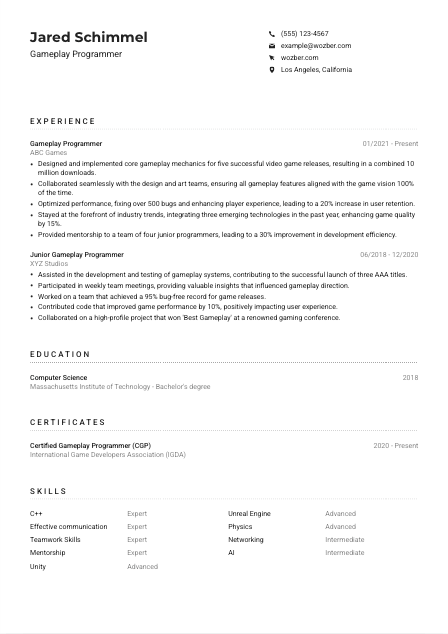
If the job requires you to be in a specific area or willing to relocate, say so clearly here. In the example, listing "Los Angeles, California" addresses the posting's location requirement right away. For other openings, use your current city and state, and mention relocation only when it is relevant to that employer.
Include a portfolio, GitHub, LinkedIn, or personal site if it shows code samples, shipped titles, gameplay prototypes, technical breakdowns, or cross-functional project work. For gameplay programming, links are most useful when they show implementation quality, engine familiarity, or feature ownership, not just a placeholder profile.
This section does not need personality flourishes. It needs to confirm who you are, how to reach you, and whether you meet any location requirement without making the reader hunt for basic facts.




This is where gameplay programmers separate themselves from generalist developers. Hiring teams look for implemented mechanics, engine-level problem solving, production collaboration, and shipped outcomes. Your bullets should show what systems you touched, how your work affected the game, and what level of ownership you handled.
Before editing bullets, identify the work the studio actually needs done. In this description, that includes core gameplay mechanics, collaboration with design and art, performance work, bug fixing, and familiarity with AI, physics, and networking. Use those themes to decide which projects and accomplishments deserve space.
Start with your most recent position and work backward. For each role, include company name, title, and dates. This helps reviewers quickly understand your current level, whether you have the required 3+ years of experience, and how your responsibilities have progressed from junior support work to feature ownership or mentoring.
Gameplay programming bullets should focus on implemented features and measurable results, not generic responsibilities. Instead of "worked on gameplay systems," write what you built, improved, or fixed. The example does this well by tying core mechanics to five releases and 10 million downloads, and by connecting bug fixing and optimisation work to a 20% increase in user retention.
Use numbers that reflect how game teams evaluate work: release count, bug volume reduced, frame rate gains, retention improvement, crash reduction, development efficiency, or scope of systems owned. Metrics make collaboration and technical execution more concrete. "Fixed over 500 bugs" says far more than "helped improve quality."
Prioritise roles and bullets that support your case as a gameplay programmer. Systems implementation, AI behaviour work, player controls, combat logic, progression features, engine scripting, and optimisation all belong here. Older work outside game development only stays if it clearly strengthens your case, such as C++ systems work, real-time simulation, or networking experience.
A studio wants to picture you inside production. When your experience section makes it easy to see what mechanics you implemented, what technical problems you solved, and what changed in the shipped game because of your work, you are much easier to move forward.
Gameplay programming roles often ask for formal technical training because the work touches systems design, performance, math, debugging, and engine architecture. Your education section should confirm that foundation quickly, then add relevant detail only if it strengthens your case.
If you have a bachelor's degree in Computer Science, Engineering, or a related field, make that easy to find. This posting asks for it directly, so your degree should not be buried. In the example, a Computer Science bachelor's clearly checks that requirement.
List your degree, field of study, school, and graduation year or date. Recruiters and coordinators often scan this section fast, especially when verifying minimum qualifications before sending CVs to engineering leads.
If you are early in your career, include coursework, academic projects, or capstones tied to gameplay systems, C++, physics, AI, graphics, or networking. For more experienced candidates, those details matter less unless the project is unusually relevant, such as a multiplayer game prototype or engine tool built in Unreal or Unity.
Student clubs, game jams, thesis work, and team projects can strengthen this section when they show production-like collaboration or technical depth. Focus on work that involved systems implementation, debugging, iteration with designers, or performance constraints rather than listing every extracurricular activity.
Gameplay programming changes with engine updates, platform requirements, and new technical approaches. If you have recent coursework or structured learning in areas like Unreal systems, multiplayer architecture, optimisation, or AI behaviour trees, include it when it supports the job you are targeting.
Once your degree and any relevant technical training are clear, let your experience carry the heavier weight. Education should confirm the foundation behind your coding and systems work, not compete with it.
Certificates are rarely the deciding factor for gameplay programming, but they can reinforce a specialty or show recent training in a toolset the studio cares about. Use this section to support your technical profile, not to pad it.
Prioritise certificates connected to the role's actual demands, such as C++, Unreal Engine, Unity, AI, networking, or performance optimisation. A credential only helps if it maps to work the team expects you to handle. The example's gameplay-focused certification fits because it supports the candidate's specialization.
Add the award date or active date range so reviewers can tell whether the training is current. That matters more for fast-changing tool ecosystems and engine workflows than for older, one-time credentials.
If your experience is lighter in one area the posting emphasizes, a relevant certification can help close that gap. For example, if a role leans heavily on Unreal gameplay systems or multiplayer implementation, recent training in those areas can strengthen your overall story.
A certificate can reinforce your profile, especially around engines or specialised systems, but it works best when the rest of the CV already shows applied gameplay programming experience.
The skills section should mirror the technical language of the role without becoming a dump of every tool you have touched. Studios scan this area for core programming strength, engine familiarity, systems knowledge, and the collaboration skills needed to build features with designers, artists, and other engineers.
Start with the exact capabilities the posting names. Here, that means C++, Unity or Unreal Engine, gameplay systems, AI, physics, networking, communication, teamwork, and mentoring. If you genuinely have them, use the employer's wording or close variants so the match is obvious to both ATS tools and human reviewers.
Lead with the tools and competencies that define gameplay programming. Languages and engines usually come first, followed by technical domains like AI, physics, networking, input systems, debugging, optimisation, and then the collaboration skills that support production work. The example gets this balance mostly right by putting C++ and engine experience alongside communication and mentorship.
Group related skills so the section reads like a technical profile instead of a scattered keyword list. For example, place programming languages and engines together, gameplay systems topics in another cluster, and soft skills such as teamwork or communication in a separate group. That structure makes your strengths easier to read in seconds.
When this section is focused and accurate, it reinforces the rest of the CV instead of repeating it. List the tools and systems you can speak about in depth during a technical interview.
Gameplay programming is collaborative work. You are translating design ideas into systems, discussing bugs with QA, and reviewing implementation details with engineers and artists. Language proficiency matters because unclear communication slows iteration, especially in cross-disciplinary teams.
If the role requires fluent English, state your level clearly. This posting does, so English should appear in this section with an accurate proficiency label. "Native" or "Fluent" works when it is true and sets the right expectation for team communication.
Additional languages can be helpful for international studios, distributed teams, or player-facing development contexts, but they are secondary unless the job asks for them. In the example, Japanese adds useful context without distracting from the required English proficiency.
Stick with familiar labels such as "Native," "Fluent," "Intermediate," or "Basic." Avoid vague descriptions. Reviewers should understand at a glance whether you can handle day-to-day meetings, written documentation, and cross-team collaboration in each language.
This section is straightforward, but it still affects how teams picture you in production. State the required language clearly and treat additional languages as added context, not filler.
The summary sits near the top of the CV, so it needs to establish your specialty quickly. For gameplay programming, that usually means years of experience, the kind of systems you build, the engines or technical areas you know well, and one or two results that show your work reached players or improved development outcomes.
Start with a direct line that tells the reader who you are professionally. A phrase like "Gameplay Programmer with 5+ years of experience" works because it immediately frames seniority and discipline. Then narrow it with the work you are strongest in, such as core mechanics, AI systems, player controls, or performance-focused gameplay implementation.
Use one or two concrete accomplishments that connect to the employer's needs. The example summary works because it mentions innovative gameplay mechanics, multidisciplinary collaboration, performance optimisation, and mentorship. If you have stronger specifics, such as shipped titles, retention gains, or large player counts, include them here.
Aim for 3 to 5 lines with real information density. Avoid broad claims about passion or creativity unless they are backed by shipped work or measurable results. This section should make someone want to read your experience because they already understand the kind of gameplay programmer you are.
A strong summary helps the studio place you quickly, whether they need someone focused on core mechanics, systems-heavy gameplay, or collaborative production support. Make those first lines precise enough that your value is clear before the first bullet point begins.
When each section points back to the work gameplay programmers actually do, your CV becomes much easier to evaluate. Hiring teams can see your command of C++, your engine experience, your work with mechanics and systems, and the effect your code had on quality, performance, and player experience.
Wozber's free CV builder helps you organise that story in an ATS-compliant CV, and its ATS CV scanner can help you spot missing requirements, align technical phrasing with the job description, and strengthen ATS optimisation before you apply. The finished result should make one thing easy to judge: you can contribute to gameplay production from day one.




