



Use Wozber and land your dream job
Create CV
No registration required
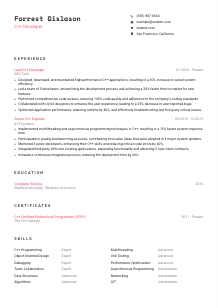
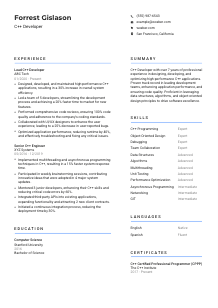
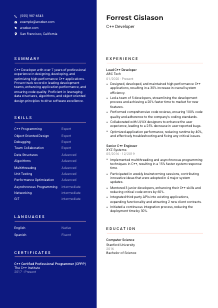
Unveiling polymorphic potentials, but your CV feels statically linked? Check out this C++ Developer CV example, created with Wozber free CV builder. It shows how to skillfully align your template metaprogramming abilities with job prerequisites, constructing a career path that dynamically matches your programming finesse!
C++ hiring usually turns on one thing fast: whether your CV shows work on systems where performance, reliability, and code quality mattered under real engineering constraints. Hiring teams want to see more than familiarity with syntax. They look for proof that you have built and maintained production software, handled debugging and optimisation work, and used core computer science fundamentals like data structures, algorithms, object-oriented design, and concurrency in a practical setting.
When that detail is tailored well, your CV reads less like a general software profile and more like a direct match for the engineering work at hand. Wozber's free CV builder helps you shape that story into an ATS-compliant CV by aligning your wording with the posting's language and keeping the structure easy to parse. For a C++ role, that makes it easier to surface the experience that matters first, from multithreaded development to performance tuning and code review ownership.
The top of the CV should settle the basics immediately so the reader can move straight to your engineering background. For a C++ Developer, that means a clean identity line, accurate contact details, and any location information the posting explicitly asks for.
Display your name clearly and prominently so it anchors the page. Keep the styling simple and professional. In technical hiring, visual polish matters less than clean presentation and scannability, especially when the reviewer is moving quickly toward your experience with C++, performance work, and system-level problem solving.
Place "C++ Developer" directly under your name if that matches the role you are pursuing. This immediately frames your background in the right lane, especially if your previous titles vary between Software Engineer, Systems Engineer, or Senior C++ Engineer. Consistent labeling helps both recruiters and ATS tools connect your profile to the position faster.
Include a phone number you answer, an email address that looks business-ready, and any professional link you actively maintain. Avoid clutter. A hiring team reviewing a backend or systems candidate expects precision, and that expectation starts with something as basic as whether your contact section is clean and current.
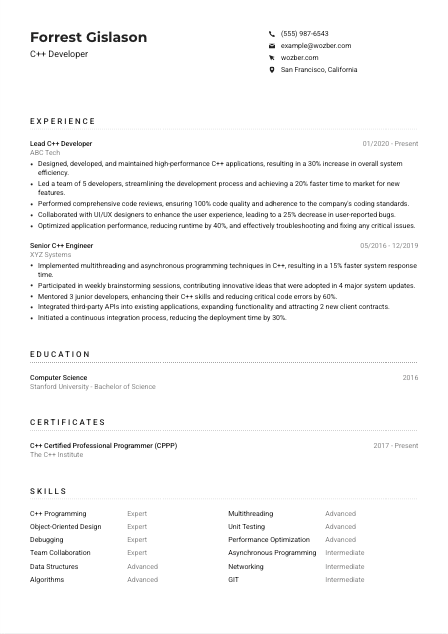
If a role specifies location, reflect it clearly in your personal details. Here, the employer asks for San Francisco, California, so listing "San Francisco, California" removes an avoidable question early. Treat this as targeted tailoring to the opening, not as a rule for every C++ CV.
Include LinkedIn, GitHub, or a personal site if it supports your candidacy with real engineering substance. For C++ developers, that could mean repositories with concurrency work, libraries, systems projects, benchmarks, or documented contributions. A link is worth adding only if it reinforces the same strengths your CV claims.
This section should remove friction, not add personality for its own sake. When your details are precise and aligned to the posting, the reader can get straight to your C++ experience and technical scope.




For C++ roles, the experience section carries most of the decision weight. This is where you show what you built, how complex the work was, what technical problems you solved, and what changed because of your contribution.
Read the description closely and extract the work themes you need to echo back in your bullets. In this case, the priorities are high-performance scalable C++ applications, code reviews, cross-functional feature delivery, troubleshooting, and performance optimisation. Those are not just keywords. They tell you which parts of your own background to emphasize and which accomplishments belong near the top.
List roles in reverse chronological order with company, title, and dates easy to scan. For technical candidates, this helps reviewers quickly place your level of ownership, from individual contributor work to mentoring, architecture input, or review responsibilities. If your most recent role includes lead or senior scope, make sure that progression is immediately visible.
Each bullet should connect a technical action to a business or engineering result. Good C++ bullets often mention optimisation, latency reduction, concurrency work, code quality, system efficiency, feature delivery, or defect reduction. The sample CV does this well with lines like reducing runtime by 40% and improving overall system efficiency by 30%, which makes the work concrete instead of generic.
Use numbers when they reflect how the work was judged. In C++ development, that might mean lower runtime, faster response time, improved throughput, fewer production bugs, faster release cycles, or better code review compliance. Metrics such as a 20% faster time to market or a 15% faster system response time tell a hiring team how your engineering decisions affected delivery and performance.
Prioritise bullets that match systems thinking, code quality, debugging, optimisation, and collaboration with engineering partners. You do not need to document every task from every job. If a bullet does not help prove your C++ depth, ownership, or relevance to the target work, remove it and make room for accomplishments that do.
A hiring manager should be able to scan this section and understand the scale of your C++ work, the problems you handled, and the results you delivered. That clarity carries more weight than a long list of duties.
Education matters most here as a qualification check and as supporting context for your technical foundation. For many C++ openings, a degree in computer science, engineering, or a related field is still a stated requirement, so present it clearly and without extra noise.
If the posting asks for a bachelor's degree in Computer Science, Engineering, or a related field, make sure your education section states that plainly. A direct match such as "Bachelor of Science, Computer Science" immediately satisfies the requirement and keeps the reviewer focused on your experience afterward.
List degree, field, school, and graduation year in a clean order. There is no need to overdesign this section. In technical hiring, readable structure matters more than decorative formatting, especially when an ATS may be parsing degree information for required qualifications.
Use the official title of your degree rather than abbreviating too heavily or rewriting it loosely. "Bachelor of Science in Computer Science" is stronger than a vague reference because it maps cleanly to what the employer requested and leaves less room for interpretation.
If you are earlier in your career, selected coursework can help reinforce relevant fundamentals such as algorithms, data structures, operating systems, computer architecture, or software design. For someone with 4+ years of experience, this is usually optional unless the courses fill an important gap or support a specialised systems profile.
Projects, programming competitions, research work, or engineering clubs can add value if they connect to C++ development, systems programming, or performance-focused problem solving. Keep them concise and only include them when they add something your professional experience does not already show.
This section does not need to carry the whole CV. It just needs to confirm the educational baseline and support the deeper technical story told in your experience.
Certifications are usually secondary for C++ hiring, but the right one can reinforce specialization and ongoing technical development. Include them when they are relevant, recognizable, and connected to the work you want to do.
Start with the job description. If no certification is required, treat this section as supporting material rather than a centerpiece. For this opening, no certificate is mandatory, but a credential like "C++ Certified Professional Programmer (CPPP)" still adds relevant depth to a systems-focused profile.
Choose certifications that strengthen your positioning as a C++ engineer, not just your general interest in technology. The best options are those linked to C++, software engineering practices, testing, performance, or adjacent technical domains you genuinely use on the job.
List issue dates or validity ranges when they help show recency or active status. In fast-moving engineering environments, recent learning can support your case, especially if the credential aligns with modern C++ practices, tooling, or quality standards.
A current certification can quietly signal that you stay engaged with your craft beyond day-to-day ticket work. That matters in roles where best practices evolve, whether around concurrency models, testing discipline, CI workflows, or maintainable code design.
This section works best when it reinforces an already credible C++ background. Relevant credentials can strengthen your profile, but they should complement real engineering achievements, not stand in for them.
A C++ skills section should read like a technical snapshot of how you work, not a grab bag of software terms. Focus on the tools, concepts, and engineering habits that support the kind of systems and application work the role requires.
The job description gives you a starting list: C++, data structures, algorithms, object-oriented design, multithreading, asynchronous programming, communication, and collaboration. Also look for implied skills behind the responsibilities, such as debugging, performance tuning, code review, testing, version control, and working across product or design teams.
Lead with hard skills central to the role, then include collaboration skills that matter in an engineering environment. For a C++ developer, that usually means keeping concepts like concurrency, optimisation, and object-oriented design near the top, while adding items such as code review, mentoring, or cross-functional collaboration only if they are backed by your experience.
Do not bury your strongest matches at the bottom. If the role emphasizes multithreading and high-performance applications, those belong above broader or less critical items. The sample CV gets this mostly right by giving prominence to C++ programming, object-oriented design, data structures, algorithms, multithreading, and performance optimisation before more peripheral skills like networking or Git.
A reviewer should be able to glance at this section and see the technical foundation for the projects in your experience section. Keep it focused on the engineering capabilities the role actually calls for.
Language requirements are usually simple, but they still matter. In software roles, clear communication affects code reviews, design discussions, documentation, and cross-team delivery, so list languages with the same accuracy you would use for technical skills.
If the posting specifies English proficiency, place English first and label it honestly. For this role, "must be adept in English" is a direct requirement, so it should not be buried beneath optional languages.
Choose straightforward levels such as Native, Fluent, Advanced, or Intermediate. Avoid vague descriptions. Technical teams rely on precise communication, and your language section should reflect that same precision.
Additional languages can be worth listing if they are real working proficiencies and relevant to your environment. They may help in globally distributed teams, client-facing engineering work, or multinational product organizations, but they are secondary to the required language.
Do not overstate fluency. If you can collaborate in standups and write documentation comfortably, say so with an appropriate proficiency level. If not, choose a lower one. Honest labeling avoids mismatched expectations later in the process.
For most C++ roles, languages should support the CV, not compete with technical content. Include them cleanly, but do not let this section become more detailed than your skills, projects, or engineering accomplishments.
This section should confirm that you can communicate effectively in the environment the role requires. Once that is clear, the focus returns to your development work and technical judgment.
The summary sits at the top of the page, so it should quickly define your technical identity, seniority, and strongest relevant contributions. For a C++ Developer, that usually means experience level, type of systems worked on, and the performance or quality outcomes you are known for.
Start with the requirements and responsibilities that matter most. Here, those include 4+ years of C++ development, strong CS fundamentals, concurrency, scalable application work, performance optimisation, and team collaboration. Your summary should reflect the parts of that list you can prove elsewhere in the CV.
A practical first line often includes your title and years of experience, followed by the type of engineering work you handle. The sample summary does this effectively by leading with more than 7 years of professional C++ experience and focusing on designing, developing, and optimising high-performance applications.
Choose strengths that map directly to the role, such as multithreaded development, performance tuning, code quality, or using algorithms and object-oriented design to solve complex engineering problems. Keep the language specific enough to separate you from a general software developer profile.
Aim for a short paragraph, usually three to five lines. Skip broad claims about passion or innovation unless the rest of the CV proves them through shipped features, measurable improvements, or technical leadership. The summary should preview the strongest parts of your experience, not repeat generic career language.
After reading your summary, the hiring team should already understand your level, your C++ focus, and the kind of engineering outcomes you deliver. That makes the rest of the CV easier to trust and faster to review.
A well-targeted C++ Developer CV makes your technical depth easy to recognize. It shows where you have built performant applications, how you have handled concurrency or debugging challenges, and what results came from your decisions in production environments.
Use Wozber's free CV builder to shape that experience into an ATS-friendly CV template, then refine it with the ATS CV scanner and AI-powered tailoring so your wording stays aligned with the job description. The final result should make one thing clear right away: you can step into the C++ work this team needs and contribute with confidence.