



Use Wozber and land your dream job
Create CV
No registration required
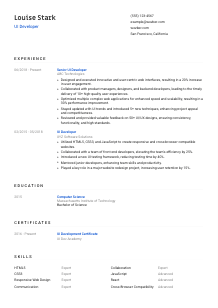
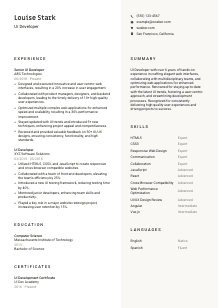
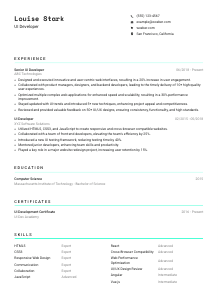
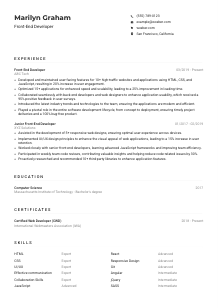
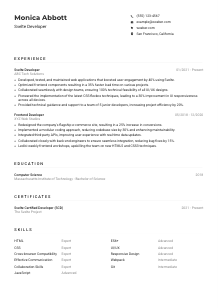
Crafting pixel-perfect interfaces, but your CV looks a bit pixelated? Check out this UI Developer CV example, created with Wozber free CV builder. Learn how to showcase your design genius and user-centricity in a way that matches job needs, making your career journey as sleek and intuitive as the interfaces you create!
UI development sits at the intersection of design intent and production code. Hiring teams want to see more than polished screens. They want proof that you can turn mockups into responsive interfaces, handle browser inconsistencies, and ship front-end work that performs well under real usage. Your CV should make that delivery record visible fast.
A tailored UI Developer CV also helps separate visual polish from actual implementation depth. When the wording reflects the target stack, front-end workflow, and performance work, hiring teams can quickly tell whether you build production-ready interfaces or mainly support design execution. Wozber's free CV builder helps structure that content into an ATS-compliant CV, so React, responsive design, performance optimisation, and cross-functional delivery are easy to read in both scans and human review.
For UI Developer roles, the header needs to do more than identify you. It should confirm core logistics quickly, especially when location, portfolio access, and role alignment affect whether your application moves forward.
Use your full name as the most prominent text on the page. Keep the styling clean and modern, much like a well-structured interface. No decorative effects, no extra labels. The goal is immediate recognition.
Place "UI Developer" directly under your name if that is the role you are pursuing. This helps recruiters and ATS tools connect your profile to the opening quickly. If your recent title was "Senior UI Developer," keep that for the experience section and use the target title here when it reflects your direction.
Make every contact line practical and professional. UI hiring moves fast, especially when teams are filling product delivery gaps, so any confusion here works against you.
Some UI roles are fully remote, but others are tied to a product team, design org, or office location. Here, the posting asks for someone based in San Francisco, California, so showing "San Francisco, California" in the header removes a predictable screening question right away.
A portfolio, personal site, or strong LinkedIn profile is especially useful in UI hiring because teams often want to see shipped interfaces, component work, or design-to-code execution. If you include a website, make sure it reflects your current standards for layout, responsiveness, and front-end polish.
This section should confirm who you are, where you are, and how to reach your work without delay. In a UI Developer CV, those basics support the faster conversation hiring teams want to have about your front-end experience.




This is where UI Developer candidates separate themselves. Hiring teams look for actual implementation work, collaboration with design and product, and outcomes tied to usability, performance, or delivery pace, not just a list of front-end duties.
Read the job description for the recurring demands behind the bullet points. In this case, the pattern is clear: build user-centric interfaces, work across product and engineering, optimise for speed and scalability, and review UI quality. Those are the themes your experience bullets should echo with real examples from your projects.
List your positions in reverse chronological order with title, company, and dates. For front-end roles, clear structure matters because reviewers often compare progression quickly, such as moving from UI Developer to Senior UI Developer or taking on broader ownership across component libraries, performance work, or design review.
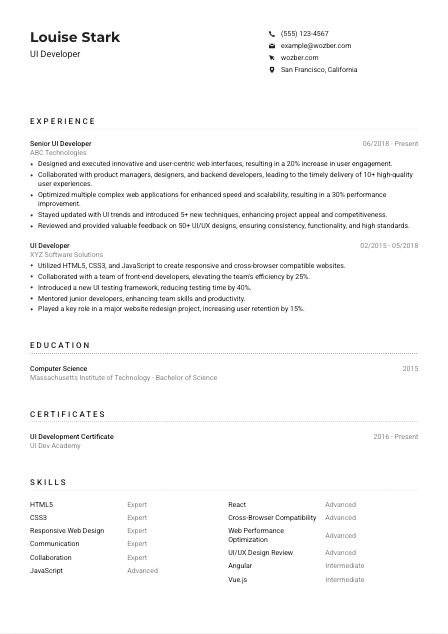
Each bullet should show what you built, how you worked, and what changed because of it. Strong UI bullets mention interface implementation, responsive behaviour, collaboration with designers or backend developers, and user-facing results. The sample does this well by tying interface work to engagement gains and design review to consistency across 50+ UI/UX designs.
Quantify impact with measures that make sense for UI development: user engagement, load-time improvement, testing time reduction, retention, delivery volume, or performance gains. Numbers like a 30% performance improvement or 10+ delivered user experiences give hiring teams a clearer picture than generic claims about quality.
Prioritise experience that matches the target role's stack and responsibilities. For this posting, that means frameworks such as React, Angular, or Vue, along with HTML5, CSS3, JavaScript, responsive design, and cross-browser compatibility. If you have broader software experience, keep it secondary unless it directly supports UI delivery, such as API integration, accessibility fixes, or design system implementation.
By the end of this section, a hiring manager should be able to see the interfaces you built, the teams you worked with, and the measurable effect of your front-end decisions. That is the level of detail that moves a UI Developer CV forward.
Education usually is not the most heavily weighted section for experienced UI Developers, but it still matters when the posting names a degree requirement. Keep it clear, relevant, and aligned with the technical foundation the role expects.
If you hold a degree in Computer Science, Web Design, or a related field, place it first and state it plainly. That directly addresses the educational requirement. In the example, a Bachelor of Science in Computer Science does this immediately.
List degree, school, and graduation year in a straightforward order. UI hiring teams should not have to interpret this section. Clean structure also supports ATS parsing, which matters when degree requirements are used as an early filter.
When your degree is directly related to front-end development, that connection does useful work for you. A Computer Science background suggests depth in programming fundamentals, while a Web Design path may reinforce interface and usability grounding. Use the exact field name rather than a vague abbreviation.
If you are earlier in your career, include coursework or academic projects tied to UI development, such as web application development, human-computer interaction, responsive design, or JavaScript frameworks. For more experienced candidates, include this only if it adds something your work history does not already show.
Honors, technical clubs, hackathons, or design competitions can help when they reinforce front-end collaboration or product building. If you already have several years of UI experience, keep these mentions brief so the section stays in proportion to your professional work.
This section should quickly confirm that you meet the stated degree requirement and have the technical foundation to support modern front-end work. Then let your experience carry the heavier weight.
Certifications are rarely the deciding factor for UI Developer hiring, but they can strengthen your CV when they point to current tools, front-end practices, or interface specialization. Present them as relevant professional development, not filler.
The job description does not require certifications, so only include ones that sharpen your case. Prioritise certificates in UI development, front-end frameworks, accessibility, web performance, design systems, or UI testing over broad unrelated credentials.
A short list of well-matched credentials works better than a long catalogue. If a certificate supports work in React, Angular, Vue, performance optimisation, or interface review, it is more useful than something generic. The sample's UI Development Certificate fits because it reinforces continuing specialization in the field.
Dates help recruiters understand whether the knowledge is current. That matters in UI development because frameworks, browser behaviour, and implementation patterns change quickly. If a credential expires or requires renewal, make sure the timeline is accurate.
UI work evolves fast, especially around component architecture, accessibility standards, performance tooling, and testing workflows. If you regularly take courses or earn certificates in these areas, this section becomes a useful indicator that your skills are staying current with modern front-end practice.
A focused certificate section can support your CV by showing continued investment in front-end craft. Keep it tied to tools, standards, and methods that matter in UI delivery today.
UI Developer skills should read like a practical build environment, not a grab bag of buzzwords. Recruiters and ATS tools look for the stack, implementation capabilities, and collaboration skills that connect directly to interface delivery.
Start with the named requirements and then expand only where your experience supports them. Here, the essentials include HTML5, CSS3, JavaScript, modern frameworks such as React, Angular, or Vue.js, responsive web design, cross-browser compatibility, and collaboration. Those belong near the top because they map directly to the role.
List the skills most central to day-to-day UI work first. Technical skills should lead, followed by supporting strengths like communication and collaboration. If your background is stronger in one framework, place that higher. The example does this effectively by showing HTML5, CSS3, JavaScript, React, responsive design, and performance-related skills together.
Avoid padding this section with every tool you have touched once. A shorter, better-matched list is easier for hiring teams to read and easier for ATS systems to parse accurately. Wozber's ATS CV scanner can help you compare your skill wording with the posting, surface missing terms, and tighten the section around the front-end capabilities the role emphasizes.
When this section is done well, a reviewer can quickly tell which front-end stack you work in, how you handle responsive implementation, and whether your skill mix fits the product environment behind the opening.
Language skills matter in UI work when the role involves cross-functional collaboration, documentation, design review, or customer-facing product teams. Keep this section practical and tied to communication needs, not decoration.
Some UI Developer postings mention language skills because the role involves close collaboration with designers, product managers, or distributed teams. Here, professional English proficiency is listed as essential, so that language should appear clearly on your CV.
Lead with the language the job asks for and state your level plainly. In this case, English belongs at the top. If your proficiency is native or fluent, say so directly so there is no ambiguity about your ability to work in meetings, reviews, and written communication.
Additional languages can help if you work with international teams, multilingual products, or global user bases. They are a secondary advantage, though, so keep the section grounded. In the example, Spanish adds breadth without distracting from the required English proficiency.
Choose clear levels such as Native, Fluent, Intermediate, or Basic. That gives hiring teams a realistic sense of how you can contribute in standups, documentation, stakeholder communication, or design feedback sessions.
For UI roles, language ability often matters less for translation and more for collaboration. Clear English can affect how efficiently you handle design critiques, document component behaviour, and coordinate with backend engineers or product stakeholders.
This section should confirm that you can operate comfortably in the team's working language and, where relevant, bring added flexibility in cross-border or multilingual environments.
Your summary should give a hiring team a quick read on your level, your front-end focus, and the kind of outcomes you produce. For UI Developer roles, that means combining implementation depth with user experience impact in a few efficient lines.
Start by identifying the few themes that define the opening. Here, those are modern front-end development, responsive and user-centric interfaces, collaboration across teams, and performance optimisation. Your summary should reflect those themes in natural language rather than repeating the posting word for word.
Lead with a direct statement of who you are and how long you have been doing the work. A line like "UI Developer with 6+ years of experience building responsive web interfaces" is specific enough to orient both the recruiter and the engineering team immediately.
Use one or two concrete achievements or focus areas to prove your value. The sample summary works because it pairs interface development with collaboration and performance gains. If you have metrics like engagement improvement, faster load times, or reduced testing cycles, use them selectively to ground the summary in real delivery.
Aim for 3 to 5 lines. That is enough space to cover your experience level, technical focus, and one or two differentiators without turning the summary into a paragraph-long biography. Every sentence should support your case for this UI role specifically.
A hiring team should be able to read these opening lines and immediately understand your level, your stack, and the kind of interface work you deliver. That sets up the rest of the CV to confirm the details.
Once these sections are aligned, your CV should show a clear front-end story: the interfaces you built, the frameworks you used, the teams you worked with, and the business or user outcomes you improved.
Wozber's free CV builder can help you organise that story in an ATS-friendly CV format, and its ATS CV scanner can sharpen how your wording matches the target posting. The finished CV should make one thing easy to judge. You can turn UI requirements into production-ready, user-focused web experiences.