



Use Wozber and land your dream job
Create CV
No registration required
Working through data, but your CV lacks discovery? Explore this Researcher CV example, created with Wozber free CV builder. Learn how to bring your investigative prowess into a format that matches the job, guiding your career journey toward groundbreaking insights!
Research work is judged through a small set of hard-to-fake signals: the quality of your questions, the rigor of your methods, and what your work actually produced. A Researcher CV needs to make those signals visible fast through study focus, analytical depth, publications, grants, lab or project scope, and the outcomes tied to your investigations.
The first screening pass often separates candidates with real research ownership from those who mostly supported execution. Using Wozber's free CV builder helps you shape an ATS-compliant CV around the language of the target posting, so hiring teams can quickly see your experience with data analysis, scientific communication, collaboration, and independent research delivery.
Research hiring is detail-sensitive from the start. If your contact information, title, or location is incomplete, the application can lose momentum before anyone reaches your publications, methods, or project results.
Place your full name at the top in a clean, readable style. In research hiring, clarity matters more than design flourishes. Your header should feel as organised as the rest of your work, especially when your CV may be reviewed alongside publication lists, grant materials, or conference records.
Add "Researcher" directly below your name when that is the role you are targeting. This creates an immediate match with the posting and helps frame the rest of the CV around research ownership, analytical work, and scientific communication rather than a broader academic or laboratory support profile.
List a reliable phone number and a professional email address, then check them carefully. Research hiring often moves through multiple reviewers, including principal investigators, lab leads, and HR, so your contact details need to be simple to find and correct on the first read.
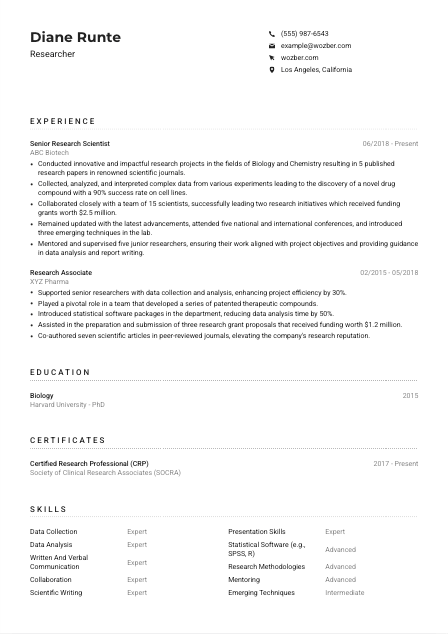
If a position specifies geography, show it clearly. Here, Los Angeles, California is part of the stated requirement, so listing that location helps remove an avoidable question. Use this kind of tailoring only when the posting makes location relevant, not as a rule for every Researcher CV.
Include LinkedIn, a faculty or lab profile, ORCID, Google Scholar, or a personal site if it strengthens your candidacy. For researchers, a link is most useful when it shows publications, projects, conference activity, or collaboration history rather than a generic online presence.
This section should confirm that you are reachable, professionally presented, and aligned with any stated application requirements. Wozber's free CV builder helps keep those essentials clean, ATS-friendly, and ready for a closer look at your research record.




The experience section carries the most weight for many Researcher roles because it shows how you handled real studies, real data, and real scientific or commercial outcomes. Hiring teams look for signs of independent contribution, methodological strength, and results that travelled beyond the bench or dataset.
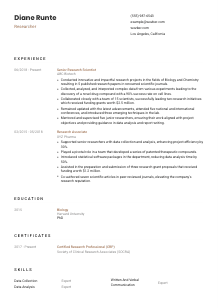
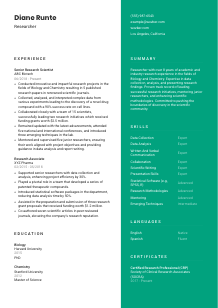
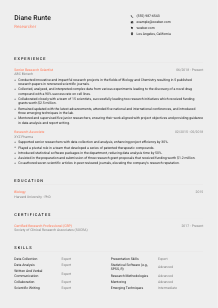
Read the job description closely, then align your bullets with the work the employer needs done. If the role emphasizes data collection, analysis, publications, collaboration, and mentoring, those themes should appear in your experience. In the example CV, the strongest bullets connect experiments and analysis to concrete outputs such as published papers, funded initiatives, and a novel drug compound.
Start with your most recent position so reviewers can quickly gauge your current level of research responsibility. For a Researcher, this helps them see whether you are leading studies, contributing to study design, supervising junior staff, or supporting principal investigators. An ATS-friendly CV format also keeps titles, employers, and dates easy to parse.
Use metrics that belong naturally in research work. Good examples include number of publications, grant amounts, patents, study success rates, reduction in analysis time, number of researchers supervised, or scale of collaboration. The sample CV does this well by citing five published papers, $2.5 million in grant funding, and a 50% reduction in analysis time after introducing statistical software.
Select accomplishments that match the field and level of the job you want. A biology, chemistry, or physics research role may value different methods, instruments, and outputs, so trim unrelated detail and emphasize the work closest to the posting. If a role calls for multidisciplinary collaboration, mention cross-functional projects, external partners, or grant work instead of listing general duties.
Keep each bullet concise, specific, and outcome-focused. Start with the action, name the method or scope when useful, and end with the result. That style mirrors strong scientific writing. "Collected, analysed, and interpreted complex data" is stronger when followed by what the analysis enabled, such as a discovery, publication, process improvement, or funded next phase.
Your experience section should show what kind of research you can run, improve, or support, and what came from that work. Wozber's ATS CV scanner can help you line up your accomplishments with the posting's methods, collaboration needs, and output expectations.
For Researchers, education is more than a credential check. It places your subject-matter foundation, shows the depth of your training, and often signals the kind of research environments where you are most prepared to contribute.
Put the most advanced and most relevant qualification first. When a posting asks for a Master's or PhD in a field such as Biology, Chemistry, Physics, or a related discipline, your education section should surface that match immediately. In the example, the PhD in Biology and Master's in Chemistry line up closely with the employer's stated academic preference.
List degree, field, institution, and graduation year in a consistent format. Researchers often have layered academic histories, and a tidy structure helps reviewers quickly understand your training path. If you also want to highlight thesis work, dissertation focus, or lab specialization, add that only when it strengthens the match for the role.
When you hold multiple degrees, give the clearest visibility to the ones that support the target role's field. A broad scientific background can be valuable, but the hiring team usually wants to see the most applicable discipline first. For example, biology and chemistry credentials should be prominent when the work involves life sciences research.
Awards, fellowships, major thesis projects, dissertation topics, or significant published academic work can help, especially earlier in your career or when applying to research-intensive environments. Keep these additions selective and tied to your scientific direction rather than treating the education section like a full academic CV.
Use official degree titles and accurate completion years. Research employers often cross-check academic history, especially when advanced study is a formal requirement. Precision here supports credibility and keeps your ATS optimisation clean and consistent.
This section should make your academic preparation easy to understand and closely tied to the field you want to work in. With Wozber's free CV builder, you can keep degree information structured clearly enough for both ATS parsing and human review.
Certifications are rarely the headline in Researcher hiring, but the right ones can reinforce methodological discipline, regulatory awareness, or subject-specific expertise. They work best when they support the kind of research environment you are targeting.
Focus on certifications connected to the research setting, methods, or compliance standards in your field. Depending on the role, that could include Good Laboratory Practice, human subjects research, clinical research, biosafety, or advanced statistical training. Add them when they sharpen your profile, not just to fill space.
A short list of useful certifications carries more weight than a long list of marginal ones. In the example, CRP and GLP make sense because they point to structured research practice and regulated environments. For other Researcher roles, different certifications may be more relevant, so tailor this section to the posting and field.
For each certification, list the issuing organisation and the date earned or validity period. That gives the credential context and helps reviewers distinguish active, recognized qualifications from informal short courses. It also keeps the section ATS-readable.
Research methods, compliance expectations, and analytical tools change over time. Update this section as you complete new training or renew relevant credentials. Recent certifications can be especially useful when they support emerging techniques or specialised methodologies mentioned in the job description.
A well-chosen certification section can show research discipline, technical development, and readiness for specific environments such as regulated labs or clinical settings. Wozber helps you present those credentials in an ATS-friendly CV format without letting them overshadow your core research experience.
A Researcher skills section should read like the toolkit behind your studies, not a grab bag of vague strengths. Focus on the methods, analytical capabilities, communication skills, and collaboration habits that support research execution and reporting.
Start with the stated requirements, then add closely related terms you genuinely use. In this case, data collection, data analysis, statistical software, written and verbal communication, collaboration, and research methodologies all belong near the top because they describe the day-to-day work of the role.
Researchers are expected to generate findings and explain them. Pair technical abilities such as statistical software, experimental design, literature review, or methodology selection with communication skills such as scientific writing, presenting findings, and cross-functional collaboration. The sample CV handles this balance well by listing both analysis strengths and presentation-related capabilities.
Keep the list selective and ordered around the job. Put the skills most likely to affect screening decisions first, especially those named in the description. If the employer highlights statistical software, do not bury "R" or "SPSS" behind generic items. This helps both ATS optimisation and reviewer speed.
This part of the CV should quickly show how you collect evidence, analyse it, communicate it, and work with others around it. Wozber's free CV builder makes it easier to align that skill mix with the terminology used in the target Researcher posting.
Language ability matters in research when it affects reporting, presentations, collaboration, publication work, or participation in international projects. Keep this section practical and tied to how you communicate in professional settings.
If the posting states a language requirement, list it prominently. Here, English proficiency is explicitly required, so English should appear first with an accurate level. That gives the employer a quick answer on a stated hiring condition.
After the required language, include other languages only if they are useful and honestly represented. In research settings, an additional language can help with conference participation, multinational teams, literature access, or external partnerships. The example's Spanish entry adds breadth without distracting from the required English fluency.
Choose straightforward levels such as Native, Fluent, Advanced, or Conversational. Avoid vague wording that leaves others guessing whether you can present findings, write reports, or collaborate effectively in that language.
Not every Researcher role needs multiple languages, so keep this section proportional. If the role involves international consortia, fieldwork, or diverse stakeholder communication, language skills become more relevant. If not, a short and accurate section is enough.
Only claim the level you can use in real professional contexts, whether that means presenting at a workshop, discussing methods with collaborators, or writing technical material. Credibility matters here just as much as it does in the rest of a research CV.
Your language section should confirm that you can meet required communication demands and, where relevant, contribute across broader research networks. Keep it concise, accurate, and clearly tied to the work.
The summary is where you establish your scientific profile in a few lines. It should quickly state your field, level of experience, core research strengths, and the kinds of outputs or responsibilities that define your work.
Open with your title, years of experience, and domain focus. For a Researcher, that may include academic, industry, clinical, laboratory, or interdisciplinary work depending on your background. The sample summary does this effectively by naming 8+ years of experience and grounding it in Biology and Chemistry.
Bring in two or three strengths that match the posting closely, such as data collection, data analysis, statistical software, scientific communication, or multidisciplinary collaboration. Keep the language natural and role-specific so the summary supports both ATS matching and human review.
Use a brief phrase that points to what your work has produced. That might be publications, grant-supported projects, process improvements, patented compounds, mentoring responsibility, or adoption of new methods. This gives the summary substance beyond a list of traits.
Aim for a compact paragraph that sounds like a scientist describing a research profile, not a generic personal statement. Avoid broad claims about passion or innovation unless the rest of the CV clearly supports them. A few precise details will carry more weight than sweeping language.
When this section is written well, it prepares the reader for the methods, outcomes, and research scope they will see in your experience. Wozber's ATS optimisation tools can help you tune that opening paragraph to the posting's terminology while keeping it grounded in your actual work.
A Researcher CV works best when each section answers a practical question: what have you studied, how have you worked, and what did that work produce? When your degree, methods, publications, collaboration history, and mentoring scope are all easy to trace, the hiring team can judge your research maturity quickly and fairly.
Use Wozber's free CV builder and ATS tools to align your content with the posting, strengthen phrasing around methods and outcomes, and present everything in an ATS-friendly CV format. The finished CV should make your ability to contribute to serious research work easy to recognize.




