



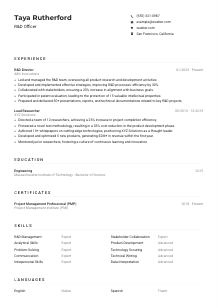
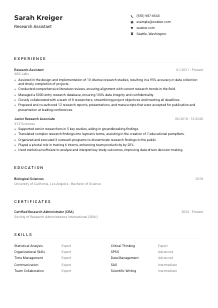
Use Wozber and land your dream job
Create CV
No registration required
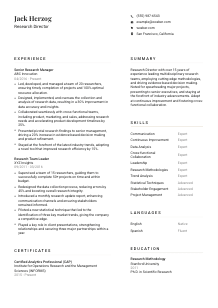
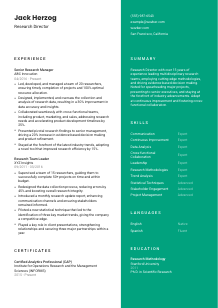
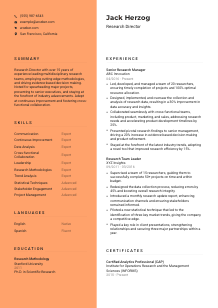
Leading groundbreaking investigations, but your CV seems to be in the shadows? Shedding light, this Research Director CV example, created with Wozber free CV builder, shows how to strategically highlight your scientific sagacity to align with top-tier positions, placing your career at the forefront of innovation.
Research Director hiring turns quickly on one question: can you lead research that stands up methodologically and still move business decisions forward. Senior candidates often have deep technical backgrounds, but CVs miss the mark when they describe research activity without showing team leadership, cross-functional influence, or the quality of decisions their work shaped.
A tailored CV changes how that leadership is read in both human review and ATS screening. When your summary, experience, and skills use the same language the employer uses for research design, statistical analysis, stakeholder presentations, and team oversight, Wozber's free CV builder helps you assemble an ATS-compliant CV that makes your scope and research credibility visible much faster.
For a Research Director, the header should confirm practical eligibility right away and stay focused on professional identity. Keep this section clean, current, and aligned with the level of responsibility attached to research leadership roles.
Use your full name as the main heading and place "Research Director" directly beneath it when that is the role you are pursuing. This immediately frames your application at the right seniority level and avoids any ambiguity about whether your background is aimed at hands-on research, people management, or executive oversight.
List a reliable phone number and a professional email address you check regularly. At this level, small errors in contact information look careless, especially for a role that involves presenting findings to senior stakeholders and running complex research programs with precision.
Some Research Director openings have a firm location requirement because the work involves close collaboration with product, marketing, sales, or executive teams. In the example here, San Francisco, California is worth stating clearly in the header because it answers a stated requirement before anyone has to search for it.
Include a LinkedIn profile or personal site if it adds useful depth, such as publications, conference speaking, research portfolio material, or leadership credentials. Make sure the content matches your CV, especially around titles, dates, and major projects.
Skip details that do not strengthen your case for leading research, such as age, marital status, or other personal identifiers. Save the space for information that supports your credibility, availability, and alignment with the role.
This section should tell the employer who you are, how to reach you, and whether you meet any immediate practical requirement such as location. For a senior research hire, that clarity matters from the first line.




This is where a Research Director CV earns its authority. Hiring teams look for proof that you have led research teams, chosen sound methods, improved research operations, and turned findings into decisions that mattered to product, commercial, or executive stakeholders.
Read the job description for the real operating demands behind the title. Here, the important themes are multidisciplinary team leadership, rigorous research design, data analysis, stakeholder communication, and continuous improvement. Those themes should guide which achievements you select and how you phrase them.
List your experience in reverse chronological order and give the most space to positions where you directed research strategy, managed teams, or owned major programs. For a Research Director application, titles such as Senior Research Manager or Research Team Leader naturally carry more weight than earlier specialist roles, especially when the bullets show scope.
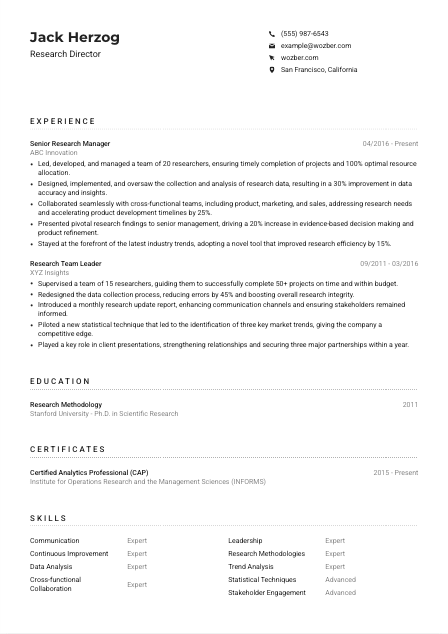
Each bullet should show what you led, how you did it, and what changed because of it. The example CV does this well with results like improving data accuracy by 30 percent, accelerating product development timelines by 25 percent, and increasing evidence-based decision making by 20 percent. That kind of phrasing shows research as an operational and strategic function, not just a support activity.
Numbers help hiring teams gauge scale. Include team size, project volume, budget ownership if relevant, turnaround improvements, error reduction, adoption of new methods, or the commercial effect of your research. Managing 20 researchers, delivering 50+ projects, or reducing data collection errors by 45 percent gives far more context than broad claims about leadership or excellence.
Prioritise bullets that reflect leadership, methodology decisions, cross-functional influence, and stakeholder communication. If a detail does not help show that you can run research programs, allocate resources, and present credible findings to senior decision makers, trim it or rewrite it so the business value is clear.
Your experience section should make it easy to see the size of the teams you led, the rigor of the work you oversaw, and the decisions your research informed. That is the clearest path from past roles to a Research Director seat.
Advanced research leadership usually rests on a strong academic foundation, so the education section matters more here than it might in some other senior roles. Keep it concise, but make the level and relevance of your training unmistakable.
When a posting calls for a Master's or Ph.D. in a scientific or related field, place that qualification where it is easy to find. In this example, a Ph.D. in Scientific Research and a Master of Science in Physics line up strongly with the employer's stated preference and reinforce depth in research methodology.
List each entry with school, degree, field of study, and graduation year or completion date. For senior research roles, clarity matters more than decoration. Reviewers want to confirm discipline relevance and degree level quickly, especially when they are comparing candidates with similar leadership backgrounds.
If your field of study connects directly to research design, analytics, experimentation, or a domain central to the employer's work, make that connection obvious through the degree and field wording. That is more useful than leaving the field broad or generic.
For most experienced Research Directors, you do not need to list coursework. Add thesis topics, dissertations, honors, or major academic distinctions only if they reinforce a specialised research background, a technical methodology, or subject-matter authority relevant to the target role.
Awards, fellowships, publications, or research-intensive affiliations can add value when they support your authority as a senior research leader. Keep them if they sharpen your profile. Leave them out if they distract from more recent professional impact.
This section should quickly confirm that you meet the role's academic bar and bring training that supports rigorous research leadership. For senior positions, that foundation matters most when it reinforces the work you have already delivered.
Certifications are not always mandatory for a Research Director, but the right ones can strengthen your profile around analytics, program oversight, and research operations. Use this section to reinforce capabilities that the role values, not to list every credential you have earned.
If the employer mentions certifications such as CAP or PMP, include them when you hold them. In this role, those credentials support two useful signals: analytical rigor and the ability to manage complex research work across teams, timelines, and stakeholders.
Prioritise certifications that strengthen your positioning in research methodology, analytics, data interpretation, project leadership, compliance, or sector-specific expertise. A short, relevant list works better than a long catalogue of marginal credentials.
Include earned dates and renewal ranges when the credential has an active status or continuing education expectation. That helps reviewers understand whether the certification is current and whether you maintain professional standards in evolving areas like analytics or project delivery.
Research leadership changes with new methods, tooling, and expectations around data quality and reporting. Recent certifications or maintained credentials can show that you still invest in how research is run, analysed, and communicated, even after reaching senior leadership levels.
Well-chosen certifications add weight when they support the kind of research, analytics, or program leadership the job requires. Keep this section focused on credentials that sharpen your value as a director-level hire.
A Research Director skills section should read like an executive snapshot of how you lead research, not a generic mix of buzzwords. The best lists combine research depth, analytical judgment, and the collaboration skills needed to move findings across teams and into decisions.
Pull directly from the posting and identify the capabilities that shape day-to-day success. Here, that includes research methodologies, data analysis, statistical techniques, team leadership, stakeholder communication, and cross-functional collaboration with product, marketing, and sales.
Include both the analytical side of the role and the management side. Skills such as statistical techniques, trend analysis, and research design show methodological strength, while leadership, stakeholder engagement, and project management show you can direct a team and carry findings into action.
Lead with the skills most central to the employer's needs rather than listing everything equally. In the sample CV, placing Research Methodologies, Data Analysis, Leadership, and Cross-functional Collaboration near the top makes sense because those capabilities sit at the centre of the role's responsibilities.
Your skills section should confirm that you can run high-quality research and lead the people and conversations around it. When the ordering is deliberate, the section supports both ATS matching and quick executive review.
Language skills matter for Research Directors when the role involves stakeholder presentations, cross-regional teams, external partners, or international research contexts. Even when only English is required, list languages in a way that is clear and professionally useful.
If the posting specifies fluent English, make that explicit. For a Research Director, strong written and spoken English supports report writing, executive presentations, methodology discussions, and cross-functional communication, so it should never be left implied.
Additional languages can be valuable when research spans markets, participant groups, or global teams. A second language will not replace core research leadership credentials, but it can strengthen your ability to manage broader collaboration or communicate findings across regions.
Stick to standard terms such as native, fluent, intermediate, or basic. Hiring teams need an honest sense of how well you can operate in meetings, presentations, and written communication, especially if multilingual stakeholder work is part of the position.
Not every Research Director role needs multiple languages. Include them when they support the scope of the work, such as international studies, multicultural audiences, or global internal teams. In other cases, a simple English entry may be enough.
Frame language skills as part of how you work, not as decoration. If you can present insights, build relationships, or interpret context across language boundaries, that can strengthen your profile in research organizations with broad stakeholder reach.
For this section, clarity matters more than volume. Show the language ability that supports your communication range and the environments in which you can lead research effectively.
The summary should quickly establish your level, your research leadership scope, and the kind of outcomes your work produces. For a Research Director, that usually means connecting methodology, team leadership, and business influence in a few tightly written lines.
Start by stating your title or professional identity along with your years of experience and core area of strength. For example, "Research Director with 15+ years leading multidisciplinary research teams" gives immediate context and anchors the reader in both level and scope.
Choose two or three strengths that matter most for the target role, such as research methodology, statistical analysis, team development, executive presentation, or cross-functional partnership. The sample summary works because it ties leadership and evidence-based decision making together, which is exactly the kind of connection employers look for in senior research hires.
Aim for a short paragraph that earns every word. Replace broad claims with direct wording about what you lead, improve, or influence. Terms like "drove evidence-based decision making" or "led major research programs" carry more weight than generic statements about passion or results.
If the employer leans heavily on team leadership, stakeholder communication, or data rigor, reflect that emphasis in the summary. This is one of the fastest places to align your CV with the posting and show that your background matches the kind of research leadership they need.
A well-built summary should make the reader expect strong leadership, sound research judgment, and credible stakeholder influence before they reach the experience section. For a Research Director, that first impression should already feel senior and specific.
A Research Director CV should now show more than years of experience. It should make your team leadership, methodological rigor, analytical depth, and stakeholder influence easy to trace from the first lines through your experience bullets.
Use Wozber's free CV builder, ATS-friendly CV templates, and ATS CV scanner to tighten the language around the role, improve ATS optimisation, and present your background in a format that keeps the focus on your research leadership. The finished CV should make it clear that you can lead research programs others rely on.