



Use Wozber and land your dream job
Create CV
No registration required
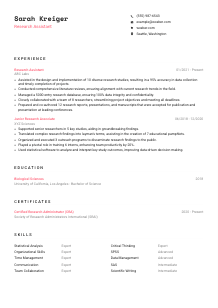
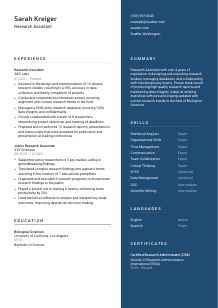
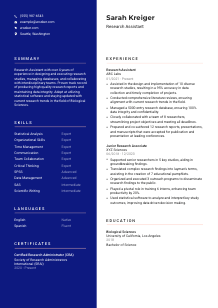
Unraveling mysteries, but your CV is still an enigma? Check out this Research Assistant CV example, created with Wozber free CV builder. It shows how to present your data-digging skills to match job requirements, helping your research journey lead straight to a career breakthrough!
Research Assistant hiring turns quickly on whether your CV shows real research support work, not just academic interest. Teams want to see how you contribute to study design, data collection, literature review, database upkeep, analysis, and publication support in environments where deadlines, data quality, and documentation all matter.
A tailored CV helps your experience read in the same language as the role, especially when applicant tracking systems scan for terms tied to methodology, statistical software, reporting, and research operations. Wozber's free CV builder helps you shape an ATS-friendly CV format around those requirements so hiring teams can more easily see where you have already handled the study coordination, analysis, and written deliverables the job calls for.
For a Research Assistant, the contact section should remove friction immediately. Hiring teams need to know who you are, how to reach you, and, when relevant, whether you already meet practical requirements such as location for on-site lab, clinical, or faculty-supported work.
Your name should be the most visible text at the top of the page. Keep it simple, readable, and consistent with the name you use in publications, campus systems, or professional profiles so there is no confusion when your CV is compared with application records or manuscript credits.
Place "Research Assistant" directly under your name if that is the role you are pursuing. This gives immediate context and helps align your CV with the posting, especially when the employer is screening candidates across adjacent titles such as research coordinator, lab assistant, or junior research associate.
List a reliable phone number and a professional email address. Research hiring often involves interview scheduling across faculty, project managers, and HR, so accuracy matters. If you include a website or profile, make sure it supports your application with relevant publications, project work, or academic credentials rather than unrelated content.
Some Research Assistant jobs are flexible, but others require local availability for lab access, participant sessions, or campus-based collaboration. Here, the posting asks for Seattle, Washington, so showing Seattle clearly in your personal details answers that logistical question right away.
A LinkedIn page, university profile, or personal academic site can strengthen this section when it reinforces your CV with posters, publications, project summaries, or software familiarity. Keep the information aligned with your CV so your research background reads consistently across every source.
This section should confirm basic eligibility without distracting from your research experience. Clean contact details and the right title help the reader move quickly to the work that proves you can support studies, manage data responsibly, and collaborate with a research team.




Research Assistant CVs are won or lost in the experience section. This is where you show how you supported the research process in practice, from study setup and participant-facing work to database management, statistical analysis, and written outputs for reports or publication.
Before writing bullets, isolate the responsibilities and requirements that define the role. In this case, the important threads are research design support, data collection and analysis, literature reviews, database integrity, collaboration with faculty or team members, and preparation of reports or manuscripts. Those themes should shape which accomplishments you choose and how you phrase them.
List roles in reverse chronological order and include job title, organisation, and dates for each entry. That straightforward structure matters in research hiring because reviewers often want to track progression from assistant-level support into more independent work such as analysis, database ownership, or manuscript preparation.
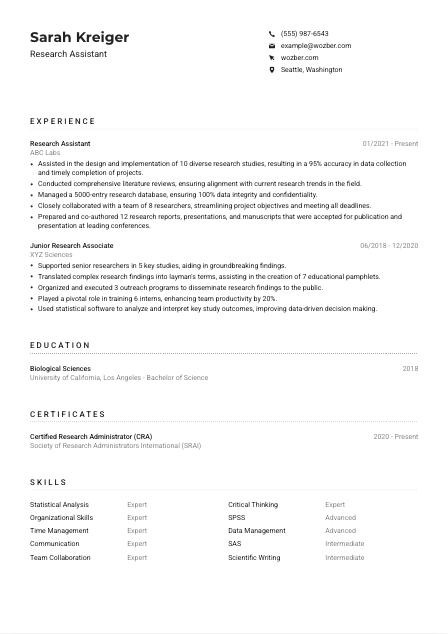
Focus each bullet on what you actually handled and what changed because of your work. Good Research Assistant bullets mention study volume, sample handling, literature review scope, reporting contributions, database accuracy, or team coordination. The example CV does this well by showing involvement in 10 studies, co-authoring 12 reports and manuscripts, and collaborating with a team of 8 researchers.
Use metrics that fit research operations: number of studies supported, database size, reporting output, accuracy rates, participant volume, turnaround time, or deadlines met. "Managed a 5000-entry research database" says much more than "responsible for data management" because it shows scale and trust. Quantification should clarify your scope, not pad the section.
Not every past duty belongs here. Keep the emphasis on methodology, statistical software, data collection, analysis support, writing, and cross-functional coordination. If you have outreach or training experience, include it only when it supports the role, as in the sample where intern training and translating findings show communication strength without replacing the core research work.
After this section, the reader should understand the kind of studies you have supported, the tools and processes you have worked with, and the level of responsibility you carried. Make it easy to see that you can step into active research operations and contribute from day one.
Education matters in Research Assistant hiring because it often establishes subject-area grounding before your experience is reviewed in detail. A degree in a relevant discipline helps explain your familiarity with research methods, scientific reading, ethics, and the vocabulary of the field.
Start with the educational baseline named in the posting. Here, the employer asks for a bachelor's degree in a related field such as Biological Sciences or Psychology. If your degree matches directly, state the degree type and field clearly so that requirement is easy to confirm.
List your degree, school, and graduation date in a clean, conventional order. This section does not need decoration. It needs to make your academic background immediately understandable, especially if the role sits within a university, lab, hospital, or grant-funded research team.
Your major should be visible because it helps connect your background to the type of research being done. In the example, a Bachelor of Science in Biological Sciences aligns naturally with research support involving data collection, literature review, and scientific reporting. If your degree is in a neighboring field, make that relevance obvious elsewhere in the CV through projects, methods, or domain-specific experience.
If you are early in your career, relevant coursework can help fill in methodological depth. Courses in research methods, statistics, experimental design, behavioral science, biology, or data analysis can support your case when your professional experience is still growing. Skip this if you already have enough full-time research experience to carry the CV.
Senior thesis work, lab projects, research assistantships, conference posters, or honors can be useful when they show study design, data handling, or scientific writing. Keep these additions targeted. They should reinforce your ability to contribute to real research workflows, not turn the section into a full academic transcript.
Your education should confirm that you have the academic base to work in the field and understand research practice. If the degree is directly aligned and clearly presented, the reader can move quickly to the experience that shows how you have applied it.
Certifications are rarely the deciding factor for a Research Assistant role, but they can add useful context when they reflect research administration, compliance, data handling, or specialised methods. Include them when they strengthen your credibility, not simply to fill space.
Some research roles require training in areas such as human subjects protection, Good Clinical Practice, lab safety, or research administration. This posting does not require a certification, so treat this section as an optional enhancer rather than a core qualification.
Prioritise certifications connected to study coordination, compliance, data stewardship, or research operations. The example's "Certified Research Administrator (CRA)" adds relevant professional context because it supports the candidate's experience with organised, deadline-driven research work.
If a certification is active, recently earned, or renewed, include the date range. In research settings, current training can matter when teams handle regulated data, grant processes, or publication workflows and need to know your knowledge is up to date.
Research methods, software, and compliance expectations change over time. A concise list of relevant certificates can show that you keep your practice current, whether through formal credentials in research administration or targeted training in analytics, ethics, or documentation standards.
A well-chosen certificate can reinforce your professionalism and readiness for structured research work. Keep only the credentials that support the kind of studies, data practices, or administrative discipline the role requires.
The skills section should reflect how research work actually gets done. Employers want to see a mix of technical capability, data discipline, and collaboration skills that match the flow of study support work from collection and analysis through reporting and team coordination.
Pull out the skills the employer names explicitly and the ones implied by the responsibilities. Here that includes research methodology, data collection, statistical software, organisation, time management, written and verbal communication, and teamwork. Those are the anchors for your section.
If you have hands-on experience with SPSS, SAS, Excel, survey tools, database platforms, or scientific writing, list them with the level of proficiency you can defend in an interview. The sample CV handles this well by separating broader capabilities like statistical analysis and data management from tool-specific entries such as SPSS and SAS.
Choose skills that support the day-to-day work of a Research Assistant rather than listing every capability you have picked up. A focused list might combine statistical analysis, literature review, data management, scientific writing, time management, and team collaboration. That tells a clearer story than a long, generic inventory.
Your skills should show that you can operate inside the research workflow, handle data carefully, communicate findings clearly, and stay organised when several study tasks move at once. Relevance matters more than volume.
Language skills can matter in research, but their value depends on the setting. For some roles, English proficiency is simply a baseline for documentation, meetings, and report writing. In others, additional languages help with participant communication, community outreach, or cross-border collaboration.
This role specifically requires effective communication in English, so English should appear clearly in your languages section if you choose to include one. That matters because Research Assistants often write summaries, contribute to manuscripts, communicate with team members, and document data in shared systems.
Order languages by relevance to the role. If English is required, list it first and note your proficiency level accurately. This keeps the section aligned with the posting instead of making the employer search for a stated requirement.
Additional languages can strengthen your CV when they are useful for participant interaction, multilingual literature review, public-facing research communication, or collaboration across institutions. In the example, Spanish adds range, but it remains secondary to the required English communication skills.
Use clear labels such as Native, Fluent, Intermediate, or Basic. Research teams rely on precise communication, so avoid overstating your level. If you can conduct interviews, explain study procedures, or write comfortably in a language, your proficiency should reflect that honestly.
For a local, English-based role, this section can stay brief. If the work involves diverse populations, international projects, or multilingual source material, language skills may carry more weight. Keep the section proportionate to the actual demands of the position.
When language ability affects participant communication, documentation, or collaboration, it is worth showing. For this kind of role, the key point is simple: make your English communication ability easy to confirm, then add other languages only if they deepen your relevance.
Your summary should read like a concise research profile, not a generic objective statement. In a few lines, it should tell the employer what kind of Research Assistant you are, what parts of the research process you support well, and which tools or outputs define your experience.
Start with the core work the job requires. For a Research Assistant, that usually means some combination of study implementation, data collection, literature review, statistical analysis, database management, and research writing. Build the summary around the parts of that workflow you have already handled.
A direct opening works best here. The sample uses "Research Assistant with over 4 years of experience," which immediately establishes seniority for an assistant-level role. You can follow the same pattern with your own timeline as long as the number is accurate and supported by your work history.
Choose two or three points that map tightly to the job description. For this posting, that could be research study support, database integrity, use of SPSS or SAS, literature reviews, and preparation of reports or manuscripts. Keep the language specific enough that the employer can already picture your contribution to the team.
Aim for a short paragraph that summarises scope, methods, and outcomes without repeating whole bullets from the experience section. Strong summaries mention field relevance, years of experience, research tasks, and perhaps one outcome such as data integrity or publication support. Leave finer detail for the sections below.
By the end of the summary, the employer should know your research focus, your working level, and the parts of the study cycle you can support confidently. A tight, well-targeted summary sets up the rest of the CV to confirm that picture.
A well-tailored Research Assistant CV shows more than interest in research. It shows that you can support studies carefully, manage data responsibly, work with the right tools, and help move projects from literature review to reporting.
Use Wozber's free CV builder to shape your content into an ATS-friendly CV, check alignment with an ATS CV scanner, and refine the language around the methods, software, and outputs each role prioritises. The final result should make one thing easy to judge: whether you can step into the research process and contribute with accuracy, organisation, and sound communication from the start.