



Use Wozber and land your dream job
Create CV
No registration required
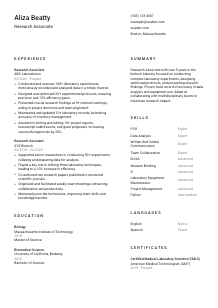
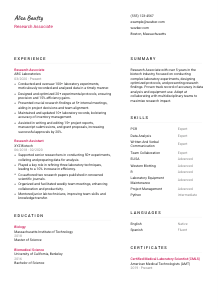
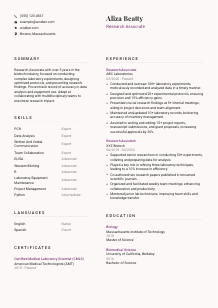
Working through data, but your CV feels like lost research notes? Cruise through this Research Associate CV example, created with Wozber free CV builder. Learn how to showcase your investigative insights to match job specifics, building a career as groundbreaking as your studies!
Research Associate hiring usually turns on one question fast: can you be trusted to run experiments cleanly, document them accurately, and turn results into usable scientific insight. CVs for this role often stay too broad, describing
The personal details section is simple, but it still shapes the first read. For a Research Associate, this section should confirm professional identity, contact access, and any logistical detail the employer has clearly asked for.
Use your full name in the most prominent text on the page. Keep it clean and easy to scan. In research hiring, where CVs may move between HR, lab managers, and principal investigators, a clear header helps everyone place your application quickly.
Place "Research Associate" directly under your name when that is the role you are pursuing. This immediately frames your background around lab execution, data handling, protocol work, and research support rather than a more general science profile.
List a working phone number and a professional email address you check regularly. If your email looks informal, replace it with a simple format such as first and last name. Scientific teams move quickly when scheduling interviews, especially when they need candidates who can discuss methods, documentation, and data analysis with confidence.
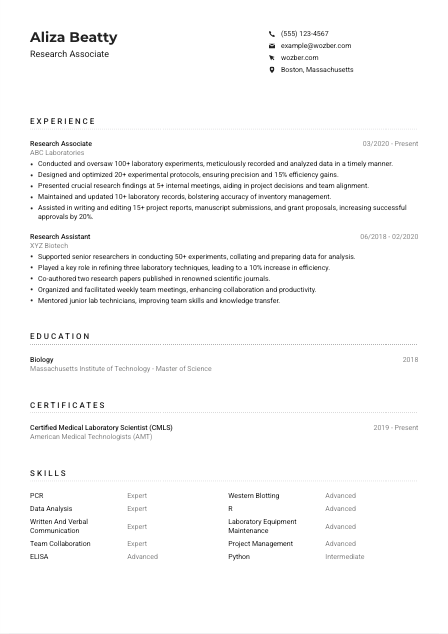
If a role specifies a location requirement, include your city and state. Here, Boston, Massachusetts matters because the employer explicitly asks for candidates based there. That is a tailoring move tied to this opening, not a universal rule for every Research Associate CV.
Include LinkedIn, an institutional profile, ORCID, or a professional website if it strengthens your application. For research roles, links are most useful when they reinforce publications, poster presentations, technical projects, or a consistent lab background rather than just filling space.
Your personal details should answer basic access and logistics without distracting from your lab experience. A clean header gives the hiring team one less reason to hesitate and keeps attention on the scientific work that follows.




This is the section hiring teams read most closely for a Research Associate role. They want to see what experiments you supported or owned, how you handled data, whether you improved protocols, and how your work contributed to research output, team efficiency, or reporting.
Before rewriting your bullets, mark the responsibilities and methods that appear in the posting. For this role, that includes running experiments, analysing data, optimising protocols, presenting findings, maintaining lab records and inventory, and supporting reports or manuscripts. Your experience section should make those functions easy to find.
Use reverse chronological order so your current or most recent lab work appears first. That structure helps reviewers quickly gauge your present technical level, whether you are operating as a hands-on bench scientist, a research support specialist, or someone already trusted with protocol ownership.
Avoid bullets that only state what you were responsible for. Show what happened because of your work. "Conducted PCR assays" is weaker than a bullet that connects the assay work to throughput, reproducibility, optimisation, or project progress. The example CV does this well by pairing experiment ownership with measurable protocol efficiency gains.
Numbers help research experience feel real. Use counts, frequencies, and outcomes that belong naturally in lab work, such as number of experiments run, protocols improved, meetings presented at, papers supported, reports drafted, or percentage efficiency gains. Metrics like "100+ experiments," "20+ protocols," or "15% efficiency gains" work because they show volume and operational impact, not just activity.
Prioritise work that overlaps with the posted role's daily rhythm. Protocol design, experiment execution, statistical analysis, equipment upkeep, and scientific writing all matter here. If you have unrelated experience, trim it or reduce it so the CV stays centered on bench research, data quality, and collaboration with the research team.
A Research Associate CV should show more than time spent in a lab. It should show experimental ownership, dependable documentation, useful analysis, and contributions the team could build on. Wozber's ATS CV scanner can help you line up those points with the terminology in the posting so the right work stands out early.
Education matters in research hiring because it establishes technical foundation. Degree level alone is not the whole story, but your field of study should clearly support the methods, experimental reasoning, and scientific discipline behind the role.
Start with your highest relevant degree if it strengthens your case, especially in Biology, Chemistry, Biomedical Science, or a related discipline. This posting asks for at least a bachelor's degree in a scientific field, so a master's in Biology, as shown in the example, reinforces depth without needing extra explanation.
Use a consistent structure: degree, field, institution, and graduation year. Hiring teams should be able to identify your academic background in seconds, especially when comparing multiple applicants with similar lab experience.
If your degree title closely matches the posting, let that alignment work for you. If your degree is adjacent rather than exact, keep the field visible so the connection is obvious. A Bachelor of Science in Biomedical Science, for example, still maps well to a research opening centered on wet-lab techniques and data interpretation.
Early-career candidates can strengthen this section with coursework tied to molecular biology, immunology, biostatistics, analytical chemistry, or experimental design. Once you have solid lab experience, coursework becomes optional unless it directly supports a required method or research area.
List honors, thesis work, publications, or major research projects if they add scientific substance. Choose items that show bench training, analytical rigor, or communication of findings, not every campus activity. The section should reinforce your readiness to contribute in a working lab environment.
Your education section should confirm that your training matches the technical level of the role. When degree, field, and research exposure are easy to read, the hiring team can move quickly from credentials to your practical lab record. Wozber's free CV builder helps keep that structure clean and ATS-friendly.
Certifications are not always required for Research Associate roles, but the right one can strengthen your profile. They are most useful when they reinforce lab practice, regulated environments, clinical relevance, or continued development in methods tied to the work.
If the posting does not require a certification, only include ones that still make sense for the research setting. A credential such as Certified Medical Laboratory Scientist can add credibility for lab discipline, technical standards, and familiarity with regulated procedures, even when it is not mandatory.
A short, focused certification section is better than a long list of loosely related courses. Choose credentials that connect to laboratory operations, biosafety, instrumentation, quality systems, or research methods rather than generic professional development.
Add issue dates and renewal periods when they show that the certification is current. In science and lab environments, recency can matter, especially for credentials tied to compliance, safety, or validated procedures.
If you have completed newer training in statistical analysis, coding for research workflows, GCP, GLP, or specialised assay platforms, include it when it supports the target role. Ongoing learning is especially persuasive when it expands what you can do at the bench or with data.
Certifications should reinforce the kind of researcher you are becoming: technically current, careful with standards, and ready to contribute in a real lab setting. Presented cleanly in Wozber's free CV builder, they add useful depth without pulling focus from your core experience.
For Research Associate roles, the skills section works best when it mirrors how the job is actually performed. That usually means a mix of wet-lab techniques, data analysis tools, documentation habits, and communication skills needed to share findings with the broader team.
Read the job description closely and extract the named techniques, software, and working skills. Here, PCR, ELISA, Western Blotting, data analysis, statistics, R or Python, and communication are all explicit. Those should appear in your skills section if you genuinely use them.
Order matters. Lead with technical skills central to the role, then add analytical and collaboration skills that support execution. In the example CV, PCR, ELISA, Western Blotting, R, Python, and laboratory equipment maintenance are stronger signals than broad terms listed on their own.
Do not crowd this section with every tool you have touched once. Include methods you can discuss in an interview with enough detail to explain workflow, troubleshooting, controls, or data interpretation. For scientific hiring, overclaiming is easy to spot once technical questions start.
A well-built skills section helps reviewers confirm technical overlap fast, especially when multiple applicants share similar titles. Use the employer's language where it matches your real experience, and let Wozber's free CV builder help organise those skills in an ATS-compliant CV that stays readable.
Language skills matter in research when the role involves documentation, presentations, cross-functional collaboration, or publication support. Even when only one language is required, listing proficiency clearly helps the employer understand how you will communicate in meetings, reports, and written research materials.
If the job asks for fluent English, list English prominently with an honest proficiency level. That requirement matters here because the role includes presenting findings and helping write reports, manuscripts, and grant materials.
Additional languages can be useful in international teams, academic collaborations, or organizations with global research partners. They are a bonus, not a substitute for the core lab qualifications the role requires.
Choose straightforward ratings such as Native, Fluent, Intermediate, or Basic. Avoid vague wording. A hiring manager should know immediately whether you can present research, draft written material, or simply hold everyday conversation.
For most Research Associate CVs, languages should stay concise unless multilingual work is central to the role. Keep the emphasis on scientific communication where it matters most: accurate records, internal presentations, and collaboration around experimental results.
For this kind of role, language skills support the real work of explaining methods, recording results, and contributing to written research output. Keep the section brief, accurate, and in scale with the rest of your scientific profile. Wozber's free CV builder can help present it cleanly in an ATS-friendly CV format.
The summary should quickly establish your scientific background, core methods, and the kind of contribution you make in a research setting. For this role, that means combining bench work, data analysis, and collaboration into a short opening that sounds grounded in actual lab practice.
Use the posting to identify the few themes that belong in your opening lines. Here, those themes are hands-on laboratory work, analysis of experimental data, protocol optimisation, communication of findings, and support for scientific reporting. Build the summary around those, not generic enthusiasm for science.
Your first sentence should state who you are professionally and how much relevant experience you bring. A line such as "Research Associate with 5+ years in biotech and academic lab environments" gives immediate context and helps the reader place the rest of your qualifications.
Use the next lines to mention the techniques and contributions most relevant to the target role. The example summary works because it connects laboratory experiments, protocol optimisation, data accuracy, and multidisciplinary teamwork. You can make yours even stronger by naming one or two core methods, such as PCR or ELISA, if they are central to the job.
Aim for 3 to 5 sentences. That is enough room to establish your research identity without repeating the experience section. Every line should carry useful information about your technical scope, scientific judgment, or contribution to research deliverables.
Your summary should make the hiring team expect a candidate who can contribute at the bench, handle data responsibly, and communicate findings clearly. Wozber's AI CV builder helps tailor that opening with role-specific language and ATS optimisation so your strongest qualifications surface from the first lines.
A Research Associate CV should leave little ambiguity about how you work. Hiring teams need to see technical overlap, disciplined experiment execution, sound data handling, and the ability to contribute to reports, presentations, and protocol improvement.
Use Wozber's free CV builder to shape your content into an ATS-friendly CV template, then refine it with the ATS CV scanner so the methods, analysis tools, and research outputs in the posting are reflected accurately across your sections. The finished CV should make it easy to picture you in the lab from day one.




