



Use Wozber and land your dream job
Create CV
No registration required
Setting quality standards, but your CV lacks essence? Review this Quality Supervisor CV example, created with Wozber free CV builder. Learn how to present your precision in line with job criteria, ensuring your career profile meets top-notch standards, just like your work!
Quality Supervisors are trusted to catch problems before they become customer complaints, audit findings, or expensive rework. Hiring teams look for people who can run disciplined quality systems, guide inspectors on the floor, and turn defect trends into corrective action that holds. Your CV needs to make that operating standard visible, especially through supervision scope, compliance work, and measurable quality gains.
When the CV reflects the language of the target role, it becomes much easier to separate hands-on inspection experience from true quality leadership. Wozber's free CV builder helps you align your wording with the posting, keep an ATS-compliant CV clean and readable, and surface details like ISO work, audit ownership, and process improvement results so the employer can quickly see supervisory range.
This section is simple, but it still does screening work. For a Quality Supervisor, it should immediately confirm who you are, what role you are targeting, and whether basic logistics such as contact details and location are already aligned with the opening.
Place your full name at the top in the largest, clearest text on the page. Quality work depends on organised documentation, and your CV should reflect that same discipline from the first line.
Add "Quality Supervisor" directly under your name when that is the title you are pursuing. This helps frame the rest of the CV around team oversight, quality systems, audits, and improvement ownership instead of reading like an individual contributor profile.
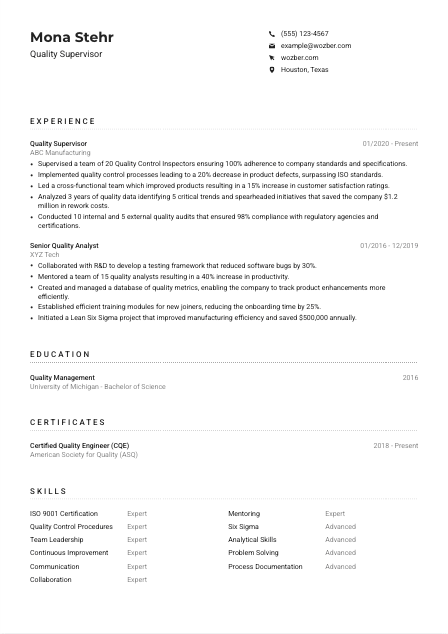
List your phone number, professional email address, and, when relevant to the posting, your city and state. In the example, "Houston, Texas" works well because the employer specifically asks for local presence or relocation willingness. If location is a hiring filter, make it easy to see.
Include a LinkedIn profile or professional website only if it supports your case with consistent career history, certifications, or project context. For quality leaders, that might reinforce experience with compliance programs, manufacturing environments, or continuous improvement work.
Skip personal information that does not help qualify you for the job, such as age, marital status, or a full street address. Keep the section focused on professional identity and practical hiring details.
Your contact section should confirm role alignment and remove basic questions upfront. If a hiring manager can immediately see your title, contact information, and location fit, they can move straight to your quality leadership experience.




This is the section where a Quality Supervisor CV usually succeeds or falls flat. Employers want to see how you supervised inspectors, maintained standards, handled audits, analysed quality data, and drove corrective action that improved product or process performance.
Read the job description line by line and identify the work that carries the most weight. In this case, that includes supervising QC inspectors, maintaining quality control processes and documentation, supporting ISO standards, analysing trends, and leading audits. Those priorities should shape which bullets you lead with.
Start with your most recent position and include title, company, and dates for each role. Then write bullets that emphasize scope and outcomes relevant to quality supervision, such as team size, audit volume, compliance rates, defect reduction, CAPA work, or cost savings tied to process improvement.
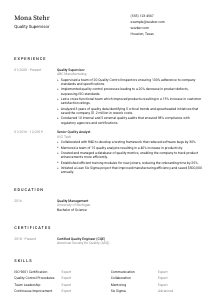
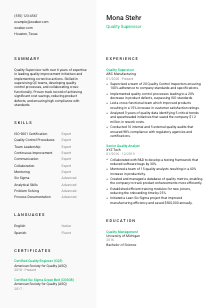
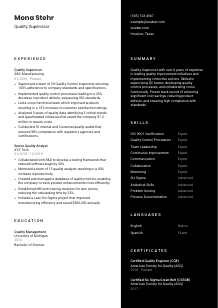
Replace generic duty statements with achievements that show control over quality performance. The example does this well with bullets such as supervising 20 Quality Control Inspectors, reducing defects by 20%, and improving customer satisfaction by 15%. Those lines show leadership, process discipline, and business impact in one pass.
Numbers matter in quality roles because they show whether your work changed the process. Use metrics such as defect rates, scrap reduction, compliance scores, audit counts, rework savings, training throughput, response time for corrective actions, or inspection coverage. "Conducted 10 internal and 5 external audits ensuring 98% compliance" is much stronger than "responsible for audits."
Choose accomplishments that support the target role, even if you have broader operations or technical experience. A project only earns space if it strengthens your case in supervision, ISO or regulatory compliance, problem-solving, process control, team development, or continuous improvement. That keeps your CV focused on the work a Quality Supervisor is hired to own.
A hiring team should be able to scan your experience and see who you led, what standards you worked under, what problems you fixed, and what improved because of your decisions. That is the clearest path from CV review to interview for a Quality Supervisor.
For quality leadership roles, education is usually a threshold requirement rather than the centre of the CV. Still, it matters because it confirms formal grounding in engineering, quality management, or another related discipline named in the posting.
If the job asks for a Bachelor's degree in Engineering, Quality Management, or a related field, present that information plainly. The example's Bachelor of Science in Quality Management aligns neatly with the stated requirement and removes any doubt about baseline qualifications.
List your degree, field of study, school, and graduation year in a simple order. This makes the section easy to scan and keeps attention on the qualification itself rather than on formatting choices.
Where your degree title is broad, use the field or related coursework to clarify relevance. A manufacturing engineering, industrial engineering, or operations-focused program can support a Quality Supervisor application when the connection to process control, quality systems, or analytical work is clear.
If you are earlier in your career, include relevant coursework, capstone projects, or lab work tied to quality systems, statistics, root cause analysis, manufacturing processes, or process improvement. For experienced candidates, those details are usually less important than audit results and supervisory accomplishments.
Honors, scholarships, or professional affiliations can stay if they support your professional credibility and do not distract from more valuable experience. Use them when they add substance, not just extra lines.
This section should quickly confirm that you meet the educational bar for the role. Once that is clear, your experience and certifications can carry the heavier part of the argument.
Certifications carry real weight in quality management because they point to recognized methods, standards knowledge, and commitment to disciplined improvement work. For supervisory roles, they also help support your authority in audits, corrective action, and process control discussions.
Lead with certifications that connect directly to the work in the posting. For a Quality Supervisor, that often means Six Sigma credentials, ASQ certifications, auditor training, or ISO-related qualifications that strengthen your case in continuous improvement and compliance.
Do not list every certificate you have earned. Focus on the ones that reinforce the employer's needs, such as quality control procedures, corrective actions, and ISO 9001 knowledge. In the example, CQE and Six Sigma Green Belt both support that profile well.
Add the issuing organisation and the date or validity period so employers can see whether the credential is current. In regulated or standards-driven environments, recency matters because methods, audit practices, and documentation expectations evolve.
Quality leadership is built on staying current with standards, audit practices, and improvement methodologies. If you continue to renew credentials or add training in areas like Lean, internal auditing, or CAPA, that signals professional discipline that matches the role.
Well-chosen certifications strengthen your CV when they connect directly to the quality systems and improvement methods the role depends on. They work best as proof of relevant specialization, not as a long inventory.
A Quality Supervisor skills section should read like the operating toolkit of someone who manages standards, teams, and improvement work. That means balancing technical quality knowledge with the leadership and analytical skills needed to keep processes under control.
Start with the exact skills the employer emphasizes. Here, that includes quality control procedures, Six Sigma, ISO 9001, analytical and problem-solving ability, and mentoring. Using the employer's language improves ATS alignment and keeps your skill list relevant to the work.
Do not build this section around soft skills alone. Quality leadership usually combines standards knowledge, process documentation, audit readiness, data analysis, root cause investigation, and corrective action management with team supervision, training, and cross-functional communication.
A shorter, sharper skills section is more useful than a long generic one. The example works because it includes core items such as ISO 9001, quality control procedures, continuous improvement, mentoring, and process documentation. Each one connects to a real part of the job rather than filling space.
Anyone scanning this section should quickly recognize a supervisor who understands standards, can read quality data, and can lead inspectors through consistent execution. If your skills list does that, it is doing its job.
In quality roles, language ability is not a side detail. Supervisors write reports, document findings, explain corrective actions, and communicate with inspectors, managers, suppliers, and sometimes auditors. If a posting names language proficiency, treat it as a real requirement.
If the role calls out English proficiency, list English prominently with an accurate level such as Native or Fluent. For this opening, that directly addresses a stated qualification and supports the reporting and communication demands of the job.
Place the language most important to the role at the top, then add others in descending order of usefulness. This helps employers quickly confirm that you can handle day-to-day communication, documentation, and audit interaction.
Extra languages can strengthen your profile if you work with diverse production teams, suppliers, or multinational operations. In the example, Spanish adds practical value because it can support clearer communication across a wider workforce, even though English is the stated requirement.
Choose clear proficiency labels and avoid overstating ability. In quality supervision, inaccurate language claims can become a problem quickly when report writing, training, or audit conversations require precision.
If your target employers operate across multiple plants, supplier networks, or international quality frameworks, multilingual ability can support smoother coordination and fewer communication gaps. Mention it when it serves the role, not as filler.
For a Quality Supervisor, language skills matter when they improve training, reporting, and compliance communication. Present them with the same clarity you would use in any controlled document.
Your summary should quickly position you as someone who has already operated at the level the employer needs. For a Quality Supervisor, that usually means combining years of experience with a few concrete strengths in team oversight, quality systems, audits, and measurable improvement.
Before writing the summary, pull out the recurring themes from the posting. Here, the essentials are quality management experience, ISO and quality control knowledge, improvement initiatives, corrective actions, analytical ability, and team leadership. Those are the ideas your summary should reflect.
Start with a direct line that states who you are and how long you have worked in the field. The example's "Quality Supervisor with over 6 years of expertise" works because it immediately establishes seniority in the exact function being hired for.
Use the next sentence or two to connect your background to the employer's needs. Mention supervisory scope, quality systems experience, audit leadership, defect reduction, cost savings, or cross-functional improvement work. The sample summary is effective because it ties leadership and process ownership to outcomes like lower defects and stronger compliance.
Aim for a short paragraph that can be read in seconds. Avoid broad claims like "results-driven professional" unless you immediately back them up with quality-specific details. Precision matters here just as much as it does in an audit report or corrective action record.
A well-written summary should make the next question obvious: how quickly can this person step in and run quality oversight, audits, and improvement work? If your opening lines create that impression, the rest of the CV has a strong foundation.
A Quality Supervisor CV should leave no doubt about four things: the standards you know, the teams you have led, the process issues you have corrected, and the measurable results that followed. When those points are clear across your experience, skills, certifications, and summary, the document reads like someone ready to manage quality performance rather than simply participate in it.
Use Wozber's free CV builder to shape that story into an ATS-friendly CV format, refine role-specific wording with AI assistance, and check alignment with an ATS CV scanner before you apply. The finished CV should make it easy to judge your ability to supervise inspectors, maintain compliance, and improve quality outcomes from day one.




