




Use Wozber and land your dream job
Create CV
No registration required
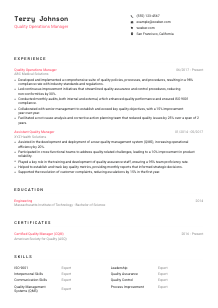
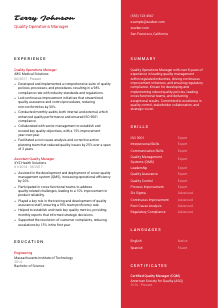
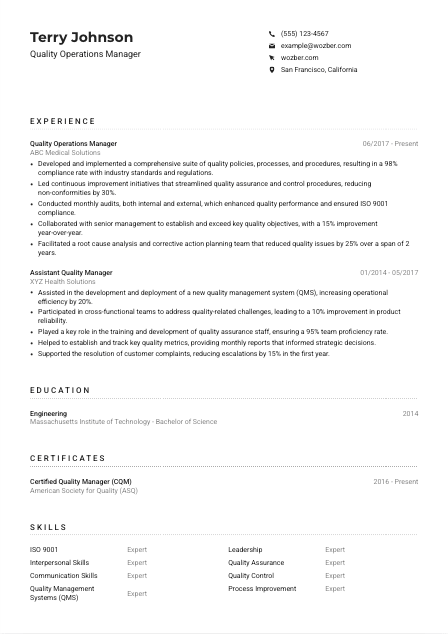
Streamlining quality, but your CV feels out of spec? Check out this Quality Operations Manager CV example, created with Wozber free CV builder. It shows how to align your quality expertise with job criteria, ensuring your career path leads straight to excellence!
Quality Operations Manager hiring usually turns on one practical question fast: can you run a quality system that holds up under audit, keeps operations compliant, and drives measurable improvement when something goes wrong. CVs in this field need to show more than familiarity with quality language. They need to make your command of QMS processes, CAPA work, audit discipline, and cross-functional leadership easy to see.
A tailored CV changes how your background is interpreted against regulated-industry requirements. When the language in your sections reflects the posting's terms for ISO 9001, quality management systems, audits, and root cause analysis, Wozber's free CV builder helps you shape that experience into an ATS-compliant CV that reads clearly for both software filters and hiring teams. The point is simple: your CV should quickly show that you can manage quality operations with control, consistency, and business impact.
The personal details section does more screening work than many candidates realize. In regulated operations roles, hiring teams want immediate clarity on who you are, how to reach you, and whether any basic logistical requirement could slow the process.
Lead with your full name and the job title you are targeting. Using "Quality Operations Manager" directly under your name helps frame the rest of the CV around quality leadership, audit ownership, and compliance management rather than general operations or manufacturing experience.
Use one reliable phone number and a professional email address. Check them carefully. For leadership roles where interview scheduling often involves HR, senior management, and quality leadership, even a small typo can cost you a conversation.
If the job asks for a specific location or relocation readiness, reflect that here. In the example, listing San Francisco, California immediately answers a stated requirement. That kind of detail is not universal for every Quality Operations Manager role, but when a posting names a location, it belongs in plain view.
Include a LinkedIn profile or professional website only if it supports your case with consistent quality-focused experience, certifications, or project scope. For this kind of role, a profile that reinforces regulated-industry work, audit exposure, or process improvement leadership adds value. A thin or outdated link does not.
Do not add age, marital status, photo, or other details unrelated to quality leadership. Keep the section focused on hiring essentials and preserve an ATS-friendly CV format that stays centered on compliance experience, credentials, and results.
This section should answer the practical basics in seconds. Once your title, contact information, and any required location detail are clear, the hiring team can move straight to your quality record.




Experience is where Quality Operations Manager candidates separate themselves. Hiring teams look for the scope of your quality ownership, the regulated environment you worked in, and the outcomes you improved through audits, investigations, process control, and corrective action.
Read the posting line by line and map its priorities to your own history. For this role, that means showing experience with quality policies and procedures, compliance with industry standards, audit activity, continuous improvement, and root cause analysis. If you have worked in medical devices, pharmaceuticals, or another regulated setting, make that context visible in your bullets.
List your most recent role first, then work backward. For each position, include title, company, and dates without clutter. This format helps both ATS systems and reviewers follow your progression from hands-on quality work into broader ownership of QA, QC, and improvement initiatives.
Each bullet should show what you led or improved, not just what you were responsible for. Strong examples in this field include implementing a QMS, leading internal and external audits, reducing non-conformities, improving complaint handling, or setting quality objectives with senior leaders. The example CV does this well by tying actions to outcomes such as compliance rate, non-conformity reduction, and year-over-year improvement.
Whenever possible, quantify the result with measures that matter in quality operations: compliance rates, audit frequency, reduction in deviations or non-conformities, CAPA closure improvement, reliability gains, complaint reduction, or efficiency gains tied to the QMS. A bullet like "reduced non-conformities by 30%" tells far more than "improved quality performance."
Prioritise work that reinforces quality management in regulated environments. A hiring team filling this role will care more about audit readiness, ISO alignment, investigation leadership, and cross-functional quality execution than older bullets that focus on unrelated administrative work. Keep the section tight around the operating demands of the job you want.
A strong experience section reads like a history of controlled processes, solved quality problems, and better compliance outcomes. If each bullet shows scope, method, and result, your CV will present you as someone who can lead quality operations from day one.
Education matters here because many Quality Operations Manager postings use it as an early qualification check. The degree itself will not carry the CV, but it should clearly support your grounding in engineering, business, or another field tied to regulated operations.
List your bachelor's degree clearly, especially if it is in Engineering, Business, or a related discipline named in the posting. In the example, a Bachelor of Science in Engineering aligns directly with the stated requirement and supports the technical side of quality systems and process control.
Keep the entry easy to scan: degree, field, school, and graduation year. That gives recruiters and ATS tools a quick match on educational requirements without burying the information under extra detail.
If your degree field connects closely to the target industry, make that visible. Engineering, industrial systems, manufacturing, life sciences, or business operations can all be relevant depending on the employer. Use the exact field name you earned rather than broadening it into something vaguer.
Early-career candidates can include coursework in quality systems, statistics, process validation, regulatory affairs, or operations management if it helps bridge limited experience. For senior candidates, that space is usually better spent on audit results, QMS leadership, or certifications.
Honors, senior projects, or research are worth adding only when they connect to process improvement, regulated manufacturing, engineering rigor, or analytical problem-solving. Once you have several years of quality leadership experience, keep education concise and let your operational record lead.
This section should confirm that you meet the baseline degree requirement without distracting from your quality leadership record. Clean formatting and accurate degree details are enough for most experienced candidates.
Certifications carry real weight in quality operations because they point to formal knowledge of systems, standards, and improvement methods. They are especially useful when the employer prefers recognized quality credentials or values structured expertise in regulated environments.
Start with credentials that directly support the job. For this posting, Certified Quality Manager and Certified Quality Engineer are especially relevant because they reinforce management capability, quality engineering knowledge, and commitment to the profession.
Ordering matters. Lead with certifications tied to quality systems, regulatory compliance, auditing, or process improvement before less relevant credentials. This keeps the section aligned with how the role is actually evaluated.
If the certification is current, renewable, or still active, include that information. In quality work, recency matters because standards, expectations, and regulated-industry practices evolve. Active ASQ credentials, for example, signal ongoing professional engagement.
Do not collect certifications for volume alone. Prioritise learning that helps you lead better investigations, strengthen QMS performance, improve audit readiness, or run continuous improvement programs more effectively. Lean, Six Sigma, auditor credentials, or industry-specific compliance training can all be useful when they match your target path.
Relevant credentials add confidence to your profile when they clearly support the work you already do. For Quality Operations Manager roles, they work best as proof of disciplined expertise in systems, standards, and improvement practice.
The skills section should read like the toolkit of someone who can manage quality in a regulated environment. Hiring teams look for a mix of system knowledge, improvement methods, and leadership capability, not a broad inventory of generic strengths.
Pull the exact skills that define the role, then include the ones you genuinely use. For this job, that includes ISO 9001, quality management systems, Six Sigma, regulatory compliance, quality assurance, quality control, and root cause analysis. Matching this language improves ATS optimisation and makes your background easier to connect to the role.
A Quality Operations Manager needs more than standards knowledge. Pair technical skills with leadership, stakeholder communication, cross-functional collaboration, and team development if those are real strengths. The example CV does this by combining QMS and ISO expertise with leadership and interpersonal skills, which fits the role's emphasis on working across functions.
Only include skills you can support with examples from your work. If you list CAPA, audit management, supplier quality, process improvement, or regulatory compliance, be ready to explain where you used them, what process you owned, and what outcome changed. Precision matters more than volume here.
A concise, role-specific skills section helps reviewers place you quickly. When the list reflects the standards, systems, and leadership demands of quality operations, it strengthens every other section on the page.
Language ability can matter more in quality leadership than candidates expect. Audit discussions, SOP communication, corrective action reviews, and cross-functional reporting all depend on precise language, especially in regulated settings where wording affects compliance and execution.
If the posting calls out strong English communication, list English clearly with an accurate proficiency level. For this job, that is a direct requirement, so it should not be implied or left for the interviewer to assume.
Additional languages can be worth listing if they support supplier communication, global teams, customer quality work, or multilingual environments. They are a plus, but they should stay secondary to the core requirement unless the role specifically depends on them.
Choose plain ratings such as Native, Fluent, Intermediate, or Basic. In quality operations, overstating communication ability can become a real issue when documentation reviews, audits, or issue escalation require precision.
If you are applying to organizations with international manufacturing sites, suppliers, or regulatory partners, language skills can help your profile stand out. That does not make them mandatory for every Quality Operations Manager role, but in the right context they support collaboration and operational range.
Treat languages as supporting information, not a feature piece. In the example, English and Spanish are listed clearly, which works because the section stays compact and does not distract from quality leadership credentials.
For this role, the main point is straightforward: show that you can communicate clearly in the language the job requires. Any additional language capability should support that story, not compete with it.
The summary sets the lens for everything that follows. For a Quality Operations Manager, it should quickly establish your years of experience, your regulated-industry background, and the quality outcomes you are known for delivering.
Start with your title, years of experience, and the environment you work in. A line such as "Quality Operations Manager with 8+ years in regulated manufacturing" immediately places you in the right hiring lane and distinguishes you from broader operations or QA candidates.
Include the core areas that shape the job, such as QMS leadership, ISO 9001, audit management, continuous improvement, CAPA, or cross-functional quality collaboration. Use the posting's terminology where it accurately matches your background.
A summary becomes more credible when it includes impact. Briefly mention results such as improved compliance, reduced non-conformities, stronger audit performance, or successful process improvement initiatives. The example summary works best where it connects leadership with regulatory compliance and measurable improvement.
Aim for three to five lines with no filler. Skip broad claims about passion or excellence unless they are backed by concrete quality work. This section should sound like an experienced operator who understands standards, systems, and execution.
A focused summary helps reviewers understand your quality scope before they reach your work history. When it names the right systems, environment, and outcomes, the rest of the CV lands with much more force.
A Quality Operations Manager CV should read like a record of controlled systems, effective audits, corrective action discipline, and measurable improvement. When your sections reflect the employer's language and your actual results, the hiring team can quickly understand the scale of quality work you have led.
Use Wozber's free CV builder and ATS CV scanner to align your content with the posting, surface missing requirements, and strengthen phrasing in an ATS-friendly CV format. The finished CV should make one conclusion easy to reach: you can lead quality operations in a regulated environment with consistency and credibility.