



Use Wozber and land your dream job
Create CV
No registration required
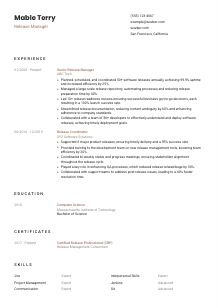
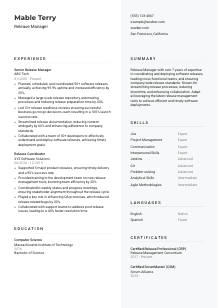
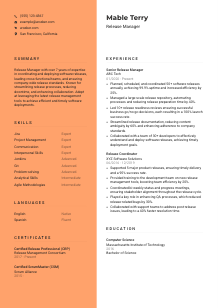
Navigating software releases, but your CV feels stuck in "beta"? Check out this Release Manager CV example, created with Wozber free CV builder. It shows how to smoothly present your release management expertise to match job expectations, making your career journey as seamless as a freshly deployed update!
Release management sits where delivery speed, system stability, and cross-team coordination meet. Hiring teams want to see whether you can move code into production on schedule, run readiness reviews with discipline, and keep releases from turning into avoidable downtime, rollback, or confusion across engineering, QA, and business stakeholders.
A tailored CV changes how quickly that story becomes visible. When your wording reflects the release cadence, tooling, and governance used in the target role, it is easier for both an ATS and a human reviewer to connect your background to release planning and deployment oversight. Wozber's free CV builder helps organise that alignment in an ATS-friendly CV format so your experience reads clearly as operational release leadership, not general IT coordination.
Release Manager hiring often starts with a fast practical check. Can this person step into the workflow, communicate professionally, and meet the basic location or work eligibility requirements? Your personal details section should answer those questions cleanly and without clutter.
Use your full name as the most prominent text on the page. In a field where hiring managers may review candidates across engineering, DevOps, QA, and project delivery backgrounds, a clear header makes your CV easier to track through interview rounds and stakeholder reviews.
Place "Release Manager" directly under your name when that is the role you are pursuing. This immediately frames your background around release planning, coordination, and production deployment rather than broader project management or operations work.
Include a reliable phone number and a professional email address. Avoid anything casual or outdated. Release Managers work across developers, QA leads, product owners, and business reviewers, so your contact details should reflect the same level of professionalism expected in release communications.
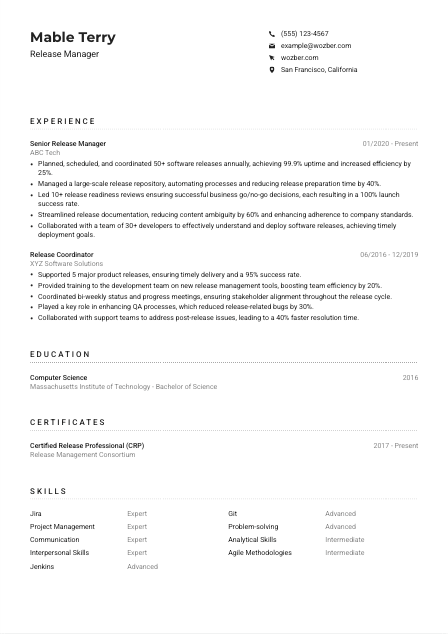
If a posting specifies a location or work eligibility, include it plainly in this section. In the example, listing San Francisco, California immediately addresses a stated requirement and removes early doubt about local availability or authorization.
If you include LinkedIn or a personal site, make sure it supports your CV with relevant content such as release governance work, delivery leadership, tooling exposure, or technical project history. A profile with mismatched titles or stale details creates noise instead of helping.
This section does not need personality flourishes. It needs accuracy, professionalism, and the few practical details that let a reviewer move straight into your release experience without unanswered questions.




For Release Managers, experience is the section that carries the most weight. Hiring teams look for proof that you have managed deployment schedules, coordinated dependencies, handled go or no-go decisions, and kept releases moving without disrupting production systems.
Read the posting for the operational work it emphasizes, then mirror that work in your bullets. For this role, that includes planning and scheduling releases, maintaining repositories and software libraries, leading readiness and milestone reviews, documenting procedures, and coordinating with development teams. These are the workflows your experience section should surface first.
Start with your most recent position and work backward, focusing on jobs tied to software delivery, deployment coordination, release governance, DevOps, or adjacent IT operations. A clear timeline helps reviewers see whether you have the progression expected for roles asking for 5+ years of release management or related experience.
Frame each accomplishment around what you owned and what improved. Good Release Manager bullets often reference release volume, deployment success rate, uptime, cycle time, defect reduction, automation, or cross-team alignment. The sample CV does this well with points like coordinating 50+ software releases annually and maintaining 99.9% uptime, which translates day-to-day release work into business-safe execution.
Use numbers that matter in release management. Annual release count, preparation time reduced, successful launches, downtime avoided, bug reduction after process improvements, and faster issue resolution all help a reviewer understand scale and control. "Reduced release preparation time by 40%" says much more than "improved efficiency" because it ties directly to release operations.
Keep the emphasis on work that shows scheduling discipline, deployment coordination, tooling knowledge, process documentation, stakeholder communication, and production reliability. If an achievement does not help explain how you run releases, resolve blockers, or improve release quality, it probably belongs off the page.
Your experience section should make one point unmistakable. You do not just participate in software delivery. You help releases ship on time, with control, and with fewer surprises for engineering teams and the business.
Education matters most here as a qualification check. For Release Manager roles tied closely to engineering teams, your degree helps establish technical fluency and comfort working around software systems, deployment workflows, and structured IT processes.
If the posting asks for a bachelor's degree in Computer Science, Information Technology, or a related field, make that match easy to see. "Bachelor of Science in Computer Science" aligns directly with the example requirement and removes any ambiguity during early screening.
List your degree, field of study, school, and graduation year in a straightforward structure. Education sections for experienced Release Managers do not need heavy detail. Clarity is enough, especially when your experience carries the deeper proof of delivery work.
When your degree is directly relevant, do not bury the field name. Computer Science, Information Technology, Software Engineering, or similar disciplines help signal that you can work comfortably with release tooling, repositories, deployment concepts, and engineering teams.
Most mid-level and senior Release Managers can keep this section brief. If you are earlier in your career, a project involving software delivery, automation, configuration management, or version control can reinforce your foundation. Otherwise, let your professional release work do the talking.
If you have pursued post-degree training in Agile delivery, CI/CD practices, IT service management, or release governance, that can strengthen the story. Keep those items relevant to deployment coordination and software operations rather than listing unrelated learning.
For this profession, education should confirm the technical baseline and get out of the way. Once that requirement is clearly covered, the rest of the CV can focus on how you run releases in real environments.
Certifications are useful when they sharpen your credibility in release operations, Agile environments, or process leadership. They matter most when they reinforce how you manage change, coordinate teams, and keep delivery standards consistent.
Choose certifications tied to release management, Scrum, Agile delivery, DevOps practices, IT service management, or project execution. In the example, Certified Release Professional and Certified ScrumMaster both support the kind of coordination and process discipline the role calls for.
A short, relevant certifications section is stronger than a long list of unrelated credentials. Hiring teams are looking for qualifications that connect to release cadence, stakeholder management, deployment workflow, or structured change control.
Show issue or active dates when that helps demonstrate currency. In software delivery roles, recency matters because release tooling, CI/CD practices, and team workflows evolve quickly. A current certification can suggest that your methods are up to date.
Release management is shaped by changing deployment practices, automation platforms, and governance expectations. Updating relevant certifications over time shows that you continue to develop alongside the way software teams actually ship and support releases.
Certifications will not replace hands-on release results, but they can strengthen your profile when they connect clearly to deployment oversight, Agile coordination, and process discipline.
The skills section should read like the toolkit behind your release work. For Release Managers, that usually means a mix of release tools, delivery process knowledge, analysis, coordination, and communication with technical and non-technical teams.
Start with the tools and capabilities the employer names. Here, Jira, Jenkins, Git, analytical ability, problem-solving, project management, communication, and interpersonal skills are all explicit priorities. Those terms should appear on your CV if they reflect your actual experience.
Lead with the skills most tied to the work. Release management tools, CI/CD-related platforms, version control, scheduling and coordination, stakeholder communication, and process documentation usually deserve higher placement than broad generic strengths. In the sample, Jira, Jenkins, Git, and project management are correctly central to the list.
Do not turn this section into an inventory of every platform you have touched. Focus on the capabilities that support release planning, deployment execution, cross-functional coordination, risk handling, and process improvement. A focused list helps both ATS matching and human review.
A Release Manager skills section should feel grounded in real delivery work. The right mix of tools, operational strengths, and collaboration skills tells the reader how you keep releases moving from plan to production.
Release Managers spend a large part of the job communicating. They run meetings, document procedures, coordinate across functions, and help teams make decisions under deadline pressure. Your languages section should support that reality, especially when the posting specifies professional English.
If the role calls for professional English communication, list English prominently with an accurate proficiency level. That matters in release notes, readiness reviews, escalation updates, and business go or no-go discussions where precision is essential.
Extra languages can be useful when release coordination spans distributed teams, support groups, or international stakeholders. While not always required, they can strengthen your profile in organizations with global engineering or customer operations.
Use honest levels such as Native, Fluent, Advanced, or Conversational. Overstating language ability is risky in a role where meetings, incident follow-up, and release documentation often demand clear and immediate communication.
If you know the company works across regions or serves multilingual teams, place the most relevant additional language here. In the example, Spanish may be a helpful bonus, though English remains the required language to foreground.
Only include languages you can genuinely use in workplace settings. For a Release Manager, the value is practical: clearer coordination, smoother handoffs, and better communication when issues arise before or after deployment.
This section is brief, but it can still reinforce an important part of release management. Teams need someone who can communicate clearly when timelines tighten, risks surface, and launch decisions need to be made.
Your summary should quickly establish the kind of release environment you have handled and the outcomes you are known for. This is where you connect years of experience, release scope, tooling familiarity, and operating style in a few focused lines.
Before writing, identify the qualities the role emphasizes most. For many Release Manager jobs, that means coordinating software releases, improving deployment efficiency, leading cross-functional communication, and maintaining standards around documentation and readiness reviews.
Lead with a direct professional identity and your years in the field. A line such as "Release Manager with 7+ years of experience" gives immediate context, then lets you layer in release scope, tooling, and delivery strengths. The example summary does this effectively by combining tenure with software release coordination and team leadership.
Choose strengths that map tightly to the posting, such as coordinating regular releases, reducing downtime, managing release standards, or working across engineering teams. If the target role stresses release repositories and business reviews, include those themes when they are part of your background rather than relying on generic leadership language.
Aim for three to five lines with concrete terms, not broad claims. Mention release management, deployment coordination, tooling, process improvement, or uptime-related outcomes in plain language. The summary should give a hiring manager a fast reason to expect well-run releases when they read the rest of your CV.
A sharp summary helps position you correctly from the first lines. Use Wozber's free CV builder and ATS CV scanner to align your wording with the job description, strengthen ATS optimisation, and present your release background in a format that hiring teams can scan quickly. The result should make your release ownership, technical fluency, and delivery discipline clear from the start.
A well-tailored Release Manager CV should make your operational value easy to read. By aligning your title, experience, tools, education, and summary with the release workflows in the job description, you show that you can plan deployments, lead reviews, manage process standards, and keep software moving with minimal disruption.
Before sending it out, review the language for exact role match, confirm the most relevant tools and outcomes are visible, and make sure the structure stays ATS-friendly. Wozber's free CV builder can help you refine that alignment and produce an ATS-compliant CV that presents your release management experience with clarity. At that point, the hiring team should be able to quickly see that you are ready to run releases with control and confidence.




