



Use Wozber and land your dream job
Create CV
No registration required
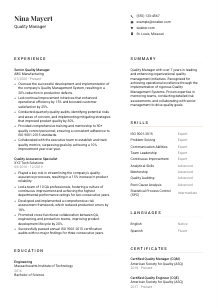
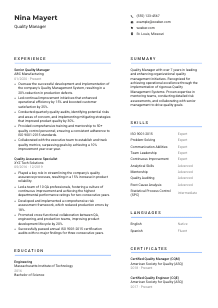
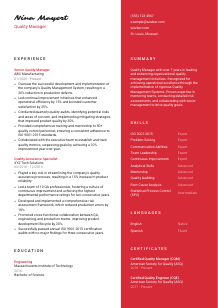
Maintaining standards, but feeling yours isn't showing the full picture? Check out this Quality Manager CV example, created with Wozber free CV builder. It shows how to present your excellence clearly to meet job specifications, setting the bar as high for your career as you do for quality!
Quality management work is judged in results that hold up under pressure. Hiring teams want to see how you built or maintained a QMS, handled audit findings, reduced defects, and turned quality issues into repeatable process improvements. Your CV needs to make that operating range visible, not just state that you care about standards.
For a Quality Manager, the first screening question is often whether your background lines up with the employer's quality framework and reporting needs. Using Wozber's free CV builder to shape an ATS-compliant CV helps you mirror the language of the posting, surface ISO 9001:2015 experience, and present improvement metrics clearly so reviewers can quickly understand your scope and credibility.
This section is brief, but it still does real work. For a Quality Manager, it should confirm who you are, the role you are targeting, and any location requirement the employer named, without adding unrelated personal information.
Place your full name at the top in the most prominent text on the document. Keep it easy to scan. On a CV built around audits, compliance, and operational control, clutter at the top sends the wrong signal.
Add "Quality Manager" directly under your name when that is the job you are pursuing. This creates immediate alignment with the posting and helps position the rest of your experience, whether it comes from manufacturing, QA, supplier quality, or broader quality systems leadership.
Include a reliable phone number, a professional email address, and a relevant profile or website only if it supports your candidacy. Double-check every detail. A missed digit or outdated link can derail follow-up, especially when employers are moving quickly on experienced quality leadership candidates.
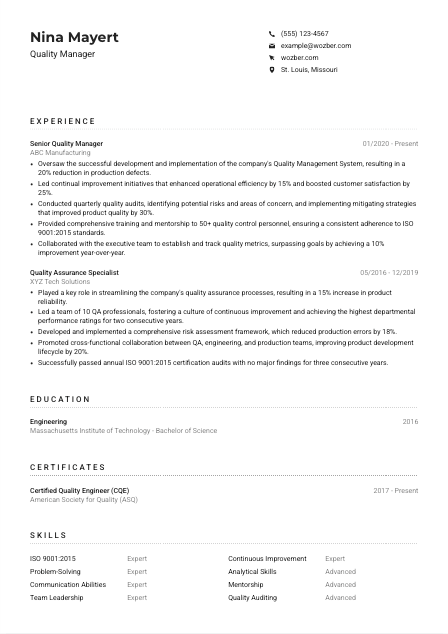
If the employer specifies a location requirement, include your city and state clearly. Here, listing St. Louis, Missouri directly supports the stated requirement. Use location this way when it removes a practical question for the employer, not as filler.
Do not add details such as date of birth, marital status, or a photo unless a local hiring norm requires it. Quality leadership CVs work best when the page stays focused on qualifications, systems knowledge, and measurable performance.
Your header should confirm the basics fast: who you are, what role you are targeting, and whether you meet any stated location requirement. Then the CV can move straight into your quality systems, audit work, and improvement results.




The experience section carries the most weight for a Quality Manager. Employers look for the scale of your QMS work, the rigor of your audits, the improvements you drove, and how well you partnered with operations, engineering, and leadership to keep standards moving into daily practice.
Read the job description closely and identify the work themes behind it: QMS ownership, continual improvement, audit execution, risk assessment, team development, and metric-setting with leadership. Then choose accomplishments that match those themes. If a posting emphasizes ISO 9001:2015 and quality metrics, lead with bullets that show system implementation, audit performance, and measurable quality outcomes.
List jobs in reverse chronological order and include title, company, and dates. For quality roles, your title progression matters. A move from Quality Assurance Specialist to Senior Quality Manager, for example, immediately shows growth in scope, leadership, and accountability.
Focus each bullet on a quality function you owned and the result it produced. Strong bullets often cover defect reduction, audit readiness, CAPA effectiveness, process compliance, customer satisfaction, scrap reduction, or risk mitigation. The sample CV does this well by tying QMS implementation to a 20% reduction in production defects and audit activity to stronger product quality.
Numbers belong naturally in quality management because the work is measured through defect rates, yield, audit findings, corrective action closure, customer complaints, and efficiency gains. Use percentages, counts, timeframes, and team scope. Training 50+ quality control personnel or improving operational efficiency by 15% gives hiring teams a much clearer view of your impact than broad claims about excellence.
Every line should strengthen your case for leading quality systems and improvement programs. Remove achievements that sit too far from compliance, process control, cross-functional problem-solving, or team leadership. Space is limited, and the most convincing CVs keep the focus on work that translates directly into better quality performance.
A strong experience section shows more than activity. It should make it easy to see that you can run a QMS, lead audits, improve process performance, and guide teams toward reliable standards.
Education is usually a straightforward section for experienced Quality Managers, but it still needs to confirm that your academic background meets the level the employer expects. Keep it clear, relevant, and easy to verify.
When a posting asks for a bachelor's degree in Engineering, Quality Management, or a related field, list that credential clearly. If your background is in a related discipline, the field name should still help the employer connect it to quality systems, manufacturing, process improvement, or operational analysis.
Present your degree, field of study, school, and graduation year in a consistent order. Hiring teams do not need extra formatting here. They need to confirm the credential quickly and move back to the sections that show your quality management scope.
If you have multiple degrees, prioritise the one that best supports the role. In the example, a Bachelor of Science in Engineering aligns directly with the stated requirement and supports the technical side of quality work, from process analysis to root cause investigation.
Early-career candidates can include honors, projects, or coursework tied to statistics, manufacturing systems, quality engineering, or process control. If you already have several years of quality leadership experience, keep this section lean unless the academic detail adds clear value.
A thesis, capstone, or research project on quality systems, reliability, operations improvement, or industrial processes can be useful if it supports the type of employer you are targeting. Include it only when it adds context that your work history does not already cover.
For most Quality Manager applications, education is there to establish the required foundation. Present it clearly, match the field to the posting where possible, and let your experience carry the deeper story.
Certifications can add real weight in quality leadership hiring, especially when they reinforce systems knowledge, audit discipline, and professional commitment. They are most useful when they connect directly to the kind of quality environment you want to manage.
Prioritise credentials that support quality systems, auditing, process improvement, or engineering quality work. ASQ certifications such as CQE or CQM are strong examples because they signal recognized knowledge in quality methods and leadership. Include only certifications that sharpen your profile for the target role.
Order certifications by relevance, not by prestige alone. If the position centers on QMS oversight, audits, and continuous improvement, certifications tied to quality management and quality engineering should appear before broader management programs.
Certification dates help show current standing and ongoing professional engagement. This is especially helpful in fields where standards, audit expectations, and quality methodologies evolve over time. An active certification can reinforce that your knowledge is current, not historical.
Quality management is built on continual improvement, and your certification record can reflect that mindset. If you have maintained credentials or added training in areas like internal auditing, SPC, Lean, Six Sigma, or risk management, include what genuinely supports the role you want next.
Certifications work best when they confirm the expertise your experience already suggests. In quality management, they can strengthen your credibility in standards, audits, analysis, and structured improvement.
A Quality Manager skills section should read like the toolkit behind your results. That means showing the standards, methods, and leadership capabilities you actually use to run audits, improve processes, investigate causes, and work across functions.
Start with the exact skills the employer named, then add the related capabilities your background supports. In this case, ISO 9001:2015 knowledge, analytical problem-solving, communication, and cross-functional collaboration are central. These should appear if they are real strengths in your work history, not just terms copied from the posting.
Quality management hiring usually looks for both. Include hard skills such as quality auditing, root cause analysis, SPC, CAPA, risk assessment, or QMS development alongside leadership skills like mentoring, stakeholder communication, and team guidance. The sample skills list works because it mixes standards knowledge with people leadership and improvement capability.
Keep the list concise and relevant. Group or order skills so the most important ones appear first, especially those tied to the employer's operating environment. Wozber's AI CV builder can help surface missing terminology and sharpen ATS optimisation, but the final list should still reflect tools and methods you have actually used in quality settings.
Your skills should reinforce the methods, standards, and leadership traits already shown in your experience. When the list matches your actual audit work, improvement projects, and QMS responsibility, it adds credibility instead of noise.
Language matters in quality management because the job depends on clear documentation, audit communication, training, and cross-functional follow-through. This section should reflect the language ability needed to perform the role, not just fill space.
If the posting specifies English communication, list English clearly and use an honest proficiency level. For a Quality Manager, this matters in written procedures, audit reports, corrective actions, and leadership communication as much as in conversation.
Order your languages by practical relevance to the job. In a U.S.-based role, English should come first. Additional languages become more valuable when you work with multilingual production teams, global suppliers, or international customer quality requirements.
Additional language ability can be useful in manufacturing, distribution, or global quality operations where training, issue resolution, and supplier communication cross language lines. Include them when they help explain stronger communication reach, not as a generic bonus item.
Terms like Native, Fluent, Intermediate, and Basic are easy for employers to understand. Keep ratings realistic. In quality roles, overstatement can become a problem quickly if the work involves formal documentation, audits, or technical discussions.
If the company works across countries, plants, or supplier networks, language skills may carry more weight. They can support smoother audits, clearer training delivery, and better coordination on quality issues that move across regions.
For Quality Manager roles, language skills matter when they improve documentation, training, audit communication, or coordination across teams. Keep the section practical and tied to how the work gets done.
Your summary should quickly establish the level of quality work you handle and the results you are known for. In a few lines, it should connect your experience with the standards, improvement work, and leadership scope the employer needs.
Start by identifying yourself in terms that match your real level of responsibility. Mention your years of experience and the core area you lead, such as QMS oversight, quality assurance, manufacturing quality, or continuous improvement. This gives immediate context before the reader reaches the experience section.
Include the operating range that defines your profile. That may mean leading quality initiatives, managing audits, mentoring teams, working with executive leadership, or improving process performance across functions. The example summary does this effectively by combining quality management leadership with operational excellence and team development.
Bring in important terms from the posting where they accurately describe your background. ISO 9001:2015, risk assessment, quality metrics, and cross-functional collaboration are all stronger than vague claims because they connect to actual work a Quality Manager is expected to perform. This also improves ATS alignment when phrased naturally.
Aim for three to five lines with enough detail to separate you from adjacent profiles like QA supervisors or quality engineers. Mention one or two concrete outcomes or strengths, then stop. A focused summary creates the right frame for the detailed evidence that follows.
Your summary should make one thing clear right away: you understand quality management at a level that includes systems, audits, improvement, and team leadership. When that is evident in the first few lines, the rest of the CV lands with more force.
A tailored Quality Manager CV should make your standards knowledge, improvement record, audit discipline, and leadership range easy to understand within a few seconds. When each section supports that picture, the employer can quickly see how you would manage quality in their environment.
Use Wozber to build an ATS-friendly CV format that reflects the posting's terminology, highlights measurable quality outcomes, and keeps your sections clean and searchable. That leaves hiring teams with a clearer read on whether you can lead the QMS, strengthen compliance, and drive continuous improvement from day one.