



Use Wozber and land your dream job
Create CV
No registration required
Keeping tabs on standards, but losing sight of your CV's worth? Check out this Quality Control Manager CV example, created with Wozber free CV builder. Learn how to highlight your quality control expertise to match job expectations, ensuring your career standards always meet the highest criteria.
Quality Control Managers are trusted with the work that keeps defective product, audit findings, and process drift from turning into expensive problems. Hiring teams read the CV with that pressure in mind. They want to see how you built control systems, managed technicians, handled non-conformance, and kept production aligned with quality standards in a real operating environment.
A tailored CV changes the first question from "does this person work in quality" to "can this person run our quality function here." That is where Wozber's free CV builder helps. It makes ATS optimisation easier by aligning your wording with the posting's quality terminology, reporting requirements, and compliance language, so your CV quickly shows whether you can lead audits, maintain KPIs, and improve product compliance.
This section is simple, but it still does important work. For a Quality Control Manager, the header should immediately confirm role alignment and remove practical objections such as location or contact issues, especially when the employer has stated an on-site requirement.
Make your name the clearest element in the header so it is easy to identify in both a recruiter skim and an ATS-friendly CV format. Keep the styling clean and professional. In quality leadership roles, a cluttered header sends the wrong message before your process discipline shows up elsewhere.
Use the exact target title, "Quality Control Manager," beneath your name when it matches your background. That direct match helps position you correctly for the role and avoids being read as a broader quality professional without people-management or systems ownership.
Include your phone number and a professional email address, then verify both carefully. For management roles that involve audits, reporting, and cross-functional escalation, small errors in basic details can undermine the impression of accuracy you need to establish early.
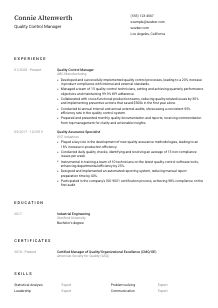
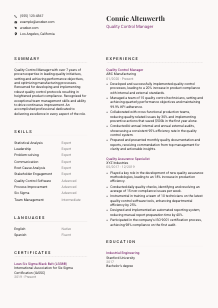
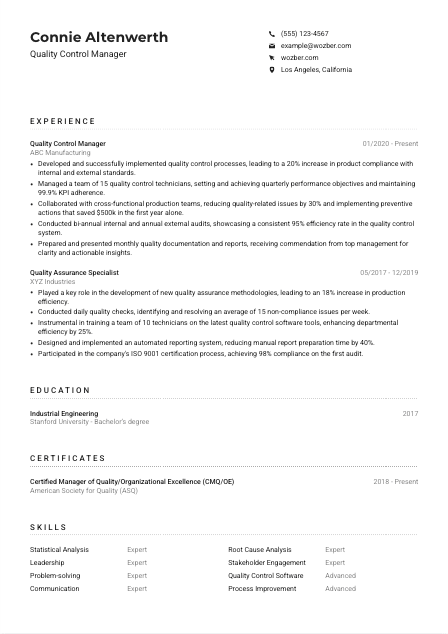
If the employer asks for a local candidate, state your city and state clearly. Here, "Los Angeles, California" directly addresses a stated requirement and prevents early screening friction. Use location this way when it matters to the opening, not as filler.
A LinkedIn profile or professional website can reinforce your quality background, especially if it reflects certifications, plant experience, audit work, or process improvement projects. Make sure the details are current and consistent with the CV, including titles, dates, and major achievements.
Your personal details should confirm three things in seconds: who you are, which role you are targeting, and whether you meet any practical screening requirement such as location. For Quality Control Manager openings, that clean start supports the credibility of everything that follows.




This is the section where quality leadership becomes concrete. Employers are looking for signs that you can run a quality function, lead technicians, reduce defects, support production, and hold up under audit and compliance scrutiny.
Before editing bullets, identify the work the employer needs handled day to day. In this case, that includes developing control processes, managing QC technicians, maintaining KPIs, collaborating with production, conducting audits, and preparing reports for management or regulators. Those priorities should shape which achievements you feature first.
List your most recent position first and show clear advancement across quality roles. For this profession, progression from specialist-level execution into ownership of systems, teams, and departmental metrics tells a hiring manager you can move from inspecting issues to managing the function that prevents them.
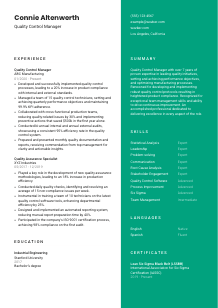
Each bullet should connect what you owned to what improved. Good Quality Control Manager bullets mention control plans, audits, CAPA work, root cause analysis, technician oversight, or compliance reporting, then show the result. The sample CV does this well with bullets such as improving product compliance by 20% and reducing quality-related issues by 30%, both of which tie directly to the posting's responsibilities.
Use metrics that belong naturally to quality work: defect reduction, compliance rates, audit scores, scrap reduction, yield improvement, reporting cycle time, cost savings, or KPI adherence. Numbers like 99.9% KPI adherence, 95% audit-system efficiency, or $500k saved from preventive actions tell a much stronger story than general claims about improvement.
Prioritise achievements that show you can lead quality in a manufacturing or production setting. Team management, audit execution, non-conformance reduction, statistical analysis, and preventive action planning belong here. Cut bullets that are operationally impressive but too far removed from product compliance, process control, or quality-system ownership.
By the end of your experience section, a reviewer should understand the scale of your quality work, the systems you improved, the teams you led, and the business results you delivered. That is what makes a Quality Control Manager CV feel credible in a manufacturing environment.
Education does not carry the whole application for a Quality Control Manager, but it still sets the academic foundation for process control, industrial systems, and analytical thinking. Keep it straightforward and aligned with the field the employer asked for.
When the posting asks for a bachelor's degree in Quality Assurance, Industrial Engineering, or a related field, make sure your degree is easy to find and easy to match. If you hold one of the listed fields, state it exactly. That direct alignment helps both ATS parsing and human review.
List the degree, field of study, school, and graduation year in a clean format. This section does not need long explanations unless you are early in your career. The goal is fast confirmation that you meet the educational baseline for a quality leadership role.
If your degree closely matches the posting, let that alignment work for you. In the example, a Bachelor's degree in Industrial Engineering lines up directly with the requirement. If your degree is adjacent rather than exact, use the field name accurately and let your experience carry the deeper quality specialization.
Relevant coursework can help if you are earlier in your career or if the degree title alone does not show your quality background. Subjects such as statistical process control, quality engineering, manufacturing systems, operations analysis, or process improvement can reinforce your technical footing.
Honors, capstone projects, or technical student work are worth mentioning when they relate to manufacturing, process optimisation, or quality methodology, especially for candidates with less leadership experience. For senior candidates, keep the focus on details that still support your current target role.
Your education section should confirm that you have the formal foundation expected for quality leadership without slowing the reader down. Clean formatting and accurate field names are usually enough to do that well.
Certifications carry real weight in quality roles because they point to recognized methods, structured problem solving, and current practice. They are especially useful when the job emphasizes standards, methodologies, audits, and continuous improvement.
Choose credentials that reinforce the kind of work you actually do, such as quality systems leadership, continuous improvement, root cause methodology, or process control. Certifications like CMQ/OE and Lean Six Sigma Black Belt are strong examples because they connect directly to quality governance and operational improvement.
Place the certifications that best match the job near the top of the section. If the employer emphasizes standards, process design, and problem solving, credentials tied to quality management systems, audit discipline, and statistical improvement methods should appear before less relevant training.
Include the year earned and, when relevant, the active or renewal status. That matters in quality work because employers often want to know that your methodology training is current and still part of how you run teams, audits, and improvement programs.
Quality standards, reporting expectations, and software tools change. Ongoing certification work or continuing education shows that your approach stays current with production realities and compliance expectations. Add new credentials when they sharpen your relevance for the jobs you are targeting.
Certifications should reinforce the kind of Quality Control Manager you are, whether that is audit-focused, process-improvement driven, or strong in team leadership and quality systems. Listed thoughtfully, they add substance rather than decoration.
A Quality Control Manager needs a skills section that feels operational, not generic. It should show how you run analysis, lead people, manage quality systems, and work with production to keep compliance and performance on track.
Start with the capabilities the employer named explicitly. Here that includes quality control standards and methodologies, statistical analysis, quality control software, communication, leadership, and problem solving. Build your section around those terms when they match your actual experience so the CV speaks the employer's language naturally.
This role sits between process discipline and people leadership, so your skills list should reflect both. Pair technical abilities such as statistical analysis, root cause analysis, process improvement, Six Sigma, or quality software with leadership skills such as team management, stakeholder communication, and cross-functional collaboration.
Place the most role-critical skills first so they are visible in a quick skim and easy for ATS systems to map. In the example, leading with statistical analysis, leadership, problem-solving, quality control software, and root cause analysis makes sense because those capabilities connect directly to audits, KPI ownership, and preventive action work.
When this section is tailored well, it reads like the toolkit of someone who can manage a quality department, not just participate in one. Keep the list focused on methods, systems, and leadership abilities you can support elsewhere in the CV.
Language ability matters in quality roles because the work depends on clear documentation, audit communication, corrective action follow-through, and coordination across departments. If the posting specifies language proficiency, address it directly.
If professional English is required, list English clearly and use an honest proficiency level. For a Quality Control Manager, this matters because reports, audit findings, SOP updates, and escalation communication all depend on precise written and verbal English.
Other languages can strengthen your application, especially in diverse manufacturing environments or supplier-facing roles. Spanish, for example, may be useful for technician communication or plant-floor coordination in some workplaces, even when it is not listed as a formal requirement.
Stick to simple labels such as Native, Fluent, Intermediate, or Basic. These terms are easy to understand and keep the section credible. Avoid vague wording that leaves the reader guessing how well you can actually communicate in a technical or professional setting.
Language skills become more important when the job involves external audits, supplier interactions, regulatory communication, or multilingual teams. If your language ability supports those parts of the work, it is worth showing because it adds practical range to your profile.
For this profession, language skills matter most when they support reporting accuracy, audit communication, and smooth coordination across the operation. Keep the section brief, accurate, and relevant to how the job is actually done.
The summary sets the lens for the rest of the CV. For a Quality Control Manager, it should quickly establish your years in quality, your operating environment, and the kind of results you deliver through systems, analysis, and team leadership.
Anchor your summary in the realities of quality leadership: maintaining standards, improving compliance, solving recurring process issues, and leading teams that protect product quality. That gives the opening more weight than broad claims about being results-driven or detail-oriented.
A direct opening works best here. Something like "Quality Control Manager with 7+ years of experience in manufacturing quality systems" immediately tells the reader your level and domain. The example summary uses this approach effectively by starting with the title and years of experience.
Bring in two or three role-specific strengths that line up with the posting, such as developing quality control processes, leading technicians, conducting audits, improving product compliance, or using statistical analysis to solve production issues. Choose strengths you can prove in the experience section.
Aim for a short paragraph that reads with authority and specificity. A hiring team should finish it with a clear picture of your quality scope, not with a list of generic traits. If you mention outcomes, use language that belongs to the role, such as compliance improvement, audit performance, defect reduction, or process efficiency.
A well-written summary tells the reader, right away, whether you are a candidate who can lead quality in a live production environment. Keep it brief, accurate, and closely tied to the standards, systems, and team leadership the role requires.
A Quality Control Manager CV should leave very little ambiguity. The reader should be able to see your manufacturing or production background, your command of quality systems and methodologies, your experience leading technicians, and your track record with audits, compliance, KPIs, and corrective action.
Wozber's free CV builder can help you organise those details into an ATS-compliant CV, and its ATS CV scanner can help you compare your content against the job description so the right terminology, standards, and responsibilities are reflected in the right sections. That makes it easier to present your experience in a way that matches how quality leadership is actually hired.
Before you submit, check every section against the posting one more time. If your CV clearly shows how you improve compliance, manage quality operations, and support production without compromising standards, it is ready for serious consideration.