



Use Wozber and land your dream job
Create CV
No registration required
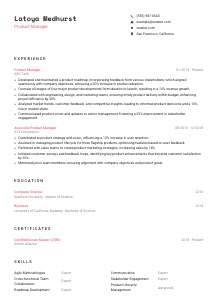
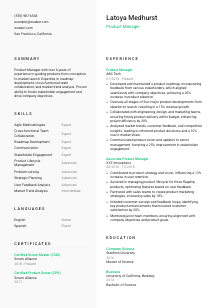
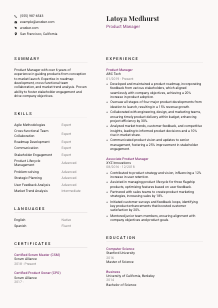
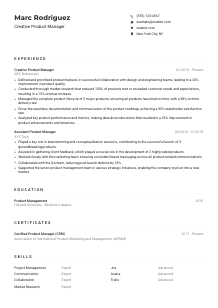
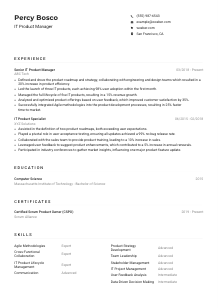
Driving product visions, but your CV isn't turning heads? Check out this Product Manager CV example, created with Wozber free CV builder. Learn how to highlight your product expertise to meet job requirements, plotting your career trajectory to match the success of your launches!
Product managers are expected to turn scattered inputs into clear product direction. Hiring teams look for evidence that you can shape a roadmap, make tradeoffs, work across engineering, design, and marketing, and carry a product through launch and post-launch review. A CV for this role needs to show judgment, delivery, and business context, not just a list of meetings attended or features shipped.
When that story is tailored well, the reader can quickly see whether your background matches the product scope they need, from lifecycle ownership to stakeholder communication. Wozber's free CV builder helps you line up your experience with the posting in an ATS-friendly CV format, so roadmap work, Agile practice, and market-driven decisions are easy to recognize from the first scan.
This section does quiet but important work on a Product Manager CV. It confirms who you are, how to reach you, and whether you meet any practical screening requirements before anyone gets to your roadmap, launch history, or cross-functional work.
Use your full name as the most visible text on the page. Keep the formatting clean and professional so it is easy to read in both human review and ATS parsing. Product management is a communication-heavy role, and even this top line should reflect clarity and control.
Place "Product Manager" beneath your name if that is the role you are applying for. This immediately frames your background around product ownership rather than adjacent paths such as project management, business analysis, or marketing. If your recent title was more junior, you can still use the target title here when your experience supports it.
Make it easy for recruiters and hiring managers to contact you without hunting through the page.
Some product roles are flexible, while others require a specific office or market presence. Here, the job explicitly asks for San Francisco, CA, so listing San Francisco, California in your personal details removes an avoidable screening issue. Treat location this way when it is a stated requirement, not as a universal rule for every Product Manager application.
Include LinkedIn or a personal site if it strengthens your candidacy. For product managers, that can mean a profile that shows product launches, strategic initiatives, writing on product thinking, or portfolio-style case studies. Make sure the content matches your CV dates, titles, and achievements.
Your personal details should answer the practical questions fast: who you are, how to reach you, and whether you meet any stated location requirement. Once that is clear, the rest of the CV can focus on product decisions, delivery results, and business impact.




This is the section that carries the most weight for a Product Manager. Hiring teams want to see how you influenced product direction, worked across functions, prioritised competing inputs, and delivered outcomes that mattered to users and the business.
Read the posting for the actual work patterns behind the title. In this case, the emphasis is on roadmap ownership, end-to-end product development, cross-functional collaboration, market analysis, and communication with senior stakeholders. Those themes should guide which bullets you choose and how you phrase them.
List jobs in reverse chronological order with title, company, and dates. That straightforward structure helps the reader follow your progression from supporting product work to owning a roadmap, launch cycle, or portfolio. For Product Managers, career progression often matters because it shows growing scope, from feature support to strategy and lifecycle ownership.
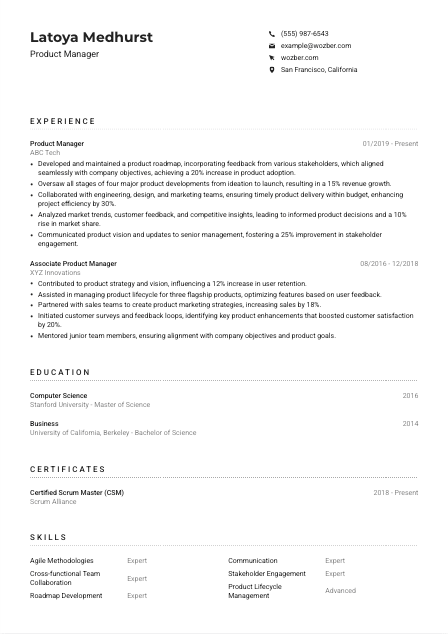
Each bullet should show what you owned, what you did, and what changed because of it. Strong Product Manager bullets often combine a product action with a business or user result. The example CV does this well with lines such as maintaining a roadmap that helped drive a 20% increase in product adoption and overseeing product development that contributed to 15% revenue growth.
Quantify results with measures that make sense for product work. Adoption, retention, revenue impact, release timeliness, market share, customer satisfaction, stakeholder engagement, and efficiency gains all give shape to your work. Numbers matter here because they show whether your prioritization and execution translated into actual product performance.
Prioritise experience that shows lifecycle management, stakeholder alignment, customer insight, and delivery with engineering, design, and marketing. Leave out older or unrelated details that do not help explain how you make product decisions. If you have adjacent experience, frame it around transferable PM work such as backlog prioritization, market research, launch planning, or cross-team coordination.
By the end of the Experience section, your CV should make it obvious that you can move a product from concept to launch, work credibly across functions, and tie product choices to adoption, revenue, retention, or market outcomes. That is the core read most Product Manager CVs need to earn.
Education matters most here as a qualification check and as context for how you built your product foundation. It supports your candidacy best when it is clear, relevant, and aligned with the background the employer requested.
Start by confirming the educational baseline in the posting. This one asks for a bachelor's degree in Business, Computer Science, or a related field, so your CV should present that information plainly. If you also hold a graduate degree, include it, but make sure the bachelor's requirement is still easy to spot.
List degree, field of study, school, and graduation year. Product roles do not usually require long education descriptions unless you are early in your career or your coursework is unusually relevant. A simple structure keeps the focus on your qualifications without distracting from your product experience.
Degrees in business, computer science, engineering, economics, or related areas all help frame your product background. In the example, a Bachelor of Science in Business meets the stated requirement, while a Master of Science in Computer Science adds useful technical credibility for working with engineering teams and technical tradeoffs.
Most experienced Product Managers can keep this section lean. If you are earlier in your career, coursework in product strategy, user research, software development, analytics, Agile delivery, or market analysis can help explain your foundation. Include it only if it strengthens your case for the target role.
Honors, leadership roles, startup competitions, or product-related projects can be useful when they connect to product thinking, collaboration, or commercial problem-solving. If you already have several years of PM experience, keep these details brief so your execution history stays dominant.
Your education section should confirm that you meet the academic requirement and add any relevant technical or business depth. For an experienced Product Manager, it supports the story. It should not compete with the experience section that proves you can actually run the work.
Certifications carry weight in Product Manager hiring when they reinforce how you work. They are especially helpful when a team values Agile delivery, Scrum rituals, backlog ownership, or structured product processes across engineering and design.
When a job calls out certifications such as Certified Scrum Master or Certified Product Owner, move those to the top of this section. They are not required for every Product Manager role, but in a posting that names them, they become a direct tailoring opportunity.
Choose certifications tied to delivery methods, discovery practices, analytics, or product strategy. A shorter, relevant list is stronger than a long collection of loosely related courses. For this role, Agile-aligned credentials make sense because the job asks for knowledge of Agile methodologies and cross-functional delivery.
Include the issue date and, if applicable, the active period. This helps the reader see whether your certification reflects current practice. In fast-moving product environments, recent and active credentials suggest you stay close to how teams actually work today.
As your career grows, update this section with certifications that match the kind of PM work you want next. That may mean Scrum credentials for delivery-heavy roles, analytics training for data-driven product teams, or strategy and leadership programs for broader ownership. Treat certificates as support for your operating style, not decoration.
The best certificates section tells a hiring team that your methods are current and relevant. For Product Managers, that usually means showing fluency in the frameworks and collaboration models that keep roadmap decisions, sprint execution, and stakeholder communication moving.
A Product Manager skills section should quickly map your toolkit to the work ahead. That usually means balancing product strategy, delivery execution, customer insight, and stakeholder communication rather than leaning too heavily on one side.
Start with the terms the employer already uses. Here, that includes product lifecycle management, Agile methodologies, problem-solving, cross-functional collaboration, roadmap development, and stakeholder communication. These are not filler keywords. They reflect the actual operating demands of the role.
If the posting says "product roadmap" or "market trends," use those phrases when they match your background instead of broader substitutes. Clear alignment improves ATS matching and also helps the hiring manager connect your skills to the team's workflow. The example CV handles this well with entries like Agile Methodologies, Roadmap Development, Stakeholder Engagement, and User Feedback Analysis.
Do not turn this section into a full inventory. Pick the skills that show you can define direction, work across teams, and make informed product decisions. A balanced list often includes strategy, execution, collaboration, analysis, and communication. That mix better reflects actual PM work than a page full of generic soft skills.
When this section is tailored well, a reader should immediately recognize a Product Manager who can handle roadmap planning, customer and market input, Agile delivery, and stakeholder updates. That is far more persuasive than a long list of disconnected capabilities.
Language skills matter in product management when communication is central to the role. Product managers write requirements, lead stakeholder conversations, present strategy, and translate customer or market input into decisions the team can execute.
This role specifically requires fluent English speaking and writing, so English should appear clearly with an honest proficiency level. When a posting names a language, treat it as a qualification check, not an afterthought.
Order matters when a language is essential for the role. Place English at the top if it is required, especially for positions that involve executive communication, customer interviews, roadmap presentations, or collaboration across multiple teams.
Additional languages can strengthen your profile when the product serves global users, international markets, or multilingual customer segments. They are a bonus, not a substitute for the required language. In the example, Spanish adds breadth while English remains the key requirement.
Stick with standard terms such as Native, Fluent, Intermediate, or Basic. Product managers are often judged on written clarity and stakeholder communication, so vague descriptions do not help. Be precise about what you can actually use in meetings, documents, and customer conversations.
If you have worked on products with regional expansion, customer research across markets, or cross-border teams, language skills can add useful context. Include them when they help explain how you operate, not simply to make the section longer.
For Product Managers, languages matter most when they support collaboration, customer understanding, and written communication. Make the required language easy to see, then include additional languages that genuinely extend your working range.
The summary should give a quick, credible read on the kind of Product Manager you are. In a few lines, it should establish your level, the product work you handle well, and the business results or operating strengths that make you relevant for the role.
Before you write, identify the few priorities the role keeps returning to. Here, those are lifecycle management, roadmap ownership, cross-functional delivery, market and customer insight, and communication with senior stakeholders. Your summary should echo that operating profile rather than opening with generic ambition.
Start with a direct statement of who you are as a Product Manager and how long you have been doing the work. A line such as "Product Manager with 6+ years of experience leading products from concept through launch" gives the reader immediate context on seniority and scope.
Choose capabilities that align tightly with the posting, such as roadmap development, Agile collaboration, market analysis, stakeholder communication, or product lifecycle management. The example summary is effective because it quickly connects years of experience with roadmap work, cross-functional collaboration, and market trend analysis.
A Product Manager summary reads better when it includes a point of impact, such as improving adoption, retention, revenue, or stakeholder alignment. Keep the section short, but make it specific enough that the hiring manager can already picture the kind of product leadership you bring.
Your summary should quickly tell the reader whether you are a roadmap owner, a delivery-focused PM, a market-driven strategist, or some combination of the three. When it is tailored well, the rest of the CV feels like proof of a product story that is already clear.
A Product Manager CV should leave little guesswork about how you think, how you collaborate, and what your decisions changed. When your sections are tailored to the posting, the reader can quickly connect your background to roadmap ownership, lifecycle management, Agile delivery, market analysis, and stakeholder communication.
Use Wozber to turn that experience into a sharper final draft with ATS optimisation, role-specific phrasing, and an ATS-compliant CV that stays easy to read. The result should make one thing clear fast: you can lead product work from idea to outcome.