



Use Wozber and land your dream job
Create CV
No registration required
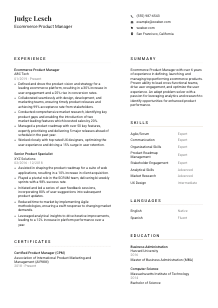
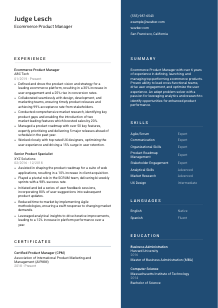
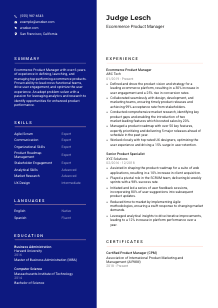
Managing online product shelves, but your CV feels out of stock? Browse through this Ecommerce Product Manager CV example, created with Wozber free CV builder. Learn how to highlight your digital retailing expertise to fit job requirements, ensuring your career stands out as much as a bestseller in the online marketplace!
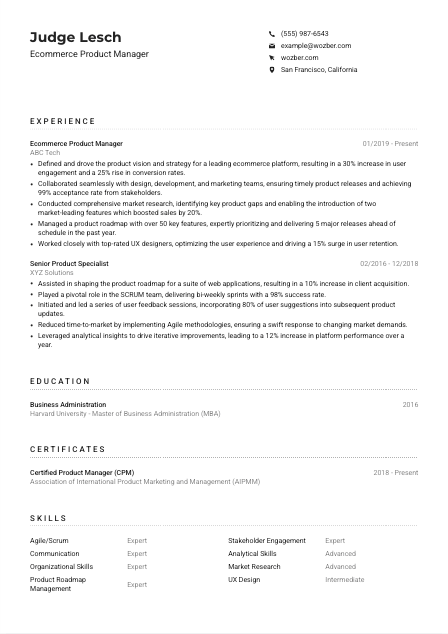
Ecommerce product management gets reviewed through results that sit close to revenue. Hiring teams want to see how you shaped product direction, prioritised a roadmap, improved the customer journey, and turned research into measurable lifts in conversion, engagement, retention, or sales. Your CV should make that operating range clear fast, especially if your work spans discovery, sprint planning, release coordination, and UX iteration.
A tailored CV helps separate ecommerce product managers from broader digital product profiles by showing platform-specific judgment in the language of the role. Using Wozber's free CV builder and an ATS-compliant CV structure, you can align your wording with the posting's terms, surface relevant product outcomes, and make it easier for the team to spot experience in roadmap ownership, cross-functional delivery, and conversion-focused product decisions.
This section is simple, but it still carries hiring signals. For an Ecommerce Product Manager, it should confirm who you are, how to reach you, and any practical requirement that affects eligibility before a recruiter even gets to your roadmap or launch history.
Use your full name as the header anchor of the CV, set apart clearly from the rest of the content. Product managers are often reviewed across several channels, from ATS records to stakeholder interview notes, so your name should be easy to scan and consistent with your LinkedIn profile and application details.
Use the title "Ecommerce Product Manager" directly under your name when that is the role you are pursuing. This creates immediate alignment with the posting and helps frame the rest of your experience around ecommerce platform strategy, feature prioritization, and growth-focused product work rather than a more general product background.
Some ecommerce roles are flexible, but others have a location filter tied to collaboration cadence or office expectations. Here, San Francisco, California is stated as a requirement, so including it in your header immediately answers that screening question. Treat location this way when a posting makes it operationally relevant, not as a universal rule for every application.
Add a LinkedIn profile or personal site if it supports your candidacy. For product managers, that might mean a polished profile with launch history, product thinking, market-facing work, or portfolio-style writeups on experimentation, user research, or feature outcomes. Only include links that reinforce your product judgment and execution record.
Your personal details do not need personality flourishes. They need to confirm identity, contact access, and any explicit screening item, such as location, so the reader can move straight into your ecommerce product record.




This is where an ecommerce product manager CV earns attention. Hiring teams want more than a list of duties. They want to see whether you have led roadmap decisions, worked cross-functionally, shipped improvements, and tied product work to commercial outcomes such as conversion, engagement, retention, or revenue.
Read the job description for the work patterns behind the keywords. Here, the priorities are clear: product vision, roadmap management, market research, cross-functional collaboration, release coordination, and UX work tied to conversion. Use those themes to decide which bullets deserve space and which older responsibilities can be trimmed.
List your most recent position first and build backward. For product roles, this helps hiring teams track increasing ownership, from supporting sprint delivery or customer feedback loops to owning strategy, prioritization, and launch decisions. The example CV does this well by moving from a Senior Product Specialist role into a dedicated Ecommerce Product Manager position.
Each bullet should show what you owned, what you changed, and what happened next. In ecommerce, that often means feature adoption, conversion lift, sales growth, release cadence, retention, or user engagement. A bullet like "defined product vision" is incomplete on its own. The stronger version in the example connects strategy work to a 30% increase in user engagement and a 25% rise in conversion rates.
Metrics matter because ecommerce product work sits close to customer behaviour and trading performance. Use numbers that reflect your actual scope, such as AOV improvement, checkout completion, feature adoption, repeat purchase rate, release velocity, or reduction in drop-off. The sample's mix of conversion, sales, user retention, and ahead-of-schedule releases gives a good model for turning product management into business terms.
If you have broad product experience, bring the ecommerce-relevant parts to the top. Highlight platform strategy, merchandising or catalogue features, checkout flow improvements, experimentation, customer journey work, Agile delivery, and coordination with UX, engineering, and marketing. The posting asks for all of those surfaces, so your bullets should sound like someone who has already worked inside that operating model.
Your experience section should leave no doubt that you can run ecommerce product work from discovery through release. When the bullets connect strategy, execution, and measurable platform outcomes, the CV reads like a product manager who already knows how to move an online business forward.
Education will not outweigh a thin product record, but it still matters, especially when the posting names a degree requirement. For ecommerce product roles, this section should quickly confirm the academic background that supports analytical thinking, technical fluency, or commercial judgment.
When a posting asks for a bachelor's degree in Business, Computer Science, or a related field, make that alignment obvious. A Bachelor of Science in Computer Science, like the one in the example, directly supports work with development teams, platform requirements, and technical tradeoffs.
List each degree with school, degree name, field of study, and graduation year. Recruiters and ATS systems both benefit from consistency here. Save the detail for sections that need narrative, such as experience or summary.
If you have an MBA or another advanced degree that supports product strategy, market analysis, or business decision-making, include it. In the example, the MBA adds commercial depth on top of a technical undergraduate degree, which is a strong combination for ecommerce product leadership.
Early-career candidates can use coursework, capstones, or university projects to show product-adjacent experience in user research, analytics, software development, or digital business. If you already have several years of product work, keep education lighter unless a program or project directly strengthens your fit for the target role.
Honors, research, or student initiatives belong here only if they support your product profile. For example, a venture lab, ecommerce startup project, or human-computer interaction work can add context. Skip unrelated details that do not help explain your path into ecommerce product management.
This section should answer the education requirement quickly and support the rest of your story. Once that is clear, let your experience carry the heavier weight on roadmap ownership, launches, and product performance.
Certifications are optional in many ecommerce product manager searches, but the right one can strengthen your profile. They work best when they support a real pattern already visible in your experience, such as product ownership, Agile delivery, experimentation, or market-driven decision-making.
Start with the posting. If it emphasizes product management practice, Agile collaboration, or ecommerce execution, a relevant certification can add useful support even when it is not required. That is the case here, where a product credential complements the role's focus on strategy, launches, and cross-functional work.
Prioritise credentials that hiring teams will recognize as relevant to product work. The sample's Certified Product Manager credential is a solid example because it reinforces formal product management knowledge without distracting from the core ecommerce experience. Use the same logic with Scrum, Agile, analytics, or UX-related credentials when they genuinely reflect your background.
Dates help show whether the certification is current or part of ongoing professional development. A range such as "2018 - Present" can be useful when the credential remains active. For fast-moving digital commerce environments, recent learning carries more weight than stale credentials with no visible follow-through.
Retire certifications that no longer support your target work, and update this section when you complete relevant coursework or credentials. Ecommerce product management evolves quickly across mobile journeys, personalization, search, checkout, and experimentation, so your learning record should look current enough to match that pace.
A certification section works when it strengthens the product narrative already established elsewhere. Keep only the credentials that add credibility to your ecommerce, Agile, or product strategy background.
The skills section should read like a practical inventory of how you work. For an Ecommerce Product Manager, that means a focused mix of product, analytical, and collaboration skills that map to roadmap decisions, release execution, UX improvement, and business performance.
Look at the posting for the capabilities behind the responsibilities. Here, the recurring themes are Agile or Scrum, analytics, communication, organisation, product vision, roadmap prioritization, market research, and UX collaboration. Those are stronger anchors than broad filler terms that could sit on any CV.
List the capabilities you actively use in your work, not every term you have seen in product job ads. The example skills list does this well by combining product roadmap management, stakeholder engagement, market research, Agile or Scrum, and analytical skills. That mix points to someone who can move from discovery to delivery in an ecommerce setting.
A crowded skills section weakens the signal. Focus on the capabilities most likely to matter for this search, especially those tied to roadmap work, release coordination, cross-functional communication, and conversion-focused UX improvement. If a skill does not help explain how you manage ecommerce products, leave it out.
This section should reinforce the methods and judgment your experience already shows. When the skills are specific to ecommerce product execution, the CV feels coherent instead of padded.
Language requirements are usually straightforward, but they still matter. For ecommerce product managers, communication often runs across engineering, design, analytics, marketing, and leadership, so your listed proficiency should reflect the level at which you can actually work in planning, reviews, and stakeholder conversations.
If the posting specifies English proficiency, list English clearly and prominently. In this case, it is a stated requirement for professional interactions, so it should appear first rather than getting buried under secondary languages.
Put the role's required language at the top, then follow with any additional languages that could support customer, market, or team communication. The example places English first and Spanish second, which keeps the section aligned with the posting while still showing broader communication range.
Extra languages can be useful in ecommerce, especially for companies serving multilingual customers or coordinating across regions. They are most helpful when they connect to the business context, such as market expansion, customer research, or cross-border collaboration. If they are not relevant, keep the section simple.
Use clear labels such as Native, Fluent, Intermediate, or Basic. Product managers spend a lot of time in nuanced discussion, from roadmap tradeoffs to launch coordination, so overstating proficiency can create problems later in interviews or on the job.
When a role includes international marketplaces, vendor relationships, or regional growth work, language ability can become more than a side note. For a standard US-based ecommerce product role, it is usually secondary to product judgment, but it can still strengthen your profile when it supports the company's customer or market footprint.
Keep this section factual and relevant. The main objective is to confirm required communication ability and add any extra language strengths that genuinely support ecommerce collaboration or market reach.
The summary sets the lens for the rest of the CV. For an Ecommerce Product Manager, it should quickly establish your level, your product domain, and the kind of results you drive, so the reader knows they are looking at someone who can manage a commerce platform rather than a generic digital product profile.
Use the job description to identify the few themes that belong in the opening lines. For this role, that means ecommerce product strategy, launches, cross-functional collaboration, market insight, and user experience work tied to conversion. Your summary should reflect that mix without turning into a keyword list.
Start with a direct line that states who you are and how long you have been doing the work. The example summary does this effectively with "Ecommerce Product Manager with over 6 years of experience," which immediately places the candidate in the right lane for the posting's 3+ years requirement.
Follow with two or three points that show the kind of product outcomes you deliver. Strong options include conversion improvement, engagement growth, launch success, roadmap ownership, or research-led feature decisions. The sample summary works because it combines cross-functional leadership, user experience optimisation, and performance improvement into a compact picture.
Aim for a concise paragraph of 3 to 5 lines. That gives enough room to establish domain, seniority, and impact without repeating the experience section. For product management roles, density matters more than flourish. Every sentence should sharpen your case for owning ecommerce product decisions.
A focused summary helps the reader interpret every bullet that follows through the right lens. By the time they reach your experience section, they should already expect to see ecommerce strategy, shipped releases, and measurable customer or business gains.
When the CV clearly shows product vision, roadmap decisions, UX collaboration, Agile delivery, and measurable ecommerce outcomes, hiring teams can quickly place you in the conversation. That is the standard to aim for in every section.
Use Wozber to tighten the language, improve ATS optimisation, and structure your experience in an ATS-friendly CV format that reflects the posting accurately. The final read should make one thing easy to judge: you know how to build, launch, and improve ecommerce products that move customer and business metrics.




