



Use Wozber and land your dream job
Create CV
No registration required
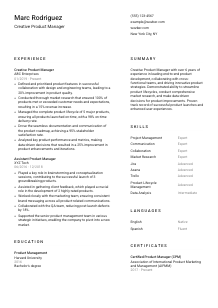
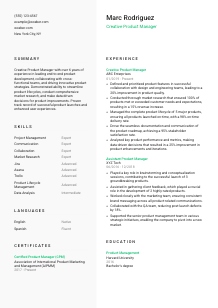
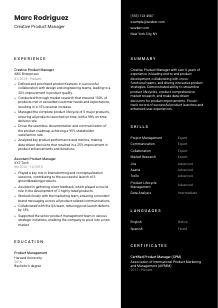
Crafting campaigns, but unsure about your CV story? Explore this Creative Product Manager CV example, created with Wozber free CV builder. It shows how to blend your market mindset and artistic excellence to match job expectations, painting a career path that's always coordinating creativity and commerce.
Creative Product Manager hiring usually turns on one question fast: can you move an idea from concept to launch without losing either the creative standard or the product discipline behind it. Your CV needs to show that balance clearly through shipped work, cross-functional collaboration with design and engineering, and decisions backed by customer research or performance data.
When that balance is buried under generic product language, hiring teams can miss whether you have actually led creative development, roadmap tradeoffs, and launch execution. Wozber's free CV builder helps you shape an ATS-compliant CV around the language of the role, so product launches, roadmap ownership, and measurable outcomes are easier to read in both ATS screening and human review.
For a Creative Product Manager, the top of the CV should establish professional alignment quickly. Keep this section clean and practical so the reader can immediately confirm who you are, what role you are targeting, and whether you meet any basic screening requirements.
Use your full name as the strongest visual element in the header. Keep the styling simple and professional. Creative product roles value presentation, but this section should show clear judgment, not design flair for its own sake.
Place "Creative Product Manager" directly under your name if that is the role you are applying for. This removes ambiguity, especially when your previous titles include adjacent roles such as Product Manager or Assistant Product Manager.
Recruiters and hiring managers should be able to reach you without friction. Use a current phone number and a professional email address, and avoid anything informal.
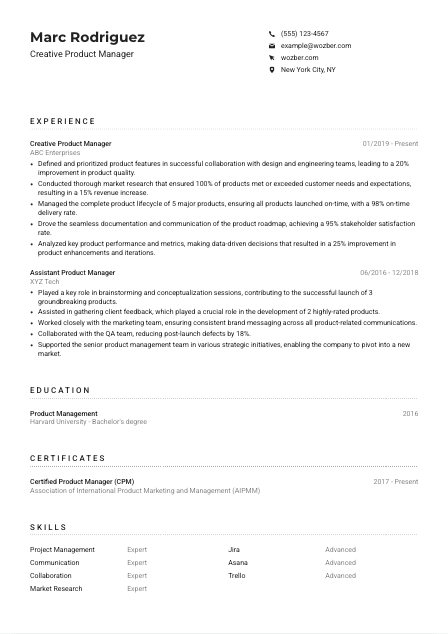
If a job posting specifies a location requirement, address it directly in your header. In the example, listing "New York City, NY" immediately confirms eligibility for a role that requires local presence.
Include LinkedIn or a professional website if it supports your candidacy. For Creative Product Managers, this can reinforce product launches, portfolio work, campaign case studies, or cross-functional achievements, as long as the content is current and consistent with your CV.
This section is brief, but it does real screening work. A clear header lets the reader move straight to your product experience instead of pausing over basic details.




This is the section that carries the most weight for a Creative Product Manager. Hiring teams want to see how you worked with design, engineering, research, and stakeholders to ship products or campaigns, improve performance, and make good roadmap decisions under real delivery constraints.
Start by identifying the operating priorities in the posting. For this role, that includes feature prioritization, market research, roadmap communication, lifecycle ownership, and performance analysis. Your bullets should reflect those same areas using examples from your own work rather than generic product management phrasing.
Show your most recent and most relevant product work first. Include job title, employer, and dates, and give extra attention to positions where you partnered closely with designers, creative teams, or brand-led product environments.
Write bullets around decisions, actions, and results. Instead of saying you were responsible for product lifecycle management, show what you launched, how you coordinated teams, and what changed. The example does this well with bullets on prioritising features, managing five major products, and improving stakeholder satisfaction.
Quantify impact with measures that hiring managers actually care about: launch volume, on-time delivery, product quality, revenue lift, stakeholder satisfaction, defect reduction, or improvement in iteration speed. Metrics such as a 20% quality improvement, 98% on-time delivery rate, or 25% better enhancement outcomes make the scope of your work easier to judge.
Prioritise experience that shows creative product judgment, not every task you have handled. If older roles are less relevant, trim them to the achievements that still support this kind of work, such as cross-functional brainstorming, customer feedback analysis, brand collaboration, or launch support.
A Creative Product Manager CV should make it easy to follow your product decisions from idea to launch and iteration. If your experience section shows creative collaboration, delivery ownership, and measurable product results, it is doing its job.
Education matters here because the posting asks for a bachelor's degree in Product Management, Marketing, or a related field. This section should confirm that foundation quickly, then stay out of the way unless academic work adds something useful to your product story.
If you have a bachelor's degree in product management, marketing, business, design, or a closely related field, make that easy to find. In the example, a bachelor's degree in Product Management aligns directly with the stated requirement.
List your degree, field of study, school, and graduation year. Keep formatting consistent so the section is easy to scan, especially for recruiters checking minimum qualifications.
When your field of study closely supports the role, name it precisely. A degree tied to product strategy, marketing, customer behaviour, or design can reinforce your background in shaping creative products around user and market needs.
If you are earlier in your career, relevant coursework or capstone projects can help fill in product research, launch planning, UX thinking, or market analysis experience. For more experienced candidates, keep these details brief unless they are unusually relevant.
Honors, leadership roles, or standout projects can be worth adding if they connect to product leadership, creative development, or market-facing work. Skip anything that does not deepen the picture of you as a product professional.
This section does not need much space once the requirement is covered. A clear education entry is enough to support the more decisive parts of your candidacy, especially your launch history and cross-functional product work.
Certifications are optional here, but they can still strengthen your CV when they sharpen your product profile. The most useful ones add substance around product practice, agile delivery, roadmap management, research, or tools used in day-to-day execution.
Even without a certification requirement, the posting points to product execution, stakeholder communication, and project management tools. That gives you a useful filter for deciding which credentials belong here.
Prioritise certificates in product management, agile methods, product marketing, user research, or platforms such as Jira and related workflow systems. In the example, Certified Product Manager supports the core discipline of the role.
Listing the year earned helps show the recency of your training. That is especially useful for certifications tied to current product methods, collaboration workflows, or evolving software practices.
Refresh the section as your work changes. If your target roles lean more heavily into creative operations, experimentation, or agile delivery, update your certifications to reflect the way you actually manage products now.
One relevant certification can reinforce your product credibility. A long list of loosely related courses usually adds less value than a focused set that matches how you lead, launch, and iterate products.
Creative Product Manager roles sit at the intersection of product thinking, creative collaboration, and delivery execution. Your skills section should reflect that mix with tools, methods, and working strengths that match how the role is actually performed.
Look for both stated and implied requirements. Here, the clearest ones are project management tools, market research, communication, collaboration, product lifecycle management, and data-driven decision-making.
List the tools you genuinely use, such as Jira, Asana, or Trello, alongside product skills like roadmap planning, market research, feature prioritization, and stakeholder communication. The example works because it combines workflow tools with collaboration and lifecycle management rather than listing software alone.
Do not turn this into a keyword dump. Choose the skills that are most likely to matter in the role you are targeting, organise them clearly, and make sure the rest of the CV proves them through real work.
A hiring team should be able to glance at this section and see a product manager who can guide creative work, coordinate delivery, and use product data to improve what ships.
Language skills matter when the job requires clear business communication across teams, stakeholders, or markets. For Creative Product Managers, this section is usually short, but it should still be precise.
If the posting explicitly asks for English, list it clearly with an honest proficiency level. In this case, strong English for business communication is a stated requirement, so it should not be buried.
Lead with the language the role requires, then include additional languages that may help with stakeholder communication, customer insight work, or cross-market collaboration.
Extra language ability can support work with broader customer groups, regional teams, or external partners. It is not mandatory for every Creative Product Manager role, but it can add value when the business has wider reach.
Terms like Native, Fluent, Advanced, or Conversational are usually enough. Keep them realistic. Overstating language skill becomes obvious quickly in interviews and stakeholder-facing roles.
If the company operates across regions or serves multilingual audiences, your language skills can reinforce your ability to gather feedback, communicate updates, and work across functions. If not, keep this section brief and factual.
For this role, the main point is simple: make business-level English easy to confirm, then add any other language strengths that genuinely support the work.
The summary should quickly position you as someone who can lead creative product work with enough structure to deliver it. Focus on the combination that matters most here: product ownership, cross-functional execution, market insight, and measurable launch results.
Read the posting for the operating centre of the job. Here, that means guiding features, using research and feedback, managing products through launch, and improving them through metrics. Those themes should shape your opening lines.
Start with your title and years of experience, then anchor it in the kind of environment you know best. For example, "Creative Product Manager with 6+ years of experience leading end-to-end product development in design-focused environments" gives immediate context.
Mention capabilities that directly match the role, such as roadmap ownership, market research, feature prioritization, or successful launches. The example summary works because it combines lifecycle leadership, cross-functional collaboration, and data-driven improvement instead of speaking in broad generalities.
Aim for three to five lines. That is enough space to establish your product focus, your working style, and one or two concrete results without repeating the experience section.
Your summary should leave no doubt about the kind of Creative Product Manager you are. When it names your scope, your environment, and your product results clearly, the rest of the CV has a much easier job.
A well-tailored Creative Product Manager CV shows how you balance creative collaboration with product discipline, from feature prioritization and customer insight to launch execution and iteration. Each section should help a hiring team quickly understand what you have shipped, how you worked with cross-functional partners, and what improved because of your decisions.
Use Wozber's free CV builder to organise that story in an ATS-friendly CV format, then refine the language with ATS optimisation in mind so the terminology, tools, and product outcomes match the target posting. The final result should make your readiness for creative product ownership easy to recognize.