



Use Wozber and land your dream job
Create CV
No registration required
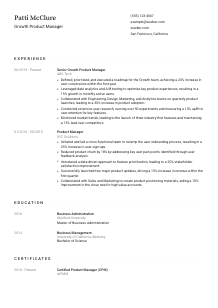
Driving product growth, but feeling your CV stagnant? Check out this Growth Product Manager CV example, created with Wozber free CV builder. It shows how to lay out your growth strategies to match job expectations, propelling your career trajectory as rapidly as the products you manage!
Growth Product Management sits at the point where product judgment meets measurable business movement. Hiring teams want to see how you identified friction in the user journey, turned insights into experiments, and moved metrics such as activation, conversion, retention, or adoption through product changes rather than broad marketing claims.
The first CV read often comes down to whether your growth work is legible fast. Wozber's free CV builder helps you shape an ATS-compliant CV around the language of experimentation, analytics, and cross-functional delivery, so the reader can quickly see where you influenced the funnel and how you worked with product, engineering, design, and marketing to move it.
Growth Product Manager hiring usually starts with a fast scan for role alignment, location fit, and clean contact details. Keep this section straightforward so nothing blocks the reader from getting to your roadmap ownership, experiment work, and growth results.
Use your full name as the visual anchor at the top of the CV. Keep it easy to read and slightly more prominent than the rest of the header so the document feels polished and professional from the first glance.
Place "Growth Product Manager" under your name when that is the role you are pursuing. This immediately frames your experience around growth loops, conversion optimisation, experimentation, and product-led user acquisition instead of leaving the reader to infer whether you are coming from a broader product background.
Add a current phone number and a professional email address, then check them carefully. At this level, missed interview outreach because of a typo is an avoidable mistake. If you include a website or LinkedIn profile, make sure it reinforces the same product, analytics, and leadership story shown on the CV.
If the role asks for San Francisco, California, or willingness to relocate, say so clearly in this section. That kind of detail can affect early screening, and adding it upfront removes uncertainty. For other applications, match whatever location wording the employer uses without turning location into a bigger point than your experience.
A LinkedIn profile, portfolio, or personal site can help if it shows shipped products, experiment case studies, writing on growth strategy, or product thinking. Skip links that do not deepen your credibility. For a Growth Product Manager, external links should extend the story of product decisions and measurable user impact.
This section should remove friction, not create it. When your title, contact details, and location are easy to confirm, the reader can move straight to the part that matters most for this job: how you drive growth through product work.




This is where Growth Product Manager CVs separate themselves. Titles matter, but hiring teams spend more time on what you shipped, which part of the funnel you owned, how you worked with engineering and design, and what changed in the metrics after launch.
Read the posting for the operating themes behind the title. Here, the clear priorities are roadmap ownership, data analysis, A/B testing, user research, cross-functional collaboration, and ongoing market awareness. Those themes should appear in your experience bullets in natural language tied to real work, not as a copied keyword list.
List your jobs in reverse chronological order and give each role enough context to show progression. For growth-focused applications, prioritise positions where you owned onboarding, activation, monetization, retention, lifecycle improvements, or product adoption. If an earlier role was broader product management, rewrite the bullets to foreground the growth side of that work.
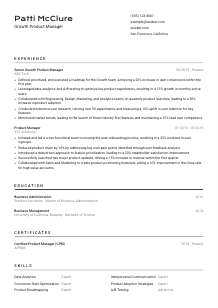
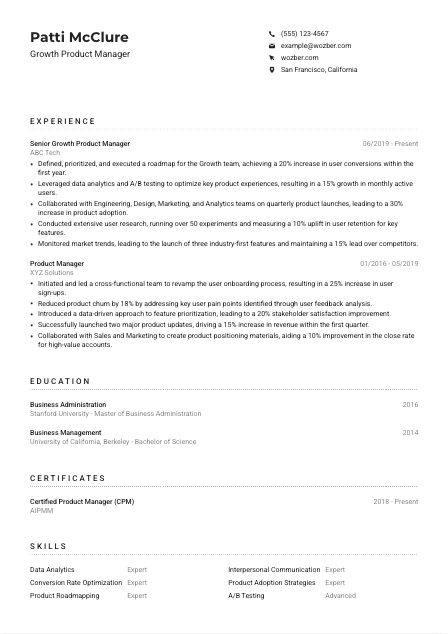
Your strongest bullets should show a clear chain: problem, action, and measurable result. The sample CV does this well with points like a 20% increase in user conversions, a 15% lift in monthly active users, and 50+ experiments tied to retention gains. Use that pattern in your own history by naming the user journey issue you addressed, the change you led, and the business metric that moved.
Numbers carry more weight when they match how growth work is evaluated. Prioritise conversion rate, activation rate, retention, churn reduction, MAU or DAU growth, onboarding completion, adoption of key features, revenue lift, experiment velocity, or win rate improvements. Pair the metric with the product action behind it so the reader sees judgment, not just the outcome.
Keep the section focused on work that proves you can identify opportunities, prioritise the roadmap, run experiments, and influence results across teams. General product bullets without a user-growth angle should be trimmed or rewritten. A hiring manager should be able to scan this section and quickly understand where you drove acquisition, conversion, retention, or product adoption.
A Growth Product Manager CV works when each role shows ownership, experimentation, and movement in the numbers. If your bullets make it easy to trace product decisions to user and business outcomes, this section is doing its job.
Education is usually a secondary screen for experienced Growth Product Managers, but it still matters when the posting names a degree requirement or a preferred advanced degree. Present it clearly and let it support, rather than overshadow, your product and growth experience.
If the employer asks for a Bachelor's degree in Business, Marketing, or a related field, include the most relevant degree first. If you also hold a Master's degree, especially an MBA or another business-focused qualification, place it prominently because it can strengthen your profile for strategy-heavy growth roles.
List school, degree, field of study, and graduation year in a consistent format. Hiring teams do not need extra explanation here. They want to confirm the credential quickly and return to the sections that show product judgment, analytics depth, and execution history.
When a posting says a Master's degree is preferred, do not bury it. In the example, the MBA immediately reinforces strategic and commercial grounding, while the Bachelor's degree in Business Management satisfies the core education requirement. If you have a similar profile, let that alignment be easy to spot.
Most experienced candidates can skip coursework. Include it only if it adds something your work history does not fully show, such as statistics, behavioral economics, digital marketing, experimentation design, or product strategy. Early-career applicants can use this space more actively than senior candidates can.
Honors, major projects, or leadership roles are useful when they connect to product, analytics, or business thinking. Keep them brief. For a Growth Product Manager, the section should suggest strong fundamentals, not read like a campus biography.
This section needs to confirm that you meet the stated degree expectations and, where applicable, show added strategic depth. Once that is clear, your CV should return quickly to the growth work itself.
Certificates are rarely the deciding factor for Growth Product Manager hiring, but the right ones can reinforce your command of product practice, experimentation, analytics, or growth strategy. Choose certifications that match how you actually work.
Even when the posting does not require certifications, relevant credentials can strengthen your profile. A certification such as Certified Product Manager can help because it complements roadmap ownership, stakeholder communication, and product decision-making. Growth, analytics, experimentation, or CRO-related credentials can also be useful when they reflect real expertise.
A short list of well-matched certifications is stronger than a long list of loosely related courses. Focus on credentials that connect to product growth work, such as experimentation, analytics, user research, lifecycle optimisation, or product leadership. Every item should feel connected to the responsibilities you want to own.
If a certificate is current, recently earned, or periodically renewed, show the date. That helps signal that your methods are current, especially in areas like testing frameworks, analytics tools, or evolving product practices. The sample's active CPM credential is a good example of simple, clear presentation.
Growth work changes quickly as tooling, privacy constraints, and user behaviour shift. Updating your learning in areas like experimentation, product analytics, or growth loops shows that you stay sharp. Keep only the certifications that still support your target role and remove outdated items that no longer add much.
This section should back up your product and growth story with a few well-chosen credentials. When the certifications align with how you run experiments, read data, and lead product work, they add credibility without taking over the CV.
A Growth Product Manager skills section should read like the operating toolkit behind your results. Generic lists weaken the section. Strong ones point to the analysis, experimentation, prioritization, and cross-functional collaboration that drive user and revenue growth.
Start with the capabilities named in the job description. Here that includes data analytics, A/B testing, growth strategy, user acquisition, conversion rate optimisation, and communication across teams. Bring those terms into your skills section only if they reflect your actual experience, then support them with matching evidence elsewhere on the CV.
Growth Product Managers need analytical and organizational range. Include hard skills such as product analytics, experimentation, funnel analysis, user research, roadmapping, and growth modeling alongside collaboration skills like stakeholder communication and cross-functional leadership. The sample list works because it mixes growth mechanics with the interpersonal side of shipping work across teams.
Do not turn the skills section into a database dump of every platform or method you have touched. Group and prioritise the capabilities most relevant to the role you want. A concise list makes it easier for both ATS screening and human review to connect your skills to your results in conversion, retention, and adoption.
The best skills section feels consistent with the rest of the CV. If the reader can move from a skill like A/B testing or conversion optimisation straight to a bullet that shows where you applied it, your CV will feel much more credible.
Language requirements are usually straightforward in Growth Product Manager hiring, but they still matter. Clear communication affects user research, stakeholder alignment, experiment readouts, and cross-functional execution, so list languages accurately and in order of relevance.
If the role requires spoken and written English, list English first and make your proficiency level clear. That immediately confirms you can handle product docs, experiment analysis, presentations, and collaboration across functions.
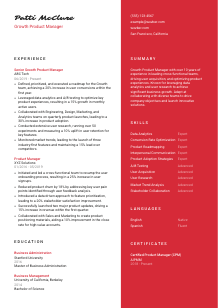
After the required language, list other languages that could support the product's user base, market expansion, or internal collaboration. In the example, Spanish adds value because multilingual communication can help in user-facing research or broader market context, even though English is the stated requirement.
Additional languages can strengthen your profile for products with international users or cross-regional teams. They are less important for every role than experience with growth metrics and product execution, so keep this section brief and relevant.
Use plain labels such as "Native," "Fluent," or "Intermediate." Avoid overstating your level. Growth Product Managers are often expected to present findings, moderate discussions, or synthesize research, so honesty here matters.
If the company operates across markets or serves multilingual users, language skills can support research quality, localization input, and market understanding. Mention them as an added advantage, not as a replacement for product judgment or growth results.
This section is most effective when it confirms the required communication baseline and adds any market-relevant language strengths without distracting from your core product and growth qualifications.
The summary sets the lens for the rest of the CV. For a Growth Product Manager, it should quickly establish your level, the growth problems you solve, and the kinds of outcomes you have driven through product strategy, experimentation, and cross-functional execution.
Before writing, pull out the few themes the employer cares about most. In this case, they want someone who can lead a growth roadmap, use analytics and A/B testing well, work across functions, and improve product performance through research and iteration. Those ideas should shape the summary more than broad claims about leadership or passion.
Start with a direct statement of who you are professionally. A line such as "Growth Product Manager with 10+ years of experience driving user acquisition, conversion, and retention" gives immediate context and positions you inside the growth discipline rather than general product management.
Use the next lines to highlight the capabilities that define your value. The example summary points to cross-functional leadership, data analytics, user research, and business growth. You can strengthen this further by naming the kinds of metrics or initiatives you influence, such as onboarding optimisation, experiment programs, or feature adoption.
Aim for three to five lines. That is enough space to establish your profile without repeating bullets from the experience section. Every sentence should earn its place by clarifying your growth focus, decision-making approach, or measurable product impact.
A strong summary makes the rest of the CV easier to read because it tells the hiring team what kind of Growth Product Manager they are looking at. Keep it specific enough that your roadmap, experiments, and outcomes feel coherent from the first lines.
A polished Growth Product Manager CV should make three things easy to see: the part of the funnel you influenced, the product decisions you led, and the metrics that changed because of that work. When those elements are clear across your summary, experience, and skills, the hiring team can quickly understand your value.
Wozber's free CV builder can help you organise that story in an ATS-friendly CV format, refine phrasing with its AI CV builder, and check alignment with an ATS CV scanner so your growth experience is easier to surface. The final read should leave no doubt about your ability to turn insight, experimentation, and cross-functional execution into measurable product growth.




