



Use Wozber and land your dream job
Create CV
No registration required
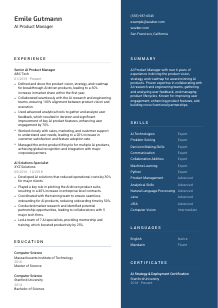
Guiding algorithms, but finding your CV lost in translation? Navigate this AI Product Manager CV example, created with Wozber free CV builder. Learn how to blend your tech-savvy leadership with insights from the job landscape, positioning your digital product vision right where the market thinks best.
AI Product Managers sit between research ambition and product reality. Hiring teams look for people who can turn machine learning capability into shipped features, business priorities, and measurable user outcomes. Your CV needs to make that translation visible through roadmap ownership, model-informed decisions, cross-functional execution, and the results you drove after launch.
A tailored CV helps reviewers quickly separate general product managers from candidates who have actually worked with AI systems, data-informed iteration, and research or engineering tradeoffs. Wozber's AI CV builder helps align your wording with the role, strengthen ATS optimisation, and surface terms such as machine learning, NLP, computer vision, lifecycle ownership, and user feedback analysis so your experience reads clearly as AI product work.
For AI Product Manager openings, the header should establish professional credibility fast and remove avoidable friction. Keep it clean, accurate, and aligned with the role so the hiring team can move straight to your product and AI experience.
Place your full name prominently, then use a clear professional title underneath. If you are targeting AI Product Manager roles, say so directly rather than using a broader label like "Product Leader" or "Technology Strategist." That immediately frames the rest of the CV around AI products, model-backed features, and roadmap ownership.
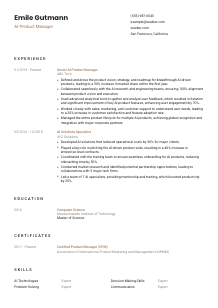
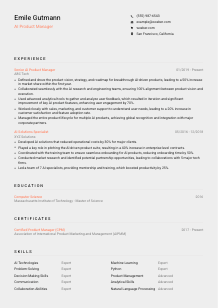
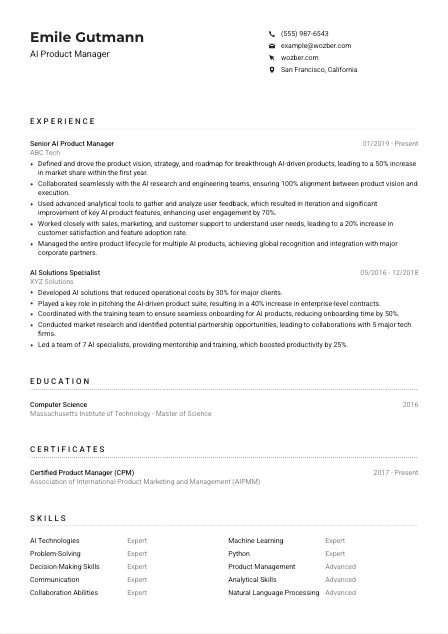
Mirror the job title when your experience supports it. "AI Product Manager" works well here because the role specifically asks for product management experience tied to AI technologies. In the example CV, that title aligns with both the current role and the technical scope described later in the document.
Keep your phone number and email professional and current. Product hiring often moves through recruiter screens, stakeholder interviews, and panel scheduling, so unreachable contact details can stall an otherwise qualified application.
Some AI product roles are tied closely to a specific office because they require regular collaboration with engineering, research, and GTM teams. This posting asks for San Francisco, CA, so listing that location in your header immediately answers a practical screening question. Treat that as role-specific tailoring, not a rule for every AI Product Manager CV.
Add LinkedIn or a personal site if it strengthens your case with product launches, thought leadership, patents, case studies, or portfolio material. For this profession, useful links often show product strategy work, technical fluency, or AI-related initiatives rather than generic personal branding.
This section should confirm who you are, what role you are targeting, and whether you meet basic logistical requirements. Wozber's free CV builder helps keep the layout polished and ATS-friendly while putting the focus where it belongs, on your AI product track record.




This is where an AI Product Manager CV earns attention. Hiring teams want to see product judgment in action, not generic ownership language. Your bullets should show how you shaped roadmap decisions, worked with technical teams, used data and feedback loops, and delivered outcomes that mattered to users or the business.
Start by identifying the repeated patterns in the posting. Here, the employer is asking for product vision, roadmap leadership, AI fluency, user feedback analysis, cross-functional collaboration, and end-to-end lifecycle management. Those themes should guide which achievements you include and which terms you mirror in your bullets.
List positions in reverse chronological order and make the path easy to follow. For this field, titles matter because they show whether you owned strategy, worked adjacent to AI teams, or directly managed AI-driven products. If you moved from an AI specialist or solutions role into product leadership, that progression tells a strong story when presented clearly.
Each role should focus on outcomes tied to AI product management. Include what you led, who you worked with, and what changed because of your decisions. The example CV does this well by connecting roadmap and cross-functional execution to outcomes like market share growth, stronger user engagement, and higher customer satisfaction. That is much more persuasive than listing duties alone.
Metrics help hiring teams understand scale and impact. For AI product roles, useful numbers might include adoption rate, engagement lift, retention, model-driven workflow efficiency, cost reduction, launch timing, revenue influence, customer satisfaction, or enterprise expansion. A bullet like "improved key AI features" becomes far stronger when paired with a result such as a 70% engagement increase or a 20% gain in feature adoption.
Prioritise experience that shows AI product strategy, technical partnership, experimentation, and lifecycle ownership. Leave out details that do not reinforce those themes. Even strong achievements from adjacent roles should be framed through product impact, customer insight, or AI implementation so the CV keeps pointing back to the role you want now.
A hiring manager should be able to scan your experience and see where you set direction, where you partnered with research and engineering, and what results your product choices produced. Wozber's ATS CV scanner can help you match that story to the language of the job description without flattening it into a list of keywords.
AI Product Manager roles often sit close to technical teams, so education still carries weight. A degree in computer science, engineering, or a related field helps establish that you can engage with model capabilities, product constraints, and engineering tradeoffs at a practical level.
Lead with the credential that best supports the role's technical expectations. This posting asks for a bachelor's degree in Computer Science, Engineering, or a related field, with a master's preferred. If you have both, list the master's first, as in the example CV, because it immediately reinforces depth in the domain.
Include degree, field of study, school, and graduation year. AI product hiring rarely needs a long academic narrative. A concise listing gives enough context while leaving room for the parts of the CV that show shipped products, roadmap ownership, and measurable outcomes.
If your degree is in Computer Science, Engineering, Data Science, or another relevant area, name it clearly. That matters in AI product work because it signals comfort with technical discussions around model behaviour, data requirements, and system constraints. The sample CV's Computer Science degrees align neatly with the employer's stated preference.
Specialised coursework can help if you are earlier in your career or if your degree title is broad. Include subjects like machine learning, natural language processing, statistics, human-computer interaction, or computer vision only when they add useful context for the target role.
Honors, research, or relevant projects can be worth adding if they connect to AI or product thinking. Keep them brief and choose items that support the role's demands, such as applied ML work, product-focused capstones, or interdisciplinary collaboration with engineering and business stakeholders.
This section should support your credibility, not compete with your experience. When your academic background is presented clearly, it strengthens the picture of a product manager who can work comfortably with AI teams and product strategy alike.
Certifications can strengthen an AI Product Manager CV when they sharpen a theme already present in your experience. The most useful ones show current thinking in AI, product strategy, experimentation, or deployment rather than collecting unrelated badges.
Prioritise credentials tied to AI technologies, product management, analytics, or go-to-market execution for technical products. For this kind of role, a product certification and an AI strategy credential make sense because they support both sides of the job, product leadership and AI fluency.
A short list of aligned certifications reads better than a long inventory. If a certificate does not help explain your ability to define roadmap priorities, work with AI teams, or guide product decisions with data, it probably does not belong here.
AI moves quickly, so timing matters more here than in many other fields. Listing the year earned or active period helps show whether your formal learning is recent enough to support current product conversations around ML, NLP, or deployment realities.
Use this section to reflect continued development in a field that changes fast. The example CV includes certifications in product management and AI strategy, which works because the experience section already shows the candidate applying that knowledge in shipped work and business results.
Well-chosen certifications reinforce your product and AI credibility. They work best when they extend the story your experience already tells about roadmap ownership, technical collaboration, and informed product decisions.
The skills section should read like the toolkit of someone who can define, launch, and improve AI products. That means balancing technical literacy with product execution, analytics, and cross-functional leadership rather than dropping in a generic list of buzzwords.
Use the job description to identify the capabilities being screened for. Here that includes machine learning, natural language processing, computer vision, analytical thinking, decision-making, communication, and collaboration across research, engineering, sales, marketing, and support. Those are the skills worth surfacing first if they reflect your experience.
Show that you can operate across both strategy and technical context. Technical items might include ML, NLP, computer vision, Python, SQL, experimentation, or analytics tools. Product-side skills might include roadmap planning, product lifecycle management, stakeholder alignment, prioritization, and user research. The sample CV mixes these two categories effectively, though you can make yours even clearer by ordering the most role-relevant items first.
Avoid overloading the section with every tool you have touched. Choose skills you can support elsewhere through bullets, launches, or summary claims. If you include proficiency levels, make sure they are believable and consistent with the rest of the CV.
A hiring team should be able to glance at this section and understand your AI fluency, your product operating range, and your ability to work across technical and commercial teams. Wozber's free CV builder can help organise those skills in an ATS-compliant CV without losing clarity.
Language skills matter when the role depends on clear communication across teams, customers, and markets. For AI Product Managers, this section is usually brief, but it can still add value when it supports stakeholder work, global product collaboration, or customer-facing responsibilities.
If the posting specifies a language, list it prominently with an honest proficiency level. This role requires strong English communication, so English should appear first and be labeled clearly, especially if you work across research, engineering, marketing, and customer-facing teams.
Additional languages can be useful if the product serves international users, enterprise clients, or distributed teams. They are most valuable when they connect to actual collaboration, market research, customer discovery, or go-to-market work.
Choose terms such as Native, Fluent, Intermediate, or Basic so reviewers can interpret your level quickly. Keep it simple and avoid inflated descriptions that are hard to assess in an interview setting.
Extra languages should strengthen your profile, not distract from your core product and AI qualifications. For example, Mandarin on the sample CV adds international range, but the main hiring case still rests on AI product leadership and measurable outcomes.
If the company operates across regions or supports multilingual user bases, language skills can support customer insight and stakeholder communication. If not, keep this section concise and let your product, AI, and execution experience do the heavy lifting.
List the languages that matter, label them clearly, and let them complement the rest of your application. In AI product hiring, language skills are most useful when they support collaboration, customer understanding, or market reach.
The summary sits at the top of the CV, so it needs to establish your level, specialty, and kind of impact quickly. For an AI Product Manager, that usually means combining product leadership with enough technical depth to work credibly with research and engineering teams.
Start with a concise line that states your role and scope. Mention total product experience and your direct AI exposure if it is meaningful. This posting asks for at least 5 years in product management and 2 years with AI-driven products, so a summary that makes both points clear will read as well matched from the start.
Choose two or three capabilities that define how you operate. Good options include product vision and roadmap ownership, collaboration with AI research and engineering, user feedback analysis, experimentation, or lifecycle management from concept to post-release iteration. The sample summary does this well by tying strategy, collaboration, and feature improvement together.
A summary becomes much more credible when it includes proof of results. You do not need to crowd it with numbers, but one concrete signal such as growth in engagement, adoption, market share, or customer satisfaction can quickly separate you from candidates whose summaries stay purely descriptive.
Aim for three to five lines with no filler. Avoid generic claims about being passionate, innovative, or results-driven unless they are anchored in actual AI product work. A clear summary should make the reader expect stronger detail in the experience section, not repeat empty language they have seen hundreds of times.
Your summary should make one thing immediately clear: you know how to turn AI capabilities into product direction, cross-functional execution, and business results. Wozber's ATS CV scanner can help you align that opening with the language of the role so the right themes surface early.
A well-tailored AI Product Manager CV shows more than interest in artificial intelligence. It shows that you can set product direction, work effectively with technical teams, learn from users and data, and carry an AI product through launch and iteration.
Use Wozber's free CV builder to organise that story in an ATS-friendly CV format, strengthen alignment with the job description, and present your experience in language that matches how AI product teams actually hire. The finished CV should make your product judgment and AI credibility easy to see.