



Use Wozber and land your dream job
Create CV
No registration required
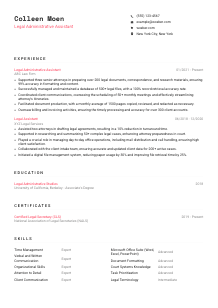
Supporting lawyers, but your CV objects? Review this Legal Administrative Assistant CV example, built with Wozber free CV builder. Learn how to outline your legal acumen and office organisation to suit any job's verdict, ensuring your career stays firmly in the court's favor!
Legal administrative assistants keep legal work moving when deadlines tighten, filings pile up, and attorneys need documents, calendars, client communication, and billing handled without errors. A CV for this field needs to show that you can manage confidential files, produce accurate legal paperwork, and keep pace in a busy office where small mistakes can affect a case, a court submission, or a client relationship.
Hiring teams often scan first for direct legal support experience, document handling, court-system familiarity, and the practical tools behind the work. Wozber's free CV builder helps you shape that experience into an ATS-compliant CV that mirrors the posting's language naturally, so the reader can quickly see your ability to support attorneys, manage legal records, and stay accurate under pressure.
Law offices expect the header of your CV to be as clean and dependable as the documents you prepare. This section should confirm who you are, how to reach you, and, when relevant to the posting, whether you already meet a location requirement without forcing the reader to search for it.
Place your full name at the top in a clear, readable format. For legal support roles, polished presentation matters because it sets the tone for the rest of the CV, much like a properly formatted pleading or client letter.
Add "Legal Administrative Assistant" directly beneath your name if that is the role you are pursuing. Matching the target title helps frame your background immediately, especially when your past positions may include close variations such as Legal Assistant or Administrative Assistant in a legal office.
List a working phone number and a professional email address. Legal employers handle time-sensitive communication around client matters, scheduling, document revisions, and billing, so your contact details should look reliable and current.
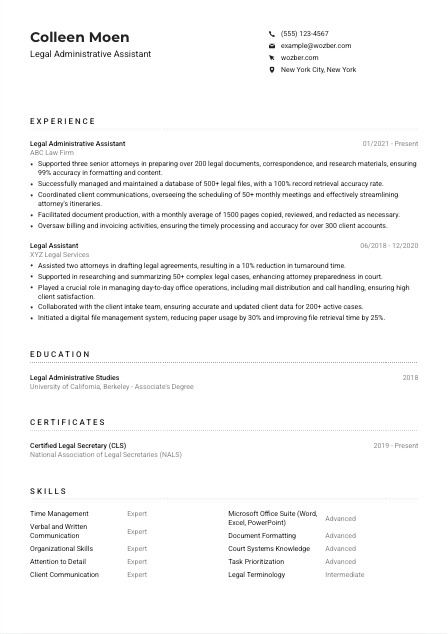
If the employer requires local availability, show your city and state in the header. Here, listing "New York City, New York" answers the posting's location requirement right away and removes a basic screening question before the CV reaches the interview stage.
A LinkedIn profile can be useful if it reinforces your legal support experience, certifications, or recommendations from attorneys and office managers. Include it only if the details match your CV and strengthen your professional record.
Your personal details should read like the top line of a well-prepared legal document: accurate, uncluttered, and immediately useful. When the basics are handled well, the reader can move straight to your legal support experience.




This is where a law firm or legal department looks for proof that you can keep attorneys organised, documents accurate, and office workflows moving. Focus less on generic admin duties and more on legal support tasks such as document preparation, file management, scheduling, redaction, client communication, research support, and billing coordination.
Read the job description and mark the recurring duties and constraints. In this case, the priorities are clear: supporting attorneys, preparing legal documents and correspondence, maintaining confidential files, coordinating meetings and itineraries, handling document production, and processing billing accurately in a fast-paced setting.
Organise your work history in reverse chronological order and make each entry easy to scan. Include title, employer, and dates, then let the bullets show the legal environment you worked in, whether that meant supporting litigators, handling intake for active matters, or maintaining filing systems for a busy practice.
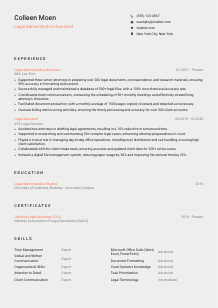
Start each bullet with a concrete action verb and connect it to a legal workflow. The sample CV does this well with lines like supporting three senior attorneys with 200+ legal documents and coordinating 50+ monthly meetings, which immediately tells the reader about workload, scope, and the type of support delivered.
Metrics are especially useful in legal administrative work because they show pace, precision, and reliability. Strong examples include number of attorneys supported, files maintained, meetings scheduled, pages produced or redacted, billing volume, retrieval accuracy, or turnaround improvements. Those details make routine support work feel tangible.
Keep older or unrelated experience only if it adds a skill the firm will care about, such as high-volume scheduling, records management, or confidential client communication. Otherwise, give most of the space to legal office work, legal document handling, and administrative duties tied directly to attorney support.
A hiring manager should be able to see, bullet by bullet, how you supported attorneys, handled legal documents, and kept confidential information organised under real workload pressure. That is the core of your value in this role.
Education usually plays a supporting role for legal administrative assistants, but it still helps shape how your background is read. Degrees in legal studies, office administration, business, or related fields can reinforce your familiarity with legal terminology, document structure, research basics, and professional office standards.
Place your most applicable degree or diploma first, especially if it relates to legal studies or administration. An Associate's Degree in Legal Administrative Studies, for example, directly supports the kind of document handling, terminology, and office procedures many firms expect.
List degree, field of study, school, and graduation year in a consistent format. Legal employers value organised presentation, and a clean education entry helps maintain that standard across the CV.
If your degree title connects clearly to the position, make sure it is written in full. A legal-focused program can strengthen your profile when the employer wants someone already familiar with legal office environments, even if the posting emphasizes experience more than education.
You do not need to list classes unless they sharpen your match for the role. If you are earlier in your career, courses in legal writing, civil procedure, records management, or business communication can help bridge the gap between school and practice.
Honors, law society involvement, or office-related academic projects can be worth adding if they reinforce discipline, writing ability, or legal interest. Keep them brief and relevant so the section stays useful rather than decorative.
Your education section should quietly support the rest of the CV by showing that your training lines up with legal office work. When it is relevant and clearly formatted, it adds context without taking attention away from your hands-on experience.
Certifications are not always mandatory for legal administrative roles, but the right ones can sharpen your profile, especially when they connect to legal office procedures, document authority, or day-to-day administrative trust. They work best when they clearly support the responsibilities named in the posting.
Start with the actual work described in the job ad. If the role involves legal document handling, confidentiality, client-facing coordination, or notarized paperwork, certifications tied to legal administration or document execution can add real value even when not explicitly required.
Choose credentials that speak to legal office work first. In the sample CV, Certified Legal Secretary and Notary Public both strengthen the candidate's profile because they connect to legal administration, documentation standards, and practical office support in a law setting.
Include the year earned and, if relevant, the active date range. This is especially useful for certifications that require renewal or state standing, because it tells the employer the credential is current enough to matter now.
Recent coursework in legal software, e-filing procedures, records management, or advanced Microsoft Office can also belong here if it improves your match. Keep the focus on training that helps you work faster, more accurately, or more confidently in a legal office.
Use certifications to show legal-office preparation, current standing, and professional initiative. When they connect directly to document handling, office procedures, or client service, they strengthen your CV without taking over it.
The best skills sections for legal administrative assistants read like a summary of how the office actually runs. Include a mix of legal support knowledge, document tools, communication abilities, and organizational strengths that map directly to attorney support, records management, scheduling, and billing tasks.
Use the job description to identify the exact capabilities the employer wants to see. Here, that includes Microsoft Office Suite, time management, written and verbal communication, attention to detail, task prioritization, legal terminology, document formats, and court-system familiarity.
Order the list so the most relevant skills appear first. For this role, that usually means legal document formatting, file management, client communication, scheduling, Microsoft Word and Excel proficiency, billing support, confidentiality, and the ability to work accurately under pressure.
Keep the list selective. A tighter set of skills aligned to legal support work will read better than a long list of generic strengths. The sample CV is a useful model here because it balances office tools, legal knowledge, and execution skills like task prioritization, court systems knowledge, and attention to detail.
When this section is tailored well, a hiring manager can picture you formatting documents, managing files, coordinating calendars, handling client communication, and supporting billing without needing to guess where your strengths apply.
Language ability can matter in legal support work because communication needs to be clear, accurate, and appropriate for clients, attorneys, and administrative staff. This section is usually short, but it becomes important when the job posting specifically names a required language or when multilingual communication supports the practice.
If the posting explicitly requires English fluency, list English at the top with your actual level. That directly answers one of the employer's stated criteria and is especially relevant in roles involving correspondence, scheduling, document preparation, and client communication.
Extra language skills can strengthen your application when a firm serves multilingual clients or works across diverse communities. Spanish, for example, may be useful in intake, scheduling, and basic client communication even when it is not listed as a formal requirement.
Choose straightforward levels such as Native, Fluent, Professional Working, or Conversational. Legal employers need an accurate sense of how comfortably you can communicate, particularly if the role includes direct client contact or drafting support.
Not every legal administrative position requires multiple languages, so do not overstate this section. Include languages when they are genuinely useful to the practice area, client population, or communication demands of the office.
If you list a language, it should imply real workplace value, whether that means smoother client interactions, clearer phone communication, or better support in a multilingual office environment. That makes the section feel relevant instead of ornamental.
For legal administrative work, language skills matter when they improve communication accuracy and client service. Present them clearly, lead with required fluency, and let the section support the realities of the office you are applying to.
Your summary should quickly establish your level of legal administrative experience and the kind of support work you handle well. In a few lines, show your familiarity with legal documents, attorney support, office systems, communication, and the pace or volume you can manage.
Before writing, identify the recurring themes in the posting. For a legal administrative assistant, that usually means attorney support, document preparation, file accuracy, client communication, scheduling, confidentiality, and the ability to stay organised under pressure.
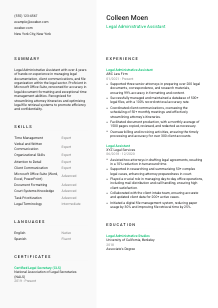
Your first line should tell the employer who you are professionally. A phrase like "Legal Administrative Assistant with 4+ years of experience supporting attorneys with legal documents, scheduling, and file management" works because it establishes tenure and relevant scope immediately.
Use the summary to mention the capabilities the employer is most likely scanning for, such as Microsoft Office proficiency, legal document formatting, court-system familiarity, billing support, or strong written communication. The sample summary works because it connects software knowledge with accuracy, time management, and improved file retrieval efficiency.
Aim for three to five lines with no filler. Focus on concrete support functions and outcomes rather than broad personality claims. A legal employer should finish the summary knowing what kind of office work you can handle and how you contribute to accuracy and workflow.
When written well, your summary gives the reader an immediate picture of your legal support background, your working style, and the office demands you can handle. It should make the rest of the CV feel consistent and easy to trust.
A legal administrative assistant CV should make one thing clear fast: you can keep attorneys supported, documents accurate, files organised, and office communication moving in a confidential, deadline-driven environment. Every section should reinforce that operational value.
Use Wozber's free CV builder, ATS-friendly CV template, and ATS CV scanner to align your wording with the posting, strengthen ATS optimisation, and present your experience in a clean format. The finished CV should make it easy for a hiring team to see that you can step into legal support work with confidence and control.




