



Use Wozber and land your dream job
Create CV
No registration required
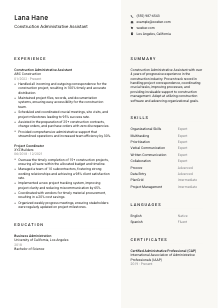
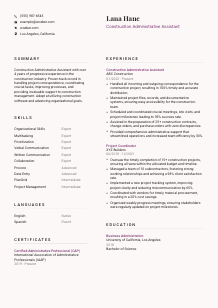
Organising projects, but your CV looks a little haphazard? Swing by this Construction Administrative Assistant CV example, created with Wozber free CV builder. Learn how to match your blueprint for organisation to the job requirements, building a career as sturdy and efficient as the structures you help bring to life.
Construction administrative assistants keep project information moving when schedules shift, site activity changes, and multiple parties need the right document at the right time. Hiring teams look for more than general office support. Your CV needs to show that you can manage correspondence, maintain organised project records, coordinate meetings and site visits, and support contracts, change orders, and purchase orders without slowing down the job.
A tailored CV quickly separates construction administration experience from broader admin work. Using Wozber's free CV builder and an ATS-friendly CV format helps you mirror the language of the posting, surface tools such as Procore or PlanGrid when you truly use them, and make your project support history easier to read in an ATS and by a construction manager scanning for someone who can keep documentation and coordination under control.
Construction offices move fast, and the contact section should remove friction immediately. Keep it clean, accurate, and aligned with the practical details a hiring team needs before they even reach your experience.
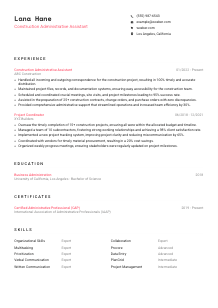
Put your full name at the top in a format that is easy to read, then make sure the role you want is visible right below it. For this position, using "Construction Administrative Assistant" helps frame the rest of the CV around project support, documentation, and coordination rather than generic administrative work.
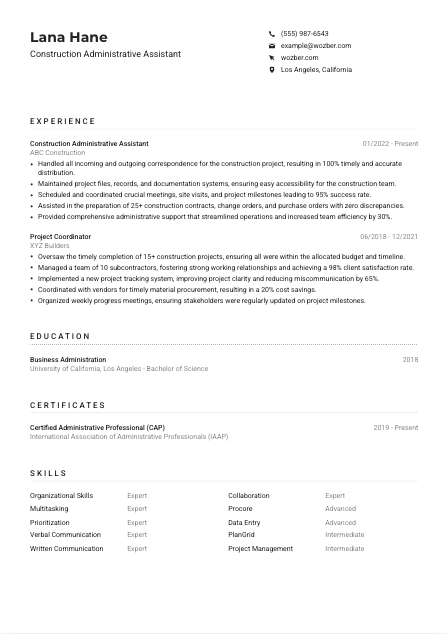
Match the job title to the opening when your background supports it. That simple line helps confirm that your CV is built for construction administration, not office support in another industry. In the example CV, the title matches the posting directly, which keeps the focus on construction workflows from the first glance.
List a reliable phone number and a professional email address, then include your city and state when location matters. Here, "Los Angeles, California" addresses a stated requirement. If a posting calls for local availability, this is the cleanest place to make that clear without repeating it across the CV.
Include a LinkedIn profile or professional website if it supports your application with consistent job history, project-related experience, or industry credibility. If the link is outdated or unrelated to construction, leave it off. Every item in this section should reinforce reliability and professionalism.
Do not add age, marital status, photo, or other personal information unrelated to the job. Construction hiring teams need accurate contact information and, when relevant, local availability. Keep the section focused on facts that help move your application forward.
This part should confirm who you are, how to reach you, and whether you meet practical requirements such as location. When it is concise and accurate, the hiring team can move straight to your project support experience.




This is where construction employers look for proof that you can keep paperwork, schedules, and communication on track while a project is moving. Prioritise work that shows document control, coordination, software use, and support for contracts or budget-related tasks.
Start by isolating the duties that define the role. In this description, the core work includes handling correspondence, maintaining project files, coordinating meetings and site visits, assisting with contracts and change orders, and supporting reporting and budget tracking. Those responsibilities should shape the bullets you choose and the language you use for ATS optimisation.
Use reverse chronological order and make sure each entry includes your title, employer, and dates. Titles such as "Construction Administrative Assistant" or "Project Coordinator" already signal experience with project operations, subcontractor communication, and documentation flow. If your past title was broader, your bullets need to do more work to show construction-specific support.
Hiring teams want to know how well you handled the work, not just whether it appeared in your job description. Write bullets that show execution and results. The example does this well by tying correspondence handling to 100% timely and accurate distribution and contract support to 25+ documents with zero discrepancies.
Metrics make this section more believable when they reflect the job's actual outputs. Useful numbers include volume of contracts or purchase orders processed, meeting cadence, record accuracy, project count, turnaround time, discrepancy reduction, budget tracking support, or efficiency gains. Figures such as a 95% meeting coordination success rate or a 30% efficiency improvement tell a construction manager what your support looked like in practice.
Focus your space on work that relates to project administration, stakeholder communication, document control, vendor coordination, and scheduling. Leave out unrelated achievements unless they show a transferable operational strength. A CV for this role should read like someone who can support a project team, keep records accessible, and prevent administrative delays on active jobs.
The strongest experience section makes it easy to picture you inside a construction project office handling records, correspondence, scheduling, and document preparation. Keep the bullets close to the work, and quantify where scale or accuracy matters.
Education usually plays a supporting role here, but it can still strengthen your case when it connects to office operations, business processes, or construction support. Present it clearly and let it complement your hands-on experience.
If you have a degree, lead with the one that best supports the role. Business Administration, construction management, accounting, or similar fields can reinforce your ability to handle documentation, reporting, coordination, and process-heavy work. In the example, a Bachelor of Science in Business Administration supports the administrative side of construction operations.
List the degree, field of study, school, and graduation year. That is usually enough. Construction hiring managers spend far more time on your project support history than on academic detail, so clarity matters more than extra wording.
If you are earlier in your career or changing industries, relevant coursework can help bridge the gap. Classes in project management, business communication, operations, accounting, or contract administration can support your fit for a role that includes documentation, reporting, and coordination across teams.
Course lists are optional. Include them when they add information your experience section cannot yet show. If you already have several years of construction administration experience, detailed coursework usually adds less value than another strong accomplishment bullet elsewhere.
Honors, leadership roles, or major student projects can stay if they support organizational ability, coordination, or administrative discipline. Keep them brief. For an experienced candidate, education should support the overall narrative rather than compete with field experience.
For this role, education helps most when it quietly supports your administrative and operational foundation. Present it clearly, then let your experience carry the weight of the application.
Certifications are not always required for construction administrative roles, but they can help when they sharpen your administrative profile or show continued development in project support, documentation, or software use.
Start with the job description. If a certification is requested, include it prominently and use the same wording when appropriate. When no credential is required, choose certifications that still support the work, such as administrative, project coordination, document control, or construction software training.
The best additions are the ones that strengthen your case for managing records, communication, and project administration. A credential like Certified Administrative Professional can support that story because it connects to organisation, communication, and office process discipline. Software training in platforms like Procore can also be valuable when that tool appears in the posting.
Construction systems and office processes change, so dates matter when they show that a certification is active or recently completed. The example CV includes the CAP credential with dates, which helps establish that the qualification is current rather than historical.
If you want to strengthen your profile further, pursue learning that reflects how construction administration actually works. Training in project documentation, purchase order workflows, change order tracking, Excel reporting, or construction management platforms can make your CV more competitive for project-based environments.
A well-chosen certification supports the same message as your experience section. You understand structured administrative work, communicate clearly, and can support the systems that keep a construction project organised.
This section should read like the toolkit behind your daily performance. Balance construction-specific software and administrative execution skills with the communication and coordination abilities that keep project teams aligned.
Use the job description to identify the skills that matter most. Here, that includes organisation, multitasking, prioritization, verbal and written communication, collaboration, and proficiency with construction software such as Procore or PlanGrid. These terms help with ATS optimisation when they match your real background.
Prioritise skills that support the job's responsibilities, not a generic master list. For a construction administrative assistant, that often means document management, data entry, scheduling, meeting coordination, purchase order support, contract documentation, budget tracking, and software used on projects. The example CV gets this mostly right by combining Procore, data entry, and project management with core admin strengths.
Group your strongest, most relevant skills and avoid padding the section with vague traits. If you use proficiency levels, make sure they are accurate. A tight list of construction software, coordination skills, and communication strengths is more persuasive than a long list of broad business terms.
Your skills section should support the picture already established by your experience. When the list reflects how you manage records, communication, software, and priorities on active jobs, it adds real value.
Construction administration depends on clear communication across project managers, vendors, subcontractors, and clients. If the posting specifies language ability, treat it as a practical requirement and present it clearly.
When a job states fluent English is required, list English prominently with an accurate proficiency level. For this opening, that requirement belongs near the top of your language section so there is no ambiguity about your ability to handle correspondence, meetings, and document-related communication.
Extra languages can be valuable when projects involve diverse crews, vendors, or client groups. In some markets, bilingual ability can help with day-to-day coordination and relationship management. The example CV includes Spanish, which can be useful in many construction settings, though it is an added advantage rather than a universal requirement.
Use clear labels such as "Native," "Fluent," "Intermediate," or "Basic." Accuracy matters because language ability affects phone communication, meeting notes, document handling, and follow-up with stakeholders. Do not overstate a language you cannot use confidently in a project environment.
This role often involves relaying updates, scheduling site visits, tracking correspondence, and keeping multiple parties informed. If another language has helped you communicate with field teams, vendors, or clients, it is worth noting because it adds context to your coordination strengths.
List only languages you can genuinely use in a professional setting. The section works best when it supports the communication demands of construction administration instead of reading like a personal profile detail.
For a construction administrative assistant, language skills are operational, not decorative. Present them clearly so the hiring team can quickly see whether you can support the communication flow of the project.
The summary sits at the top of the CV and should immediately place you in the construction environment. Focus on years of experience, the kind of project support you provide, and the tools or strengths most relevant to the opening.
Look at the main responsibilities and requirements before you write. For this role, that means construction industry administrative experience, communication, organisation, collaboration, and familiarity with tools like Procore or PlanGrid. Your summary should reflect that mix in a few direct lines.
Start with your title and years of relevant experience. "Construction Administrative Assistant with 4+ years of experience" immediately tells the reader that you have the baseline industry background they requested. The example summary does this effectively and keeps the focus on construction, not generic administration.
Use the next sentence to name the project support functions you do well, such as managing correspondence, maintaining project files, coordinating meetings, assisting with contracts and change orders, or supporting reporting. Add one or two strengths that matter in this environment, such as process improvement, accuracy, or cross-team coordination.
Aim for a short paragraph, not a biography. Every sentence should point back to construction administration. If a phrase does not help explain your experience with project documentation, scheduling, software, or team support, cut it and replace it with something more concrete.
A well-written summary tells the hiring team, within seconds, that you understand project office work and have the experience to support it. Keep it specific enough that the rest of the CV feels like proof, not explanation.
A Construction Administrative Assistant CV should show that you can keep project communication, records, scheduling, and document support running smoothly under real construction deadlines. When each section reinforces that story, the hiring team can quickly see where you add value.
Use Wozber to shape that story into an ATS-compliant CV with role-matched language, cleaner section structure, and stronger ATS optimisation. The final result should make your experience with construction documentation, coordination, and software support easy to judge before the interview.