



Use Wozber and land your dream job
Create CV
No registration required
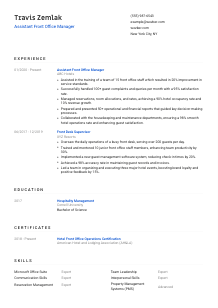
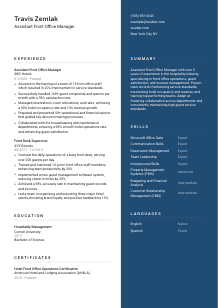
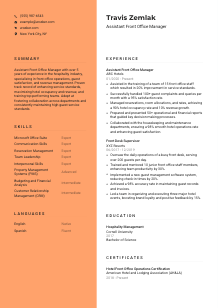
Steering the front desk flow, but your CV feels checked out? Check out this Assistant Front Office Manager CV example, created with Wozber free CV builder. It shows how to manage your career path as adeptly as guest arrivals, positioning your front office finesse to match job expectations and create a concierge-like career journey!
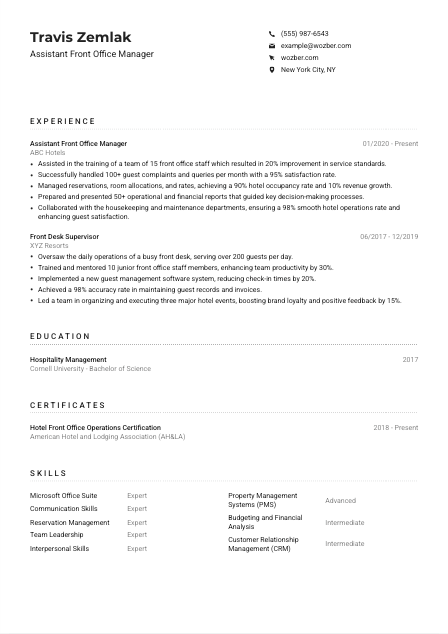
Front office leadership sits at the point where guest experience, room revenue, and daily hotel operations meet. An Assistant Front Office Manager CV needs to show that you can keep service standards high during busy shifts, resolve guest issues without escalation dragging on, and support a desk team that runs cleanly across arrivals, departures, and room assignments.
When that experience is tailored well, hiring teams can quickly see whether your background matches the actual rhythm of the role, from PMS-driven reservations work to cross-department coordination with housekeeping and maintenance. Wozber's free CV builder helps you shape that experience into an ATS-compliant CV that uses the right hospitality language, so your document reads clearly for both screening systems and hotel leaders reviewing whether you can step into operations with confidence.
For a front office management role, the top of the CV should feel orderly and professional. Hotels move fast, and hiring managers notice small details. Your contact section should confirm who you are, where you are based if the posting asks for it, and how to reach you without any friction.
Place your full name at the top in a slightly larger font than the rest of the page. Keep it simple and polished. In hospitality leadership roles, presentation matters, and a clean header sets the same tone you would be expected to bring to the guest arrival experience.
If you are applying for an Assistant Front Office Manager opening, use that title directly under your name when it reflects your target role or current level. This immediately aligns your CV with the position and helps ATS screening connect your document to front office supervision, guest service, and hotel operations work.
List a reliable phone number and a professional email address. Avoid outdated usernames or extra contact channels that do not help the hiring process. For a role that depends on polished communication with guests, department heads, and team members, even basic contact details should reflect professionalism.
Some hotel roles require local availability or immediate access to the property. Here, the New York City, NY requirement makes location worth stating clearly in your header. If a posting includes a similar condition, adding your city and state removes a practical question before it becomes an objection.
A LinkedIn profile or professional website can help if it reinforces your hospitality background, leadership progression, or certifications. Keep it current and consistent with your CV. If your online presence adds no useful context about hotel operations, front office leadership, or guest service performance, leave it out.
This section does not need flair. It needs accuracy, professionalism, and any practical details the hotel wants confirmed early, such as location. When the top of the page is tidy and complete, the reader can move straight to your operations and guest service experience.




This is the section that carries the most weight for an Assistant Front Office Manager. Hotels want to see how you handled guest volume, supervised staff, supported occupancy goals, and kept operations moving when issues hit the desk. Vague duty lists will not do that. Specific accomplishments will.
Start by identifying the work this property cares about most. In this posting, the recurring themes are team supervision, guest issue resolution, reservations and room allocation, reporting, and coordination with other departments. Those themes should shape which bullets you keep, which ones you rewrite, and which hospitality keywords you mirror naturally.
List your positions in reverse chronological order and make the growth visible. A path from Front Desk Supervisor to Assistant Front Office Manager tells a useful story because it shows increasing responsibility in guest handling, staff oversight, and operational control. That progression appears clearly in the example CV and strengthens credibility for a management-track opening.
Each bullet should connect your work to a result the property actually cares about. Good examples include service score improvement, faster check-in flow, stronger occupancy, cleaner billing accuracy, or better guest complaint resolution. The sample bullet about handling 100+ guest complaints per month with a 95% satisfaction rate works because it links a daily front office responsibility to a measurable guest outcome.
Numbers matter here because front office work is measured constantly. Include team size, guest volume, complaint volume, occupancy rate, revenue impact, record accuracy, check-in time improvements, or reporting cadence where you have them. Metrics like a 90% occupancy rate, 10% revenue growth, or 200 guests served per day tell a hotel leader far more than general claims about being service-oriented.
Keep the section centered on front office leadership. If an achievement does not say something useful about guest service, reservations, rate management, cross-functional coordination, staff training, or operational control, it probably belongs off the page. The goal is not to document every task you have ever done. It is to show that you can help run the desk, support the team, and protect the guest experience under pressure.
A hiring manager should be able to scan this section and picture you handling arrivals, coaching staff, solving guest issues, and supporting occupancy and revenue goals. If your bullets show operational scope and measurable hotel results, the CV starts working much harder for you.
Education usually sits behind experience for this level of hotel role, but it still matters, especially when the posting asks for a bachelor's degree in Hospitality Management or a related field. Keep it concise and directly relevant so the reader can confirm the requirement quickly.
List the degree that best matches the posting. For this role, a bachelor's in Hospitality Management is a strong match because it supports the operational, service, and administrative side of front office leadership. The example CV does this well by naming the Bachelor of Science in Hospitality Management clearly.
Include the degree, school, field of study, and graduation year or date range if appropriate. There is no need to overbuild this section unless you are early in your career. Hotels reviewing management candidates typically want to confirm credentials quickly and return to your record of running guest-facing operations.
When a job description specifies a degree area, make sure your wording is easy to connect to it. If your field is not an exact match, use the full official title and let the relevance show through related coursework or surrounding experience. Clear wording helps both ATS parsing and human review.
Coursework can be useful if you are newer to hospitality management or if your program included hotel operations, revenue management, lodging administration, or guest services topics that strengthen your case. For an experienced candidate, this is usually optional because your work history should already carry the stronger proof.
Honors, leadership roles, or hospitality-related activities can be worth including if they add something meaningful. Keep them only if they support your candidacy rather than distracting from it. For a front office management CV, operational experience will still matter more than campus detail once you have several years in the field.
This section should quietly support your application by confirming the educational baseline the property asked for. If the degree is relevant and clearly presented, it does its job and keeps the reader focused on your front office track record.
Certifications are not required for every Assistant Front Office Manager role, but they can help when they reinforce hotel operations knowledge, service standards, or front office procedures. In hospitality, the right credential can show that you take the mechanics of the role seriously, not just the guest-facing side of it.
Start with the job description. Here, certification in Hotel Front Office Operations or a related area is preferred rather than mandatory. That means a relevant credential can strengthen your profile, especially if several applicants have similar supervisory experience.
Prioritise certifications tied to front office operations, lodging management, guest services, or hospitality supervision. The example certificate, Hotel Front Office Operations Certification, fits because it directly supports the responsibilities in reservations, guest handling, and service standards.
If the certification is current, recently earned, or requires renewal, include the date information. This helps show whether your training is active and relevant. In hospitality roles where procedures, systems, and standards evolve, recency can add useful context.
If you are aiming for larger properties or more revenue-sensitive front office roles, continued professional development can help. Certifications in hotel operations, service excellence, or revenue-related systems can support your move from desk supervision into broader management responsibility.
A well-chosen certificate will not replace experience, but it can sharpen your profile by showing formal training in the exact part of hotel operations you manage. Include credentials that make your front office leadership look deeper and more current.
This section should reflect how the front office actually runs. Hotels hiring for this role are looking for a mix of systems ability, service judgment, staff coordination, and commercial awareness. A scattered list of generic soft skills will miss that balance.
Read the job description for explicit and implied skill needs. In this case, PMS proficiency, Microsoft Office, communication, interpersonal ability, supervision, reservations handling, and reporting all stand out. Those are stronger CV skills than broad claims with no connection to hotel operations.
Use skill wording that reflects the posting where it truthfully matches your background. If the role asks for Property Management Systems, do not hide that experience under a vague systems label. The example CV gets this right by naming Property Management Systems, Reservation Management, Team Leadership, and Microsoft Office Suite directly.
Lead with the skills you would use during a normal front office shift or in daily management follow-up. Guest communication, complaint resolution, room allocation, reservations control, reporting, and team leadership should usually come before less relevant extras. If you include ratings, make sure they are believable and consistent with your work history.
A hiring manager should be able to glance at this section and understand how you operate at the desk, in the office, and with the team. Keep the list focused on the systems, service skills, and management abilities that actually drive front office performance.
Language ability can be a real advantage in hospitality, especially in high-traffic properties and international markets. For an Assistant Front Office Manager, it matters most when it helps you communicate professionally with guests, guide staff, and handle issues clearly at the desk.
If the posting names a required language, list it clearly with your proficiency. Here, professional English communication is required, so English should appear prominently. Do not assume it is obvious. If it is part of the requirement, state it.
Extra languages can strengthen your profile when they are useful in the market or property setting. Spanish, for example, may be valuable in many guest-facing hospitality environments. The sample CV uses this well by pairing native English with fluent Spanish, which broadens guest communication capability without overstating its importance.
Use honest proficiency labels such as Native, Fluent, Advanced, or Conversational. Front office managers often step into sensitive guest interactions, so overstating your ability can create problems quickly. Accurate levels are more credible than inflated ones.
Only include languages you could reasonably use in a guest or team interaction. A long list of beginner-level languages usually adds little. A short, believable list tied to guest communication is more valuable than a broad one that has no operational use.
If the hotel serves international travelers, event guests, or a multilingual local market, language skills can support smoother service recovery and stronger guest satisfaction. Use this section to reinforce that you can communicate effectively in the environment the property operates in, not just that you studied a language once.
In hotel operations, languages matter when they improve communication, service recovery, and the guest's overall stay. Keep this section truthful and useful, and it will add practical value to your front office profile.
Your summary should quickly establish your level, your area of hospitality expertise, and the kind of operational results you bring. For this role, that usually means combining front office leadership, guest satisfaction, team supervision, and revenue or occupancy awareness in a few clear lines.
Before writing, identify the two or three responsibilities that define the opening. Here, those include supervising front office staff, resolving guest issues, and managing reservations and room allocations while supporting hotel performance. Your summary should reflect that mix rather than describing yourself in broad hospitality terms.
Lead with a clear professional identity, such as Assistant Front Office Manager or Front Office Supervisor with 5+ years in hospitality operations. This immediately places you in the right lane and helps both recruiters and ATS tools understand your seniority and specialization.
Use real role language from the posting where it matches your background, such as front office operations, guest satisfaction, service standards, reservations, revenue management, or team training. The sample summary does this effectively by combining guest satisfaction, revenue management, and cross-department collaboration in one concise paragraph.
Aim for three to five lines with no filler. Mention your years of experience, your front office focus, and one or two outcomes you are known for, such as improving service standards, lifting occupancy, or leading high-performing desk teams. A summary should create a quick, accurate picture of how you operate in a hotel environment.
When the summary, experience, and skills sections all point to the same strengths, your CV reads like a candidate who can step into the front office and contribute quickly. Use Wozber's AI CV builder to sharpen your wording, align your CV with the posting, and build an ATS-friendly CV template that makes your guest service results, supervisory experience, and hotel operations judgment easy to recognize.
An Assistant Front Office Manager CV works best when it shows how you handle the real pressures of the desk: guest issues, team supervision, reservations control, reporting, and coordination across departments. That is what separates general hospitality experience from a profile that looks ready for front office management.
Use Wozber to organise that experience into an ATS-friendly CV format, align your wording with the job description, and strengthen your ATS optimisation without losing the practical detail that matters in hotel hiring. The final read should make one thing clear: you can help run the front office smoothly, professionally, and with strong guest outcomes.




