



Use Wozber and land your dream job
Create CV
No registration required
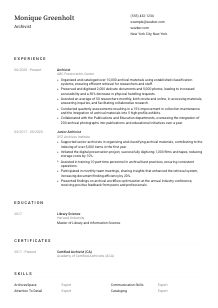
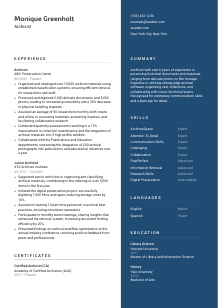
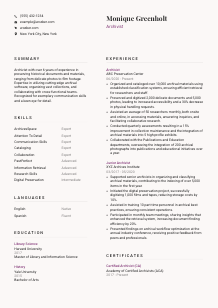
Preserving history, but your CV feels ancient? Check out this Archivist CV example, created with Wozber free CV builder. It shows how to catalogue your archival expertise to align with modern job records, and rewrite your career narrative for its rightful place in the annals of success!
Archivist hiring often turns on whether your CV shows disciplined control over collections, not just a general interest in history or preservation. Employers want to see that you can describe arrangement and description work, preservation decisions, digitization scope, and researcher support in a way that reflects how archives actually operate day to day.
A tailored CV changes which parts of your background stand out first, especially when an employer is sorting candidates by archival systems, records handling, and access work. Wozber's free CV builder helps you align that language in an ATS-friendly CV format, so cataloging, preservation, digitization, and reference support are easy to recognize where they matter most.
For archivist roles, the header needs to do one job well: present accurate, professional contact details without distracting from the collection work, preservation background, and systems knowledge that follow. Keep it clean, complete, and aligned with any practical requirement named in the posting.
Use your full name as the most prominent line at the top of the page. Archivist CVs are often reviewed alongside research, cataloging, and institutional records experience, so your header should feel orderly and professional from the first glance.
Place "Archivist" under your name when that is the role you are pursuing. This immediately frames your background around archival processing, preservation, access, and collection stewardship rather than adjacent paths such as librarianship, museum work, or records administration.
Include a working phone number and a professional email address. Accuracy matters in archival work, and small mistakes in basic details can create doubt before anyone even reaches your experience with classification systems or researcher services.
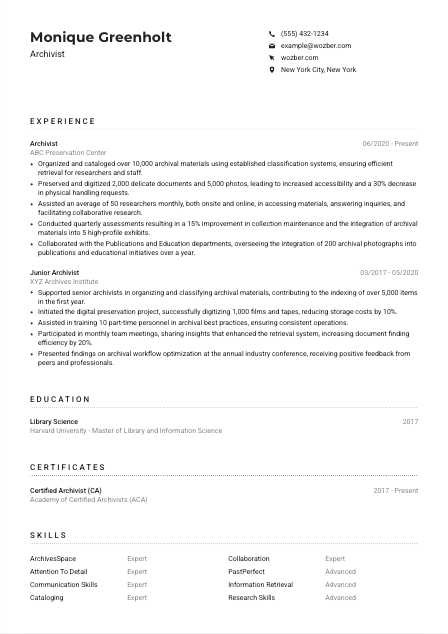
If a posting specifies a location requirement, reflect it clearly in your header. Here, listing "New York City, New York" helps answer a practical screening question early. For other archivist roles, include your city and state when they support local eligibility or on-site collection access needs.
A LinkedIn profile, portfolio, or institutional bio can help if it reinforces your CV with projects such as digital exhibits, finding aids, publications, or conference presentations. Keep it updated so it matches the preservation, cataloging, and outreach work described in your application.
This section should read like well-maintained metadata: accurate, relevant, and easy to verify. Once the basics are in place, the rest of your CV can focus on the archival work itself.




This is the section most likely to decide whether you move forward. For archivist roles, hiring teams look for proof that you can process collections, preserve fragile material, support researchers, and work across departments without losing accuracy or access standards.
Start by isolating the work the employer actually needs done. In this description, the priorities are organising and cataloging materials, preserving and digitizing fragile items, assisting researchers, assessing collections, and contributing to exhibits or educational work. Those functions should shape which accomplishments you foreground and which wording you mirror.
List positions from most recent to oldest, and include title, institution, and dates. That structure helps the reader quickly follow your development from junior processing or digitization support into broader responsibility for collections, access services, and cross-department collaboration.
Each bullet should show what changed because of your work. Instead of saying you were responsible for cataloging or preservation, show the scale of the material, the system or workflow used, and the result for access, handling, or maintenance. The sample does this well by tying cataloging to 10,000 materials and digitization to reduced physical handling requests.
Quantify volume, turnaround, researcher usage, preservation output, retrieval improvement, or exhibit integration when you can. Useful metrics include number of items processed, percentage improvement in retrieval efficiency, monthly researcher support, or reduction in storage or handling pressure. Those measures make your contribution easier to compare across repositories and collections.
If you have work in libraries, museums, special collections, or records management, lead with bullets that show transferably archival work such as arrangement, description, digitization, metadata creation, environmental monitoring, or patron support. Leave unrelated achievements in the background unless they clearly strengthen your case for stewardship, accuracy, or institutional collaboration.
Your experience section should make it easy to picture you handling real archival material, real users, and real institutional needs. When the bullets show scope and outcome, your background reads as operationally ready.
Academic background matters in archivist hiring because it often signals training in historical research, information organisation, appraisal, preservation theory, and archival methods. Present it clearly so the employer can quickly connect your studies to the work of managing collections and access.
When a posting asks for a bachelor's degree in Library Science, History, or a related field, make that qualification easy to spot. If you also hold graduate study in library and information science, archives administration, or public history, include it prominently because it strengthens your grounding in archival standards and systems.
List degree, field, school, and graduation year in a consistent layout. Recruiters and hiring managers should be able to confirm your educational background quickly without hunting through extra description.
Specific wording matters here. A "Master of Library and Information Science" or a "Bachelor of Arts in History" speaks directly to common archivist requirements and helps ATS matching when the posting references library science, history, or related disciplines.
Coursework, capstone projects, or thesis work can add value when you do not yet have extensive professional archive experience. Focus on subjects such as preservation, metadata, archival description, records management, or digital curation rather than listing broad academic interests.
Academic distinctions, fellowships, or leadership in archives, special collections, or historical organizations can strengthen this section. Choose items that support your seriousness about the field, especially if they connect to research support, preservation projects, or collection-based work.
Education should confirm that your training supports the demands of archival processing, preservation, and access work. Keep it direct, relevant, and connected to the field.
Certifications are not required for every archivist opening, but they can reinforce professional commitment and current practice. When chosen well, they show that your knowledge extends beyond formal education into standards, ethics, and continuing development.
Some archivist jobs do not require a certification, but that does not mean the section is optional if you have one. A credential such as "Certified Archivist (CA)" adds weight because it connects your profile to recognized archival practice and ongoing professional engagement.
Prioritise certificates tied to archives, preservation, records management, digital curation, or related collection work. This keeps the section aligned with the employer's needs rather than filling space with training that does not support archival responsibilities.
Add issue or renewal dates where relevant. In a field shaped by changing digitization workflows, metadata practices, and preservation standards, current dates help show that your knowledge has stayed active.
Recent coursework, workshops, or in-progress credentials can be useful if they relate to archival systems, preservation handling, digital asset management, or access services. That is especially helpful when the target role emphasizes software proficiency or collection care beyond your formal degree.
A well-chosen certification section can reinforce your seriousness about archival standards and continued learning. Keep it focused on credentials that strengthen your day-to-day suitability for the role.
For archivists, the skills section should read like a practical toolkit, not a generic list of strengths. The best entries connect to the systems, methods, and working habits that make collections usable, preserved, and accessible.
Start with the job description's language. Here, archival software proficiency is central, with ArchivesSpace and PastPerfect given as examples. If you have direct experience with those systems, list them. If your background is in similar collection management platforms, include them in language that stays accurate to your experience.
Balance system knowledge with the core work of the profession. Cataloging, archival description, information retrieval, digital preservation, collection assessment, and researcher assistance usually carry more weight than broad soft skills listed without context. The sample CV handles this well by pairing software with cataloging and digital preservation.
Place the most role-specific skills first, especially those tied to collection systems, preservation work, and access support. A hiring manager should be able to scan the section and immediately see whether you can step into the repository's workflow, metadata environment, and service model.
The right skills list should sound like the daily language of an archive. When software, processing work, preservation, and user access are all visible, the section supports the rest of your CV instead of repeating it.
Language ability can matter in archivist roles when collections, researchers, donors, or institutional partners work across more than one language. Even when English is the main requirement, clear language listing can strengthen your profile for access and outreach work.
If English proficiency is highlighted, list it clearly with an honest level such as Native or Fluent. This matters for archivists because reference responses, finding aid notes, donor communication, and internal documentation all depend on precise written communication.
Additional languages are worth including when they help with multilingual collections, researcher requests, translations, or community engagement. Spanish, for example, can be useful in institutions serving diverse publics or working with regional history collections.
Describe each language with clear levels such as Native, Fluent, Intermediate, or Basic. Avoid vague wording. Straightforward labels are more useful for hiring teams deciding whether a candidate can support reading-room inquiries, correspondence, or material description in another language.
If the role involves public history, educational programming, donor relations, or internationally relevant collections, language skills can support more than conversation. They can affect access, interpretation, and the usefulness of the archive to a wider audience.
List languages because they expand what you can do in the role, not simply because they are personally impressive. For archivists, that may mean helping researchers navigate material, communicating with stakeholders, or working with records that require more than one linguistic context.
When language skills are relevant, present them as part of how you support collections and the people using them. That makes the section feel connected to archival work rather than separate from it.
Your summary should give a hiring team a fast, accurate picture of the kind of archivist you are. In a few lines, it needs to establish your experience level, the collections or formats you work with, and the archival functions you handle well.
Start with a direct description such as your title and years in archival, preservation, or records work. That immediately places you in the right professional lane and helps distinguish you from candidates whose background is more academic than operational.
Reference the work that appears repeatedly in the posting, such as cataloging, digitization, preservation, researcher support, or cross-department collaboration. The sample summary works because it links years of experience to preserving documents, using archival software, organising collections, and collaborating with other teams.
Aim for 3 to 5 lines with specific archival language. This is enough space to mention collection formats, software familiarity, and one or two strengths without turning the summary into a compressed version of your full experience section.
Archivist summaries work best when they sound steady, informed, and precise. Emphasize collection care, access, systems knowledge, and communication in language that feels credible for repository work rather than promotional or overly broad.
By the end of this section, a reader should understand what kind of archive work you handle best and where you add value. Keep it focused enough that the rest of the CV can deepen the picture.
An effective archivist CV shows more than appreciation for history. It shows how you organise collections, preserve vulnerable materials, support researchers, and help institutions make archival holdings usable in exhibits, publications, and public-facing work.
Use Wozber's free CV builder to shape that experience into an ATS-compliant CV with language that matches the posting, then refine it with the ATS CV scanner to spot missing requirements and strengthen alignment. The finished document should make one thing clear quickly: you can manage archival material with care, structure, and professional judgment.




