



Use Wozber and land your dream job
Create CV
No registration required
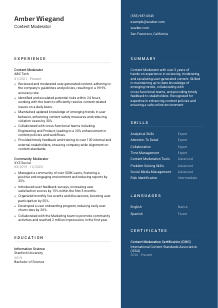
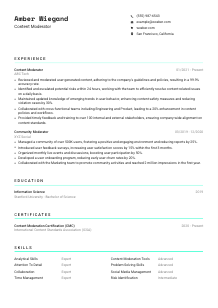
Guarding online realms, but your CV feels flagged? Check out this Content Moderator CV example, created with Wozber free CV builder. Learn how to showcase your filtering skills to match job criteria, ensuring your career flow stays accountable and abuzz with the right content!
Content moderation work sits where policy, judgment, and speed meet. Hiring teams want to see that you can review large volumes of user-generated content, apply standards consistently, flag edge cases, and keep communities safer without losing accuracy under pressure. Your CV should make that operational judgment visible from the start.
That becomes much easier when your CV uses the same policy, risk, and workflow language the employer uses. Wozber's free CV builder helps shape that wording into an ATS-compliant CV, so moderation experience, escalation work, and policy collaboration are easier to surface in both automated screening and human review. The clearer your CV is, the faster a team can recognize you as someone who can handle live content decisions responsibly.
Moderation teams work in environments where accuracy matters, and your header should reflect that same discipline. Keep this section clean, professional, and aligned with any practical requirement the employer has already made clear.
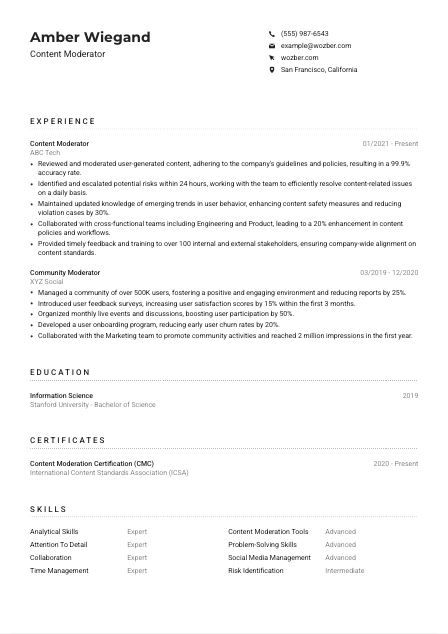
Place your full name at the top in a slightly larger font so it is easy to find in a quick scan. For content moderation roles, a clean header signals the kind of consistency and attention to detail that also matters when reviewing policy-sensitive content.
Use the title "Content Moderator" directly beneath your name when that is the role you are targeting. It immediately connects your CV to the opening and helps ATS matching when the employer is screening for exact role terms rather than adjacent titles alone.
List a current phone number and a professional email address, then double-check both. Moderation hiring can move quickly, especially when teams are filling shift-based or high-volume review roles, so broken contact details can cost you an interview.
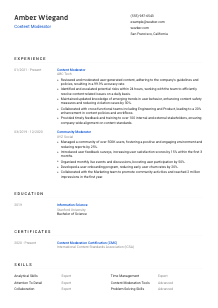
If the employer requires a specific location or relocation, include your city and state clearly. In the example, San Francisco, California should appear because the posting asks candidates to be based there or willing to relocate, and that removes an avoidable question early in the review.
Include LinkedIn or a professional website if it supports your candidacy. For moderation work, that usually means a profile that reinforces your experience with community platforms, trust and safety work, policy operations, or cross-functional collaboration rather than a generic online presence.
Do not add age, gender, marital status, or other details that have no bearing on moderation performance. Save the space for information that supports your ability to review content carefully, communicate clearly, and meet the role's practical requirements.
This section should answer the hiring team's first logistical questions in seconds. If your title, contact details, and location are clear, the reader can move straight to your moderation experience instead of getting stuck on basics.




For content moderation, experience is where hiring teams look for proof of decision quality. They want to see how you handled review volume, policy enforcement, escalation paths, stakeholder feedback, and the measurable effect your work had on safety or community health.
Start by identifying the operational responsibilities in the posting, then mirror them in your experience section using your own history. For this role, that means content review, risk escalation, policy awareness, cross-functional work, and training or feedback. If you have done those things, name them directly instead of describing them in broad support language.
Show your most recent moderation work first, since that is usually the most relevant to current tools, policies, and platform standards. Keep each entry easy to scan with title, employer, and dates so reviewers can quickly track your progression from community support or moderation into more policy-driven work.
Each bullet should show what you reviewed, how you applied standards, and what happened as a result. The example does this well by pairing tasks with outcomes such as 99.9% moderation accuracy, 24-hour risk escalation, and a 20% improvement in policies and workflows. That kind of phrasing tells a hiring manager you were doing real operational moderation, not just general community support.
Use numbers that are natural for the field, such as review accuracy, case turnaround time, reduction in violations, report volume, stakeholder count, or community size. Metrics like reducing violation cases by 30% or training more than 100 stakeholders help translate day-to-day moderation into performance that a trust and safety team can compare.
Prioritise bullets that connect to policy enforcement, user safety, escalation judgment, trend monitoring, and workflow improvement. If you also have broader community or marketing experience, keep only the parts that strengthen your case for moderation work, such as handling a 500K-user community or reducing reports through better community management.
A content moderation CV gains credibility when the bullets show policy decisions, response speed, collaboration, and measurable safety outcomes. If your experience section makes those patterns easy to spot, you are giving the hiring team what they need most.
Education usually plays a supporting role in moderation hiring, but it still matters when the posting asks for a bachelor's degree or equivalent background. Present it clearly, then let your moderation experience carry the heavier weight.
Read the education line closely before you format this section. Here, the employer asks for a bachelor's degree in a relevant field or equivalent practical experience, so a completed degree helps confirm eligibility, but closely related hands-on moderation work can also strengthen the case.
List your degree, field of study, school, and graduation details in a compact format. Recruiters do not need a long academic narrative here. They need a fast read on whether your education meets the stated requirement and whether the field connects reasonably to platform, communication, or information work.
If your degree connects to online behaviour, communication, information management, or digital systems, make sure that connection is clear. In the example, Information Science works well because it supports the analytical and platform-oriented side of moderation work without overstating what the degree alone proves.
Relevant coursework, research, or academic projects can help if you are earlier in your career or moving into moderation from a nearby field. Focus on topics such as online communities, digital ethics, media analysis, user behaviour, data review, or platform governance rather than listing classes that add no hiring value.
Honors, leadership roles, or notable student projects are worth mentioning when they reinforce judgment, analysis, communication, or online community work. This is most useful for junior candidates who need extra proof of initiative before they have a deep moderation track record.
This section should confirm the academic baseline and support the rest of your story. Once that is clear, the CV should move quickly back to moderation results, policy work, and platform experience.
Certificates are not always required for content moderation roles, but they can strengthen your profile when they relate to content standards, digital safety, policy enforcement, or platform operations. They work best when they add relevant specialization rather than filling space.
Some moderation roles do not name a specific credential, but they still value structured training in trust and safety, platform policy, or online risk management. If the job asks for strong analytical judgment, evolving policy awareness, or moderation tool proficiency, a relevant certificate can reinforce those areas.
Choose certifications that connect to content review, community standards, online safety, abuse prevention, or policy operations. The example's Content Moderation Certification supports the candidate's specialization because it aligns with the core work of reviewing content and applying standards consistently.
Moderation policies, platform risks, and harmful behaviour patterns change quickly, so dates matter. Showing when a certification was completed or is still active helps employers see that your training is current enough to be useful in a fast-changing review environment.
Ongoing training can sharpen your value, especially if you work with changing enforcement guidelines, emerging abuse patterns, or new moderation workflows. Certifications should show that you stay current with policy interpretation, user behaviour trends, and platform safety practices, not that you simply collect credentials.
When a certificate clearly relates to moderation standards or content safety, it adds depth to your CV. Keep the list focused so each credential supports your ability to make sound review decisions.
The skills section should reflect how content moderation actually gets done. That means balancing judgment-heavy soft skills with the operational abilities needed to review content accurately, work within policy, and collaborate when cases need escalation or process changes.
Start with the skills the posting names explicitly, then add closely related abilities you genuinely use. For this role, that includes moderation tools, analytical thinking, attention to detail, problem-solving, teamwork, adaptability, and English proficiency. These are stronger than vague terms such as "hardworking" or "good communicator."
Lead with the abilities that affect review quality and policy enforcement. Analytical skills, attention to detail, risk identification, content moderation tools, and collaboration belong near the top because they connect directly to the responsibilities in the job description. The example skills list works because it combines decision-making traits with platform-specific moderation capability.
Group or order skills so a recruiter can read them quickly without sorting through filler. A tight list of relevant abilities is more useful than a long inventory. If a skill does not help explain how you review content, escalate issues, train stakeholders, or improve moderation workflows, consider cutting it.
A hiring team should be able to glance at this section and recognize the tools, judgment, and collaboration style needed for policy-driven content review. Relevance matters more than volume here.
Language ability matters in content moderation because policy interpretation, case notes, and stakeholder communication all depend on clear reading and writing. If a role names a required language, make that easy to find immediately.
When the job description specifies a language, list it clearly and match the stated expectation. Here, English proficiency is mandatory, so it should appear prominently in your languages section, especially if moderation decisions and stakeholder feedback are handled in English.
Use straightforward labels such as native, fluent, or intermediate so recruiters understand your working level at a glance. For moderation roles, this matters because policy enforcement often depends on nuance, context, and precise written communication rather than casual conversation alone.
Additional languages can be valuable when platforms serve multilingual communities or global user bases. Spanish, for example, may support broader coverage or help with user context, but it should complement, not distract from, the required language and core moderation strengths.
Be honest about your level. Overstating language ability can become a problem quickly in moderation work, where a misread phrase, cultural nuance, or slang interpretation can affect enforcement decisions.
If the platform, market, or team serves diverse communities, a second language can strengthen your application by showing broader moderation reach. Keep the emphasis practical: better content review coverage, clearer user context, or stronger communication across teams and audiences.
For content moderation, language skills are operational, not decorative. Present them clearly so employers can quickly understand whether you can review, document, and communicate at the level the role requires.
Your summary should quickly establish the kind of moderation work you do, the scale or scope you have handled, and the strengths that make you reliable in policy-based environments. Keep it concise, but give the reader something concrete to remember.
Before writing the summary, identify the two or three themes the job emphasizes most. In this case, those themes include hands-on moderation experience, risk escalation, policy awareness, collaboration, and feedback or training. Your summary should reflect that operating profile, not a generic customer support pitch.
Lead with your current professional identity and years of relevant work. A line such as "Content Moderator with over 2 years of experience" works because it answers the first qualification check immediately and places you in the right hiring lane.
Use the next sentences to highlight the capabilities that matter most for the job, such as reviewing user-generated content, escalating risk, tracking behaviour trends, improving content policies, or training stakeholders. The example summary succeeds because it stays close to the posting instead of drifting into broad personality language.
Aim for three to five lines with direct wording and no filler. This section should read like a compact briefing on how you operate as a moderator, giving the recruiter enough substance to continue into your experience section with the right expectations.
A well-built summary gives the reader an immediate sense of your moderation background, judgment, and scope. If it names the right experience and responsibilities clearly, the rest of the CV has a much easier job to do.
A Content Moderator CV should show more than familiarity with online communities. It should show that you can apply policy consistently, escalate risk responsibly, work with cross-functional teams, and help maintain safer user spaces at scale.
Use Wozber's AI CV builder, ATS CV scanner, and ATS-friendly CV format to tighten that alignment section by section. When the language, structure, and priorities match the role, your CV gives hiring teams a much clearer read on whether you can step into live moderation work with confidence.