



Use Wozber and land your dream job
Create CV
No registration required
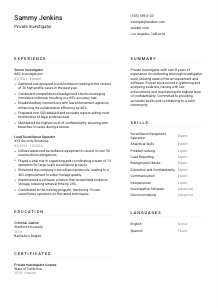
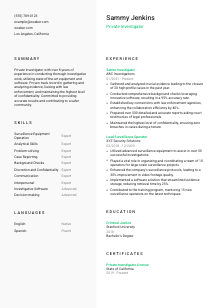
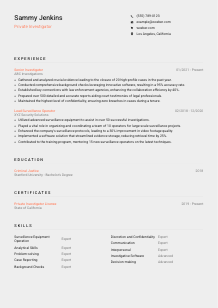
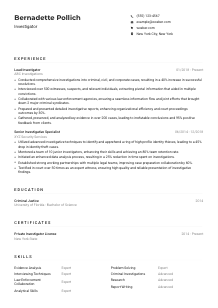
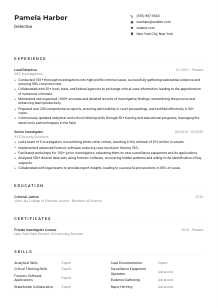
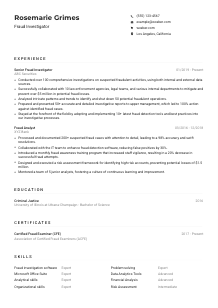
Sleuthing in the shadows, but your CV is staying hidden? Check out this Private Investigator CV example, put together with Wozber free CV builder. It shows how to spotlight your surveillance skills to match job criteria, making your career investigations as fruitful as your findings!

Private investigator CVs are strongest when they read like disciplined casework. Hiring teams look for people who can gather facts without overstatement, protect confidentiality, document findings accurately, and stay reliable when surveillance, interviews, records research, and courtroom support all intersect. Your CV should make that operating standard visible from the first section.
A tailored CV also helps separate investigative experience from adjacent security or compliance work, especially when employers screen for surveillance, background checks, report writing, and licensing requirements. Wozber's free CV builder supports that targeting in an ATS-friendly CV format, so the right keywords and case-relevant achievements are easier to surface and the hiring team can quickly see whether you can handle real investigative assignments.
Private investigation work depends on credibility, traceability, and clean records. Your contact section should reflect that same discipline by presenting accurate, professional details that make you easy to reach and easy to place for the role.
Use your full name in a prominent, readable format. In a field built on precise documentation, even basic presentation matters. Keep it simple and professional so the page opens with the same clarity your reports should have.
Place "Private Investigator" directly under your name when it matches your background and target role. That immediate alignment helps distinguish you from candidates coming from general security, loss prevention, or surveillance-only positions. In the example, the title mirrors the opening exactly, which removes any doubt about the direction of the application.
Include a phone number you answer regularly and a professional email address. Add a LinkedIn profile or professional site only if it is current and consistent with your casework history, licensing, and employment dates. Any mismatch in basic identity details can raise unnecessary questions in a profession where accuracy matters.
If the employer specifies a city or state, show that information in your header. Here, listing "Los Angeles, California" directly addresses the location requirement and signals local availability. Use this only when it is relevant to the job you are targeting, not as a default rule for every application.
A personal website can help if it presents professional credentials, public-facing investigative specialties, or speaking and training work. Leave it out if it is sparse, outdated, or too casual. For private investigators, any online presence should reinforce professionalism, discretion, and lawful practice.
Your personal details should confirm that you are a real, reachable, professionally presented investigator with no loose ends in the basics.




Experience is where private investigator CVs either gain credibility or lose it. Employers want to see the kind of cases you handled, the methods you used, how accurately you documented findings, and whether your work held up under legal or client scrutiny.
Start by marking the responsibilities named in the posting, then bring forward roles and bullets that reflect the same work. For this position, that includes surveillance, evidence gathering, interviews, document verification, background checks, case records, and collaboration with legal or law enforcement partners. If you have broader security experience, focus your bullets on the investigative portions rather than patrol, monitoring, or general operations.
List roles in reverse chronological order and make the progression easy to follow. A posting asking for 5+ years of investigative work needs that history to be visible without extra interpretation. The sample CV does this well by moving from Lead Surveillance Operator into Senior Investigator, showing a natural increase in case responsibility and reporting depth.
Each bullet should show what you investigated, how you handled it, and what came from the work. Useful verbs here include gathered, analysed, verified, interviewed, documented, collaborated, testified, and maintained. Instead of saying you were responsible for investigations, show the work in motion, such as conducting background checks with investigative software or preparing reports used in court support.
Quantify results where the metric makes sense. Closed cases, report volume, accuracy rate, retrieval time, collaboration improvement, or confidentiality record all carry weight in this field. The example's "closure of 20 high-profile cases," "95% accuracy rate," and "over 500 detailed reports" are effective because they tie investigative activity to workload, quality, and outcome rather than vague impact claims.
Keep the section centered on evidence handling, surveillance operations, records research, reporting, coordination, and discretion. Leave out achievements that are impressive but unrelated to investigative practice. Every line should help the employer picture you running a case file, supporting litigation, or delivering defensible findings under deadline.
Your experience section should leave no doubt that you can run investigations carefully, document them thoroughly, and produce work that stands up in legal and professional settings.
Education matters in private investigation when it connects directly to legal awareness, research ability, interview technique, and evidence handling. Even when experience carries more weight, the degree section still needs to confirm that you meet the role's stated academic baseline.
If the posting asks for a bachelor's degree in Criminal Justice or a related field, write that information plainly. Do not bury the field of study. In this example, "Bachelor's Degree" and "Criminal Justice" are both visible at a glance, which immediately satisfies a core requirement.
Include degree, field, school, and graduation year or date. Private investigator hiring often involves quick checks against minimum requirements, and a clean format helps that review move quickly. Save deeper academic detail for cases where it adds relevant value.
A directly related degree signals training in criminal procedure, legal systems, ethics, interviewing, or investigative methods. If your degree is in a related field, make sure the rest of the CV clearly carries the investigative weight through experience, licensing, and specialised skills.
If you are early in your career, selected coursework in criminal law, forensic methods, research, evidence, or constitutional issues can strengthen the section. If you already have years of casework, keep the focus tighter unless an academic credential is unusually relevant to the employer's niche, such as fraud, digital investigations, or legal support.
Short programs, workshops, or continuing education in surveillance technology, interview technique, legal updates, or investigative software can show that your methods are current. This is especially useful when the role emphasizes modern tools and accurate reporting.
Your education should quickly show that you meet the academic requirement and have a solid foundation for investigative reasoning, documentation, and lawful practice.
Private investigation is a regulated profession, so credentials are not decorative. They tell an employer whether you can legally operate, whether your training is current, and whether you are ready to step into active casework without avoidable delays.
When a valid Private Investigator License is required, list it clearly with the issuing authority and active dates. In the example, the California license immediately answers one of the posting's most important screening questions. If you are in the process of obtaining a license, state that accurately and match the wording to the employer's requirement.
Add certifications that strengthen your profile for the actual work, such as surveillance, interviewing, fraud examination, digital evidence, or legal procedures. Skip certificates that do not change how an employer views your case readiness.
Dates help employers judge whether a credential is active, expired, or recently earned. That matters in regulated work and in any role involving testimony, records integrity, or licensed investigative activity. Keep the format clean so the status is obvious.
Investigation methods evolve with new software, databases, camera systems, and legal expectations around privacy and evidence handling. Recent certifications can show that you have kept pace with the tools and standards the work now demands.
Your certificates section should make licensing status and specialised preparedness easy to confirm, especially when the employer needs someone who can move into investigative work quickly.
The best private investigator skills sections do more than repeat soft traits. They point to the tools, methods, and judgment used in surveillance, research, interviewing, verification, documentation, and confidential case handling.
Pull the required capabilities directly from the job description, then include the ones you can genuinely support in your experience. For this role, that means surveillance equipment, investigative software, analytical ability, problem-solving, decision-making, report writing, and confidentiality. This improves both ATS alignment and human review.
Favor skills that help an employer picture you handling live casework. Surveillance operations, background checks, document verification, case reporting, interview support, records research, evidence analysis, and discretion are stronger than broad terms with no context. The sample CV does this well by combining technical and judgment-based skills instead of leaning on generic adjectives.
Arrange skills so the most role-critical items appear first, and use consistent naming. If you separate technical skills from interpersonal ones, keep both categories focused on the job. Clear organisation helps the reviewer spot whether you can operate the tools, produce reliable findings, and communicate them effectively.
Your skills list should read like the operating toolkit of a working investigator, not a collection of generic strengths borrowed from another field.
Language ability matters in private investigation when it affects interviews, written reports, witness interaction, and day-to-day field communication. Include languages in a practical way that reflects how they support the work.
If the posting calls for strong English literacy, list English first and state your level clearly. For investigators, this is about more than conversation. It affects report accuracy, document review, statement quality, and courtroom communication when needed.
Additional languages can strengthen your value when cases involve diverse communities, multilingual interviews, or records from different sources. Spanish, for example, may be especially useful in some markets, but treat that as an application-specific advantage rather than a universal requirement.
Choose clear labels such as Native, Fluent, Intermediate, or Basic. Overstating language ability can create problems quickly in witness interviews, subject interaction, or written documentation where nuance matters.
If you speak more than one language, the benefit is practical. It can support rapport in interviews, reduce reliance on intermediaries, and improve fact gathering in the field. Keep the wording grounded in work, not broad claims about being well rounded.
When the employer serves a multilingual population, language skills can be a real differentiator. The Los Angeles example makes fluent Spanish worth mentioning, but only include extra emphasis when it connects to the geography, client base, or case mix you are targeting.
List languages in a way that shows how you can communicate accurately, document clearly, and operate effectively across the people and communities your investigations may involve.
The summary should quickly establish your investigative range, years of experience, and the kind of work you can be trusted to handle. For private investigators, that means a short paragraph grounded in methods, case responsibilities, reporting quality, and confidentiality.
Review the posting before you write. If the role centers on surveillance, evidence gathering, background checks, legal coordination, and reporting, your summary should open from that same core instead of a generic statement about being motivated or detail oriented.
Your first sentence should state your experience level and the main areas of investigative work you handle. The sample summary opens with over 8 years of investigative experience and immediately mentions equipment and software, which suits a role asking for both fieldwork and technical proficiency.
Choose strengths that match the opening and that the rest of the CV can support, such as evidence analysis, collaboration with law enforcement, high-volume reporting, document verification, or strict confidentiality. Keep the language specific enough to sound credible and broad enough to fit the whole CV.
Aim for a short paragraph that can be read in seconds. Avoid dramatic language, vague mission statements, or claims you do not prove later. A hiring manager should finish the summary with a clear picture of the cases, tools, and professional standards you bring.
Your summary should introduce you as an investigator who can gather facts, protect sensitive information, and produce reliable findings without needing the reader to decode your background.
A private investigator CV works best when every section supports the same conclusion: you can handle evidence carefully, document findings accurately, work within legal and ethical boundaries, and stay discreet under pressure. That is the standard your experience, license, skills, and summary should all reinforce.
Use Wozber's AI CV builder, ATS CV scanner, and ATS-friendly CV template to align your wording with the job description, strengthen ATS optimisation, and present your background in a format that is easy to screen. The final result should make one thing clear right away: you are prepared for real investigative work.




