



Use Wozber and land your dream job
Create CV
No registration required
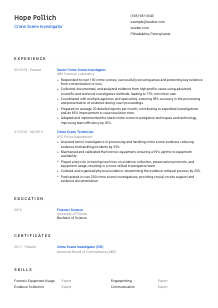
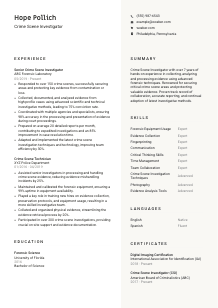
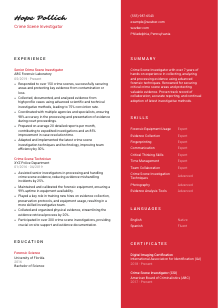
Unraveling mysteries, but your CV seems encrypted? Check out this Crime Scene Investigator CV example, created with Wozber free CV builder. It shows how to bring your forensic flair together with job specifics, painting a career picture that's just as detailed as the cases you crack!
Crime scene investigation work is judged in the field long before it reaches a lab or courtroom. A hiring team wants to see that you can secure a scene, protect chain of custody, document details accurately, and turn physical evidence into reports that hold up under scrutiny. Your CV should make that discipline visible from the first section.
When a Crime Scene Investigator CV is tailored well, the distinction between general forensic exposure and true scene-processing experience becomes much clearer. Wozber's free CV builder helps you shape an ATS-compliant CV around the language of evidence collection, documentation, reporting, and forensic tools, so reviewers can quickly see whether your background matches the operational demands of the role.
Personal details are straightforward, but they still carry screening value in a Crime Scene Investigator application. This section should confirm who you are, how to reach you, and, when relevant to the posting, whether you already meet practical requirements such as location.
Use your full name as the clearest heading on the page. Keep the format simple and professional so it reads cleanly in both human review and ATS parsing. Avoid nicknames or decorative styling that can distract from the formal tone expected in forensic and law enforcement settings.
Place the exact job title you are pursuing under your name when it accurately reflects your background. For this opening, "Crime Scene Investigator" immediately tells the reader that your experience is aligned with scene response, evidence handling, and investigative documentation rather than a broader laboratory or public safety role.
List a reliable phone number and a professional email address. Accuracy matters here for the same reason it matters in evidence logs and case reports. Small mistakes can interrupt the process before your qualifications are ever reviewed.
If a role specifies a city or region, show that you meet it. In the example, listing Philadelphia, Pennsylvania supports a stated requirement and removes doubt about immediate availability. Only include this when it is relevant to the posting or your candidacy.
A LinkedIn profile or professional website can help if it supports your casework, training, certifications, or forensic background. Keep it current and consistent with your CV, especially if it includes investigative experience, court-related work, technical training, or professional association activity.
For a Crime Scene Investigator, precision starts before the experience section. Clear personal details remove avoidable friction and let the reader move straight to your scene work, training, and forensic qualifications.




Experience is the section most likely to separate candidates who have direct scene-processing responsibility from those with adjacent forensic exposure. Focus on work that shows how you handled evidence, documented scenes, worked with other agencies, and contributed to case progress with disciplined investigative practice.
Read the posting for the actual work being prioritised. Here, that includes securing scenes, collecting and preserving evidence, using forensic equipment, coordinating with law enforcement and legal professionals, and preparing detailed reports. Those duties should shape the language of your bullets so your experience reads like a direct match rather than a loose forensic summary.
Start with your most recent position and include job title, employer, and dates in a format that is easy to scan. This helps reviewers track your progression from technician-level support to lead scene responsibilities, which matters in a field where experience often reflects exposure to more complex cases, stronger documentation standards, and greater courtroom accountability.
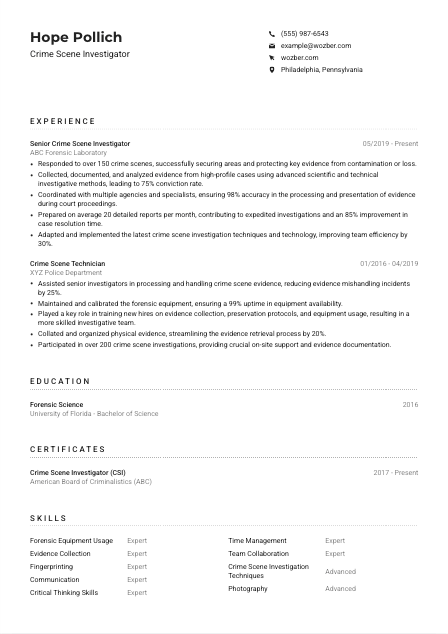
Each bullet should show what you did at the scene or in evidence processing, how you did it, and what changed because of your work. The example does this well with points such as responding to more than 150 crime scenes, securing areas against contamination, and preparing around 20 detailed reports per month. That kind of detail ties daily forensic practice to real case impact.
Quantify your work where the numbers are meaningful. Useful measures in this profession include number of scenes processed, report volume, evidence accuracy, equipment uptime, reduction in mishandling incidents, or improvements in case resolution time. Metrics like 98% evidence-processing accuracy or 25% fewer mishandling incidents make your contribution easier to understand than broad claims about being effective.
Prioritise experience that supports crime scene work. Laboratory support, photography, fingerprint processing, chain-of-custody management, evidence cataloging, courtroom preparation, and cross-agency coordination all belong here when relevant. Leave out unrelated achievements that do not strengthen your case for scene investigation responsibilities.
A hiring manager should be able to see, in a few bullets, the kinds of scenes you handled, the forensic methods you used, and the reliability of your documentation. That is what turns experience into a credible case for interview.
Education matters in crime scene investigation because it establishes your grounding in forensic science, criminalistics, and scientific handling of physical evidence. Present it clearly, especially when the posting names a degree requirement.
If the role asks for a bachelor's degree in Forensic Science, Criminalistics, or a related field, make sure that information is easy to spot. In the example, a Bachelor of Science in Forensic Science directly supports the stated requirement and strengthens ATS alignment without extra explanation.
List degree, field of study, school, and graduation year in a clean order. This keeps the section readable and helps ATS systems identify the credential correctly. For regulated or technically trained roles, clarity matters more than visual flourishes.
Be specific about your course of study. "Forensic Science" is stronger than a vague label when it reflects your actual degree, because it immediately connects your academic background to evidence handling, scientific analysis, and investigative procedure.
If you are early in your career, include coursework, capstone projects, lab work, or honors tied to crime scene processing, trace evidence, digital imaging, or forensic photography. For more experienced candidates, keep this brief unless the detail is especially relevant to the target role.
Additional workshops, agency training, or specialised forensic coursework can reinforce your commitment to current methods and legal standards. That is especially useful in a field where documentation practices, imaging tools, and evidentiary requirements continue to evolve.
Your education section should quickly confirm that you have the scientific training expected for scene investigation work. Once that foundation is clear, the rest of the CV can focus on how you applied it in the field.
Certifications carry real weight in crime scene investigation because they show formal validation of technical practice and ongoing professional standards. Use this section to highlight credentials that matter to scene processing, evidence handling, and specialised forensic methods.
If the posting calls for a valid Crime Scene Investigator certification or equivalent, place that credential first when you have it. This is one of the fastest ways to confirm that you meet a stated requirement and understand the standards tied to the role.
Choose credentials that support the work described in the posting. In the example, Digital Imaging Certification adds value because scene photography and visual documentation are central parts of evidence preservation. Similar logic applies to fingerprint, bloodstain, or evidence-management training when it reflects your background.
List the year earned and, when relevant, whether the credential is current. That matters in fields where certification maintenance reflects active professional standing and current procedural knowledge.
Crime scene methods, imaging technology, and evidentiary expectations do not stand still. Recent certifications, renewals, or specialised updates signal that you are keeping your practice current, which is particularly useful when the role mentions staying updated on new techniques and legal requirements.
Relevant certifications add another layer of trust to your CV. They show that your scene work is backed by recognized training, current credentials, and discipline in a field where process matters.
A Crime Scene Investigator skills section should read like the toolkit behind your field performance. Focus on skills that connect directly to evidence collection, documentation, equipment use, analytical judgment, and coordination with investigators and legal teams.
Build this section from the technical and professional requirements named in the job description. Here, that includes crime scene investigation techniques, evidence collection and preservation, forensic equipment, photography, fingerprinting, analysis tools, communication, organisation, and critical thinking.
Include the capabilities that appear in your experience, certifications, or training. Skills such as evidence collection, forensic equipment usage, fingerprinting, and photography are especially strong when your work history also shows scene counts, report volume, or documented improvements in evidence handling.
Do not overload the section with generic workplace traits. A focused mix of forensic techniques, documentation tools, evidence protocols, and core professional skills will do more for a Crime Scene Investigator application than a long list of broad competencies. Organise them cleanly so both ATS systems and hiring teams can scan them quickly.
The best skills section reinforces the rest of your CV. It should sound like the toolkit of someone who can arrive at a scene, preserve what matters, document it correctly, and support the investigation from collection through reporting.
Language ability is rarely the primary deciding factor for a Crime Scene Investigator, but it can still matter in field communication, coordination, and public-facing interactions. Present languages clearly and in proportion to their relevance for the role.
If the posting specifies English proficiency, make sure English appears in this section with an accurate level. That is a direct requirement here and should not be left implied.
Additional languages can be useful in jurisdictions where investigators interact with diverse communities, witnesses, victims, or partner agencies. In the example, fluent Spanish broadens communication range, which can be an asset depending on the population served.
Use honest proficiency labels such as Native, Fluent, Advanced, or Conversational. Overstating language ability can create problems quickly in a profession where accurate communication affects reports, interviews, and courtroom preparation.
Do not force this section to carry more weight than it should. If another language supports your ability to work in the community or coordinate more effectively, include it. If not, a simple English entry is enough when that is the only language requirement.
For some candidates, language skills can support clearer communication during scene response, collaboration with officers, or interactions around case processing. Frame them as a practical capability, not as a generic character trait.
If language ability is part of your CV, keep it factual and useful. In this field, credibility depends on precise representation, whether you are describing evidence, writing reports, or listing your own capabilities.
The summary is your opening snapshot, and for a Crime Scene Investigator it should establish field experience, technical focus, and the kind of casework you are prepared to handle. Keep it compact, but make sure it points clearly to the rest of the CV.
Before writing, identify the recurring themes in your experience. For this profession, that often means years in scene response, strength in evidence collection and preservation, confidence with forensic equipment, and reliable report writing. Those themes should shape the summary, not a generic statement about being motivated.
Start with your professional identity and level of experience. A line such as "Crime Scene Investigator with over 7 years of hands-on experience" works because it establishes role alignment immediately and gives the reader a quick sense of depth.
Choose strengths that map directly to the job description. In the example, securing scenes, protecting evidence, collaborating across agencies, and using advanced forensic techniques are all stronger than broad claims about being detail-oriented. Mention the kinds of responsibilities you actually perform.
Aim for a summary that can be read in a few seconds and still communicate your level, specialty, and value. Dense, specific language works best here. If your summary already covers evidence handling, reporting, and investigative scope, you do not need extra filler.
A clear summary tells the reader what kind of Crime Scene Investigator you are before they reach the bullet points. It should make your experience level, forensic strengths, and practical contribution easy to grasp right away.
When each section reflects the actual demands of crime scene investigation, your CV becomes much easier to trust. Degrees, certifications, field experience, forensic tools, and reporting work should all support the same conclusion: you can process scenes carefully and document findings in a way that stands up to review.
Use Wozber to tighten that alignment, strengthen ATS optimisation, and present your background in an ATS-friendly CV format that highlights the right investigative details. The finished CV should make it easy to see your readiness for real scene response, evidence preservation, and disciplined forensic reporting.




