



Use Wozber and land your dream job
Create CV
No registration required
Cracking cases, but your CV keeps hiding clues? Investigate this Detective CV example, created with Wozber free CV builder. Learn how to make your investigative prowess stand out, mapping your career path to match job criteria head-on!
Detective work is built on facts, documentation, judgment, and the ability to move a case forward with credible findings. Hiring teams read CVs through that same lens. They want to see what kinds of investigations you handled, how you worked with evidence, whether your reports stood up in court or internal review, and how effectively you coordinated with agencies, legal teams, or field investigators.
A tailored CV helps those priorities surface quickly, especially when an ATS first scans for investigation experience, licensing, reporting, and tool familiarity. Wozber's free CV builder helps you align your wording with the posting in an ATS-friendly CV format, so your case volume, analytical work, and courtroom or interagency experience are easier to spot from the start.
For a Detective CV, the top section should establish professional credibility fast. Keep it clean, factual, and aligned with the posting, especially when the employer has practical filters such as location, title, or required contact details.
Use your full name at the top in a clear, readable format. This section does not need design flair. It needs immediate legibility, the same way a report heading needs to identify the investigator without distraction.
Place the job title directly under your name if it matches your target role. Using "Detective" here reinforces your direction and helps align your CV with the language in the posting, which is useful for ATS matching and for quick human review.
List a reliable phone number and a professional email address, then verify both. Investigative roles depend on precision, and a typo in your contact details creates the wrong first impression. If you include LinkedIn or a professional website, make sure the information matches your CV.
Some employers need candidates who are already based in a specific area. Here, the position calls for someone in New York City, New York, so stating that clearly in your personal details removes an immediate point of doubt. Treat location this way when it is a stated hiring requirement, not as a default rule for every application.
Add a LinkedIn profile or professional site only if it supports your candidacy with consistent, job-relevant content. For detectives, that might include investigative leadership, compliance work, fraud examination, public safety experience, or training credentials. Skip profiles that are sparse or unrelated.
This opening block should confirm that you are reachable, professionally presented, and properly aligned with the basic terms of the role before the reader gets into your investigations and case results.




This is the section most likely to decide whether your CV moves forward. For Detective hiring, experience should show the scope of your investigations, the methods you used, the quality of your documentation, and the outcomes your work helped produce.
Start by identifying the work patterns in the job description. Here, that includes conducting investigations, gathering evidence, interviewing, analysing data, maintaining records, preparing reports, testifying in court, and coordinating with local, state, and federal agencies. Those are the experience signals your bullet points should reflect.
Organise each position with employer, title, and dates, then focus your bullets on investigative responsibilities and outcomes. Roles in law enforcement, private investigations, fraud examination, compliance investigations, or related fields should make clear what types of cases you handled and what level of responsibility you carried.
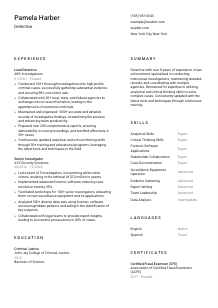
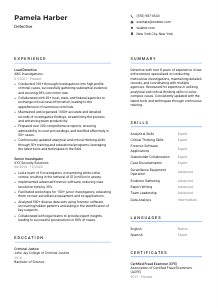
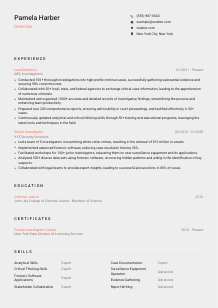
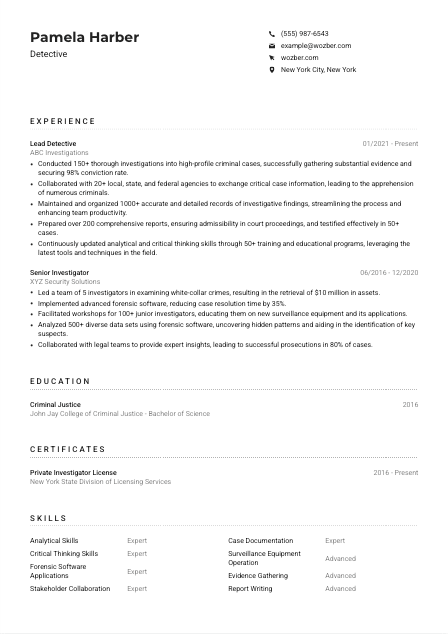
Use bullet points to show what happened because of your work. Strong examples include case volume, evidence gathered, suspects identified, prosecutions supported, records managed, or reports prepared for court or internal proceedings. In the sample CV, "Conducted 150+ thorough investigations" and "Prepared over 200 comprehensive reports" work because they connect activity to measurable output.
Quantify with metrics that belong in investigative work. That can mean conviction rate, case resolution time, number of agencies coordinated with, records maintained, assets recovered, or number of court appearances. The sample's 98% conviction rate, 35% faster case resolution, and $10 million in recovered assets are effective because they show operational impact, not inflated claims.
Prioritise experience that supports investigative judgment, evidence handling, documentation, surveillance, interviews, fraud analysis, forensic software use, or courtroom preparation. If an older role does not strengthen your candidacy, trim it back. Hiring teams are looking for relevant investigative depth, not a complete life history.
By the end of this section, a reader should understand the kinds of cases you have worked, the tools and methods you used, and whether your findings held up in reports, prosecutions, or other formal outcomes.
Education matters more when the posting names a specific degree requirement, as this one does. Present it clearly so the employer can confirm your academic background without having to search for it.
When a posting requires a bachelor's degree in Criminal Justice or a related field, make that qualification easy to find. If you have a direct match, such as a Bachelor of Science in Criminal Justice, list it plainly and without extra wording.
Include degree, school, field of study, and graduation year or date. Keep the formatting consistent with the rest of the CV. For experienced detectives, this section should be brief and orderly rather than expanded with unnecessary detail.
If your degree supports investigative work through criminal justice, criminology, forensic science, psychology, or another related discipline, name the field clearly. In the sample CV, the John Jay College of Criminal Justice degree is a clean match to the posting and should be easy for both recruiters and ATS tools to identify.
Relevant coursework, capstones, or academic projects can help if you are earlier in your career or pivoting from an adjacent field. For an experienced detective with 5+ years of investigative work, those details usually matter less than casework, reports, and results.
This role also values continued training. Formal education should stay in this section, while investigative workshops, surveillance training, forensic software instruction, or legal update programs can strengthen your experience or certificates sections. The sample CV's mention of 50+ training programs is a good example of showing current practice beyond the degree itself.
Your education section should quickly establish that you meet the stated academic requirement and have the foundational training to handle investigative analysis, documentation, and legal process.
In investigative hiring, required licenses are often a hard filter. Certifications then add depth by showing specialization in areas such as fraud, compliance, interviewing, surveillance, or evidence handling.
If the role asks for a valid state-issued Private Investigator, Detective, or related license, list that credential prominently. This posting does, so it should appear before optional certifications. Employers often screen for licensure early because it affects legal eligibility to perform the work.
Include certifications that reinforce the kind of cases or methods you handle. Useful examples can include fraud examination, forensic interviewing, cyber investigations, compliance, financial crimes, or evidence-related training. In the sample CV, the Certified Fraud Examiner credential adds weight because it supports analytical and investigative capability beyond the basic license.
Many licenses and certifications have active periods, renewals, or continuing education expectations. Listing dates helps show that your credentials are current. For regulated roles, that is more useful than simply naming the certificate without context.
Investigation methods change with new digital evidence sources, surveillance tools, forensic platforms, and legal standards. Ongoing certification and training show that your methods are current and that you take procedure, admissibility, and professional standards seriously.
This section should remove doubt about licensing and show whether you have specialised credentials that match the cases, tools, and regulatory environment tied to the role.
A Detective skills section should read like a quick inventory of capabilities you actually use in investigations. Prioritise skills that connect to case development, evidence handling, analysis, reporting, and coordination with other parties in the process.
Start with the posting's stated needs, then add closely related skills you can support elsewhere in the CV. Here, that includes analytical and critical thinking skills, investigative tools and techniques, surveillance equipment, forensic software, recordkeeping, report writing, and cross-agency collaboration.
Detective hiring usually looks for a blend of investigative judgment and practical execution. Include tool-based skills such as forensic software applications or surveillance equipment operation alongside operational strengths like evidence gathering, interviewing, case documentation, testimony preparation, and stakeholder collaboration.
Do not overload this section with generic soft skills. Choose skills that are central to the work and can be backed up by your experience bullets. The sample CV does this well by listing analytical skills, case documentation, forensic software applications, and stakeholder collaboration, all of which are reflected in the candidate's work history.
A hiring manager should be able to scan this list and immediately see that you understand investigative workflows, can work with the required tools, and can document findings in a way that supports legal or internal action.
Language ability can matter in detective work for interviews, witness communication, statement review, and coordination across communities or agencies. List languages in a way that is accurate and relevant to the environment you work in.
If the job requires effective use of English, list English clearly with an honest proficiency level. For detective work, this is not a minor detail. Interview quality, report writing, affidavit accuracy, and testimony all depend on strong command of the language.
Lead with the language that is essential for the role. In this case, English belongs at the top. That makes it easy for the employer to confirm a stated requirement without searching through the section.
Additional languages can be valuable when they help with community interaction, witness interviews, document review, or multi-agency coordination. The sample CV lists Spanish as fluent, which can be a practical asset in many investigative settings without being treated as a universal requirement.
Be specific about your level, such as native, fluent, conversational, or basic. Overstating language ability can create problems in interviews or on the job, especially in work that depends on precise communication and legally sensitive documentation.
Some detective roles are highly local, while others involve broader agency coordination, cross-border fraud, or communities with diverse language needs. Highlight additional languages when they genuinely support the type of cases you pursue, not simply to fill space.
Used well, a language section shows communication range that can support interviews, documentation, and public-facing investigative work without distracting from your core case experience.
Your summary should give a concise read on your investigative background before the employer reaches the detailed case history. Focus on years of experience, area of specialization, core methods, and the kinds of outcomes your work supports.
Start with a direct line that places you in the field, such as Detective with 8+ years of experience in law enforcement or investigations. This immediately positions you against the posting's minimum experience requirement and tells the reader your background is relevant.
Use the next lines to name the capabilities most tied to the role, such as evidence gathering, witness or subject interviews, data analysis, report preparation, court testimony, surveillance, forensic software use, or interagency coordination. Keep these strengths anchored in how you actually work.
Aim for 3 to 5 sentences with concrete language. A summary full of vague traits will not carry much weight in investigative hiring. The sample summary works best where it mentions over 8 years of experience, detailed records, coordination with multiple agencies, and ongoing training in tools and techniques.
Close by reinforcing the value you bring to the target role. That might be your ability to support complex investigations, produce court-ready documentation, improve case resolution efficiency, or contribute to high-stakes criminal or fraud matters. Keep the focus on contribution, not generic enthusiasm.
A well-written summary should tell the reader, within a few lines, what kind of investigator you are, how much relevant experience you bring, and whether your background matches the level and demands of the assignment.
Your Detective CV should make the essentials easy to confirm: investigative experience, case-related results, documentation quality, tool familiarity, required education, and active licensing. When those details are clearly organised, hiring teams can quickly judge whether you can handle interviews, evidence, reporting, and coordination at the level the role requires.
Use Wozber's free CV builder to shape that content into an ATS-compliant CV, refine wording with its AI CV builder tools, and check alignment with an ATS CV scanner. The final document should make one thing clear right away: you can conduct disciplined investigations and produce work that stands up under scrutiny.