





Use Wozber and land your dream job
Create CV
No registration required
Sleuthing out leads, but your CV case is unresolved? Check out this Investigator CV example, put together with Wozber free CV builder. Learn how to present your analytical acumen and investigative prowess to match job demands, turning your career narrative into a case closed!
Investigator hiring turns quickly on whether your background shows sound judgment under pressure. Teams want to see that you can move a case forward methodically, protect evidence, conduct effective interviews, and turn complex facts into findings that hold up with clients, counsel, or in court. Your CV should make that operating standard visible from the first few lines.
When investigator CVs are tailored well, the reader can immediately tell what kinds of matters you have handled and how reliably you document them. Wozber's free CV builder helps shape that into an ATS-compliant CV by aligning your wording with the posting and keeping the structure clean, so your experience reads clearly for roles that depend on thorough investigations and credible reporting.
For investigator roles, the header needs to do more than identify you. It should confirm basic hiring requirements quickly, especially title alignment, contact accuracy, and any sample-specific location expectation. Keep it simple, professional, and easy to scan.
Place your full name at the top in the largest text on the page. Hiring teams often review many CVs for investigative positions, and you do not want your name buried beneath design elements or extra labels. A clean header supports the same professional discipline expected in case files and reports.
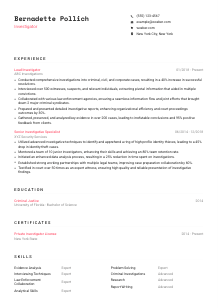
Add "Investigator" directly under your name if that is the role you are pursuing. This immediately aligns your CV with the posting and helps frame the rest of your background around investigations, evidence handling, interviews, and reporting. If your current title is more specific, such as "Lead Investigator" or "Senior Investigative Specialist," that can appear in the experience section.
List a phone number you answer, a professional email address, and check both for errors. Investigative work depends on accuracy, and small mistakes in your own contact details undermine the credibility you are trying to establish. Use an email based on your name rather than a casual handle.
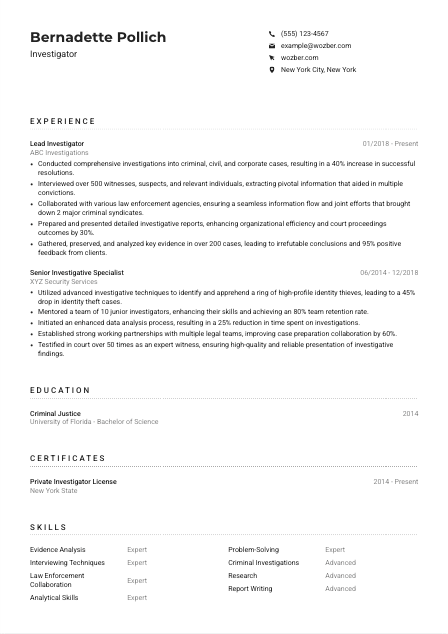
Some investigator openings are tied to licensing, court activity, fieldwork, or local agency coordination. In the provided example, New York City, New York is an explicit requirement, so including that location in the header removes an avoidable question. Treat this as tailoring to the posting, not a universal rule for every investigator CV.
Include LinkedIn or a professional website only if it reinforces your investigative credibility. That might mean a profile showing law enforcement, compliance, corporate investigations, fraud work, or court-facing experience. Keep the information consistent with your CV, especially dates, titles, and credentials.
This section should confirm that you are reachable, appropriately titled, and positioned to meet the basic logistics of the role. For investigator hiring, that kind of precision sets the tone for everything that follows.




Experience carries the most weight on an investigator CV because it shows how you actually handle cases. Hiring managers look for scope, case type, evidence work, interview depth, reporting quality, and collaboration with law enforcement or legal teams. Your bullets should reflect the work as it is practiced, not just list duties.
Start by identifying the work themes in the posting. Here, the priorities include criminal, civil, and corporate investigations, evidence collection and preservation, witness and suspect interviews, report preparation, and coordination with outside stakeholders. Those themes should guide which accomplishments you choose and how you word them.
List positions in reverse chronological order with your title, employer, and dates. Under each role, use bullet points that show the kinds of investigations you handled, the methods you used, and the outcomes you influenced. The example does this well by separating a lead investigator role from an earlier senior investigative specialist role, which makes career progression easy to follow.
Metrics make investigator experience more credible when they match how the work is measured. Strong examples include case resolution rates, number of interviews conducted, time saved through process improvements, court testimony volume, client satisfaction, or the scale of evidence reviewed. In the sample CV, figures such as 500 plus interviews, 200 cases, and a 40% increase in successful resolutions give the reader a concrete sense of workload and results.
Remove accomplishments that do not strengthen your case for investigative judgment. Prioritise bullets about evidence preservation, interviewing, analysis, report writing, courtroom support, surveillance, fraud detection, or interagency coordination, depending on your background. If you include leadership or mentoring, connect it to better investigative output, stronger case handling, or improved team quality.
Investigators rarely work in isolation. Mention collaboration with police departments, attorneys, compliance teams, insurers, HR leaders, or external experts when it materially affected the case. The example's references to law enforcement coordination, legal team partnerships, and court testimony help show that the candidate can operate in environments where findings need to stand up to scrutiny.
Your experience section should leave no doubt about what you investigated, how you handled information, and what happened because of your work. That is the core proof most investigator hiring teams want to see.
Education matters most when it confirms the foundation behind your investigative methods. Degrees in criminal justice, forensic science, and related disciplines can support your credibility, especially when the posting asks for them directly. Present the basics clearly, then add relevant detail only if it strengthens your case.
If the posting specifies a bachelor's degree in Criminal Justice, Forensic Science, or a related field, make sure that information is easy to find. When your degree aligns directly, as it does in the example with a Bachelor of Science in Criminal Justice, it helps remove an early screening question.
Include your degree, field of study, school name, and graduation year or date format consistent with the rest of the CV. Investigator CVs usually benefit from straightforward presentation rather than extra formatting. The point is to confirm qualifications quickly, not turn this section into a transcript.
If your academic background closely supports the role, let that connection be obvious. Criminal procedure, forensic methods, evidence handling, criminology, or fraud-related study can reinforce the analytical and procedural side of your experience. Keep the emphasis practical and tied to the work you now perform.
Relevant coursework can help if you have limited professional investigation experience or if the role leans into a specialty area. Courses in forensics, interviewing, research methods, or criminal law may be useful. For someone with several years in the field, hands-on casework usually deserves more space than classroom detail.
Student organizations, academic honors, or field-related projects can support your profile if they connect to investigative work, public safety, legal research, or evidence-based analysis. For more experienced candidates, include them only if they still say something distinctive about your background.
This section should quickly show that your training supports the kind of investigative work the employer needs. When the degree matches the posting, keep that connection visible and move the reader back to your field experience.
Licenses and certifications carry particular weight in investigation work because they speak to legal eligibility, specialised knowledge, and professional standards. If a posting mentions state-specific licensing or the ability to obtain it, treat that as a direct tailoring point.
Read the posting carefully for licensing language. Here, the employer asks for relevant state-specific investigative licenses or certifications, so this belongs near the top of the section. If you already hold the required credential, name it clearly. If you are eligible to obtain it, state that elsewhere in your CV or cover letter when appropriate.
Choose certifications that match your actual work. A private investigator license, fraud certification, digital forensics credential, interview training, or compliance-related certification can all add value when they connect to the cases you handle. In the example, the New York State Private Investigator License and Certified Fraud Examiner designation both reinforce the candidate's investigative range.
For licenses and certifications, dates matter because they show current standing. Use issue dates, renewal ranges, or "Present" when the credential is active. That is especially helpful in regulated environments where employers need confidence that your licensing status is current.
Investigation methods evolve with changes in fraud patterns, digital evidence, privacy rules, and reporting standards. Keeping certifications current signals that you stay engaged with the field and maintain professional discipline beyond day-to-day casework. That matters in roles where findings may be challenged by clients, counsel, or opposing experts.
A well-chosen certifications section supports your authority and your eligibility to do the work. For investigator roles, that combination can be a decisive advantage.
The skills section works best when it mirrors how investigator work is actually done. That means balancing technical and procedural strengths such as evidence analysis, research, and report writing with judgment-heavy skills like interviewing, problem-solving, and communication. Focus on what the role requires, not everything you have ever done.
Look for exact terms in the job description and use them when they match your background. This posting calls for analytical ability, research, problem-solving, and strong written and verbal communication, so those belong on the CV in natural language. Matching the employer's phrasing also supports ATS optimisation when the terms reflect your real experience.
Lead with the abilities most central to investigative work, such as evidence analysis, interviewing techniques, case management, report writing, surveillance, database research, or law enforcement collaboration, depending on your background. The sample CV does this effectively by foregrounding evidence analysis, interviewing, analytical skills, and criminal investigations.
Do not overload the section with broad traits or redundant wording. Choose skills that the hiring team can expect to see demonstrated in your experience bullets, reports, testimony, or cross-functional work. A shorter list of relevant skills usually lands better than a long inventory with no clear investigative focus.
If your skills section is aligned well, it should prepare the reader to see the same abilities backed up in your case history, reporting work, and collaboration record.
Language ability can be genuinely useful in investigative work, especially in witness interviews, field inquiries, document review, or cross-border matters. Still, this section should stay grounded in the posting. Lead with required language proficiency, then add other languages that could expand your effectiveness in the field.
This posting makes English proficiency a fundamental requirement, so list it directly and indicate your level honestly. For investigation roles, English fluency often affects interviews, written reports, court documentation, and communication with law enforcement or legal teams, so do not leave it implied.
If you speak additional languages, include them when they could help with witness communication, community-based investigations, document review, or multi-jurisdictional work. In the example, Spanish adds practical value without distracting from the core requirement.
Describe each language with straightforward terms such as "Native," "Fluent," "Intermediate," or "Basic." Investigative work can involve sensitive interviews and high-stakes reporting, so inflated language claims can quickly create problems if tested.
Extra languages matter most when they help you gather information more effectively or navigate a broader set of stakeholders. If the role involves community outreach, international matters, or frequent interaction with non-English speakers, multilingual ability becomes more than a nice addition. It becomes operationally useful.
If you are actively improving a language that supports your investigative work, that can be worth mentioning in interviews even if it does not belong on the CV yet. Communication range matters when trust, nuance, and accurate information gathering are central to the job.
Done well, this section shows that you can communicate clearly in the environments your investigations require. Accuracy matters here as much as it does anywhere else on the CV.
An investigator summary should quickly establish your level, your case environment, and the kind of results your work produces. Keep it compact, but make it specific enough to distinguish you from adjacent profiles in security, compliance, or general operations. The strongest summaries point straight to investigation work and the outcomes it supports.
Before you write, identify the core needs in the job description and choose the two or three that best match your background. In this case, that means investigation scope, evidence work, interviews, reporting, and cross-functional collaboration. Your summary should reflect that mix rather than opening with generic claims about being hardworking or detail-oriented.
Lead with your title or specialty, then note your years of experience and the environments you have worked in. The example summary opens with more than 9 years in the field and quickly moves into conducting investigations, gathering evidence, and collaborating with law enforcement. That gives the reader a useful frame immediately.
Mention capabilities that the rest of the CV proves through accomplishments. Good options include high-volume interviewing, evidence preservation, fraud detection, courtroom presentation, interagency coordination, or investigative leadership. If you mention outcomes, keep them believable and tied to your actual experience.
Aim for a short paragraph that reads with the control of an executive case brief. Four to five lines are usually enough. The summary should create a clear investigative profile, then hand the reader to your experience section for the supporting detail.
A focused summary helps the hiring team understand your case background before they read a single bullet point. It should make your investigative scope, judgment, and reporting value easy to recognize.
An effective investigator CV makes your case history easy to follow, your evidence handling credible, and your reporting strength visible. When each section is tailored to the posting, the hiring team can quickly see whether your background matches the kind of matters they need handled.
Use Wozber to turn that experience into a sharper, ATS-friendly CV format with targeted language, cleaner structure, and practical ATS optimisation. The final result should make one thing clear: you can conduct investigations thoroughly, document findings reliably, and support decisions that stand up to scrutiny.




