



Use Wozber and land your dream job
Create CV
No registration required
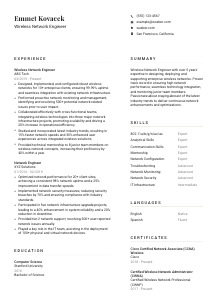
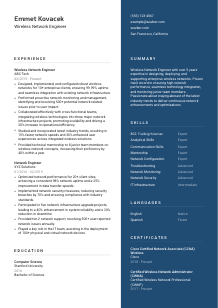
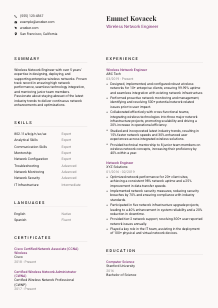
Setting up Wi-Fi waves, but your CV has no bars? Check out this Wireless Network Engineer CV example, built with Wozber free CV builder. It shows how to match your wireless wizardry to job criteria, keeping your career signal strong and never dropping!
Wireless network engineering gets evaluated in the real world when users stay connected, roaming works cleanly, coverage is reliable, and incidents get solved before they spread across a site or client environment. Your CV needs to make that operational impact visible fast. Hiring teams want to see how you design, deploy, monitor, secure, and improve wireless environments, especially when the work involves enterprise scale, uptime targets, and coordination with broader network infrastructure.
A tailored CV changes how quickly your wireless depth is recognized in ATS screening and early technical review. When your wording matches the role's language around 802.11 standards, Wi-Fi 6, monitoring, troubleshooting, and enterprise support, Wozber's free CV builder helps you shape an ATS-compliant CV that surfaces the right experience early and makes your readiness for production wireless environments much easier to judge.
For infrastructure roles, the header does more than identify you. It sets the context for availability, role alignment, and how easily a hiring team can contact you when they are moving quickly on technical candidates. Keep this section clean, factual, and directly relevant to the Wireless Network Engineer opening.
Use your full name as the clearest visual anchor on the page. A simple, readable presentation works best. This role depends on technical credibility and precision, so your header should feel orderly from the first line.
Place "Wireless Network Engineer" directly below your name when that is the role you are pursuing. That immediately connects your profile to the opening and avoids any ambiguity if your recent title was broader, such as Network Engineer or Infrastructure Engineer.
Include a reliable phone number and a professional email address. Check them carefully. For technical hiring, interview scheduling often moves through recruiter screens, hiring manager calls, and panel coordination, so one typo can cost you momentum.
If the employer asks for local presence or relocation, state your city and state in a straightforward way. In this example, listing "San Francisco, California" directly answers the location requirement and removes an early screening question.
Include LinkedIn, a personal site, or a portfolio only if they strengthen your case. For a Wireless Network Engineer, that could mean a profile with certification details, network project context, or technical summaries that reinforce the CV rather than repeat it.
A precise header keeps the application process friction-free and confirms key basics early. For this kind of role, that means the team can move straight to your wireless experience, certifications, and infrastructure scope.




This is where your CV proves you can operate in live environments, not just talk about wireless concepts. The most convincing experience sections show what you built, what you supported, how you improved performance, and what changed because of your work across enterprise networks.
Start by marking the responsibilities and requirements that appear most central to the role. Here, that includes designing and configuring wireless networks, monitoring performance, resolving network issues, integrating with existing infrastructure, and mentoring junior staff. Those points should shape both your bullet selection and your wording.
List your most recent position first and keep each entry easy to scan with employer, title, and dates. Wireless engineering hiring often looks for progression from general network support into deeper design, deployment, optimisation, or enterprise wireless ownership, so your chronology should make that growth obvious.
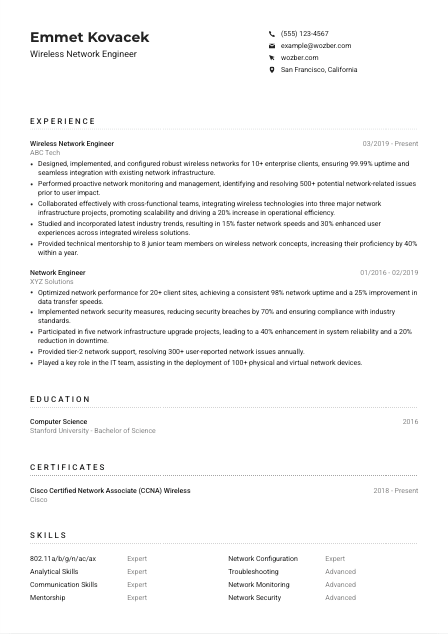
Write bullets around delivered results instead of generic task lists. "Designed, implemented, and configured robust wireless networks for 10+ enterprise clients" is much stronger than saying you were responsible for wireless deployment. It shows environment type, action, and scope in one line.
Use metrics that make sense for infrastructure work: uptime, issue volume, incident reduction, speed improvement, deployment scale, user impact, or operational efficiency. The sample CV does this well with 99.99% uptime, 500+ issues resolved proactively, and a 20% efficiency gain from infrastructure integration.
Cut details that do not help prove enterprise wireless capability. Prioritise work with 802.11 environments, monitoring, troubleshooting, security, integration, and optimisation. Even if part of your background comes from broader network engineering, frame the bullets around the parts that translate directly to wireless performance and support.
Your experience section should leave little doubt that you can design, support, and improve wireless environments under real operating conditions. The clearer the link between your past work and enterprise wireless outcomes, the stronger your case for interview.
Most Wireless Network Engineer roles expect a formal grounding in networking, systems, or computer science. Education rarely carries the application on its own, but it does confirm that you meet baseline requirements and helps frame the technical depth behind your deployment and troubleshooting experience.
If the posting asks for a bachelor's degree in Computer Science, Information Technology, or a related field, make sure that qualification is easy to find. In this example, a Bachelor of Science in Computer Science aligns directly with what the employer requested.
List degree, field of study, school, and graduation year in a consistent structure. That makes it easy for ATS parsing and quick human review, especially when recruiters are screening several technically similar candidates.
Lead with the degree that best supports your networking background. For this profession, degrees tied to computer science, information technology, telecommunications, or network engineering usually deserve the most visible placement because they support the technical nature of the work.
Relevant coursework can help if you are earlier in your career or if your program included classes in networking, wireless communications, security, or systems administration. Skip it when your professional experience already proves that depth more effectively.
Honors, lab work, student organizations, or technical projects belong here only if they strengthen your case for network engineering work. Early-career candidates may benefit from showing a wireless lab project or networking club leadership, while experienced candidates usually gain more from keeping the section lean.
Education should confirm that you meet the role's academic baseline without slowing down the CV. For an experienced Wireless Network Engineer, it works best as a concise technical credential that supports the story told by your project and operations history.
In wireless infrastructure hiring, certifications often act as quick shorthand for current technical commitment. They are especially useful when the role names preferred credentials or when you want to distinguish wireless specialization from broader network administration experience.
When a posting calls out credentials such as CCNA Wireless, CWNA, or CCNP Wireless, move those to the top of the section if you hold them. That shows direct alignment with the employer's preferences and reinforces your focus on wireless engineering rather than general networking alone.
A shorter list of directly useful certifications is stronger than a long inventory of unrelated credentials. For this role, wireless networking, routing and switching, security, or enterprise infrastructure certifications usually carry more weight than broad IT certificates with little connection to network design or support.
Include earned dates and, where relevant, active status or renewal periods. Wireless standards, hardware ecosystems, and best practices evolve, so current certifications help show that your knowledge has kept pace with technologies such as newer 802.11 standards and Wi-Fi 6 environments.
Update this section as you renew credentials or add new ones. In a field shaped by evolving protocols, controller platforms, security expectations, and performance demands, recent certification activity signals continued engagement with the discipline.
Your certifications should quickly tell the reader that your wireless knowledge is current, relevant, and backed by formal study. When they match the posting closely, they strengthen your technical profile before the interview even starts.
A Wireless Network Engineer skills section should read like a usable technical profile, not a catch-all list. Focus on the protocols, operational strengths, and infrastructure capabilities that actually matter in enterprise wireless design, deployment, monitoring, troubleshooting, and cross-team delivery.
Build this section from the specific capabilities the employer is asking for. Here, that includes wireless protocols and standards such as 802.11a/b/g/n/ac/ax and Wi-Fi 6, along with network design, deployment, and support in enterprise environments. If you have worked with those technologies, name them clearly rather than hiding them inside experience bullets alone.
Pure technical terms are not enough. Add role-relevant strengths such as troubleshooting, network monitoring, security, analytical skills, and collaboration. Wireless engineers are often brought in when performance drops, interference appears, roaming fails, or integration issues affect users, so the section should reflect both hands-on knowledge and problem-solving depth.
Choose the skills that help you qualify for the specific opening. The sample CV keeps the emphasis on 802.11 standards, monitoring, configuration, troubleshooting, security, and mentorship, which aligns well with the job description. Use that as the model: focused, readable, and tied to the work you actually do.
This section should give a hiring manager a quick read on your wireless toolkit and your day-to-day operating strengths. If the listed skills line up with the job description and your experience section proves them, the CV feels far more convincing.
Wireless Network Engineers spend plenty of time in technical execution, but communication still matters. You may need to explain outages, document changes, guide junior staff, or coordinate with systems, security, and support teams. If a posting calls out language ability, make it easy to find.
When strong English communication is listed, include English clearly and state your proficiency level. That matters for writing documentation, discussing incidents, explaining design choices, and working across infrastructure teams.
Lead with the language the role requires. If English is essential, place it at the top of the section and label it accurately as Native or Fluent, depending on your actual proficiency.
Additional languages can be useful, especially in global IT environments, managed services, or organizations with distributed teams. They are not usually core hiring criteria for wireless engineering, but they can strengthen your profile when they support stakeholder communication.
Choose straightforward ratings such as Native, Fluent, Intermediate, or Basic. Clear labels prevent awkward mismatches later, especially if the role includes technical calls, written documentation, or training responsibilities.
If your work has involved cross-regional support, vendor communication, or multilingual user environments, another language can be worth listing. Just keep the emphasis proportional. For most Wireless Network Engineer roles, language supports the job, while network performance and troubleshooting remain the core story.
If communication is part of the hiring criteria, a concise language section answers the question immediately. That keeps the focus on whether you can operate effectively with the teams, users, and documentation demands around the wireless environment.
Your summary should work like a technical snapshot at the top of the CV. In a few lines, it should establish your level of experience, the kind of wireless environments you handle, and the outcomes you are known for delivering. Skip vague personality language and get to the network work quickly.
Before writing the summary, identify the handful of points the employer is most likely to care about first. In this case, that includes enterprise wireless design and support, modern 802.11 standards, troubleshooting complex issues, and improving performance, availability, and security.
Begin with a direct statement that names your role and experience level. A line such as "Wireless Network Engineer with 5+ years of experience in enterprise wireless design, deployment, and support" gives immediate context and tells the reader where you operate.
Use the rest of the summary to highlight the strengths most relevant to the opening. That might include uptime improvements, proactive monitoring, infrastructure integration, security, or mentoring. The example summary works because it connects enterprise wireless expertise with performance, integration, and team support rather than staying generic.
Aim for three to five lines with clear, role-linked language. This section should be easy to scan and should echo the vocabulary used in the posting without sounding copied. A concise summary with real wireless context is far more effective than a paragraph full of broad claims about passion or results.
By the time someone finishes these opening lines, they should understand your level, your wireless specialty, and the kind of enterprise outcomes you deliver. That clarity sets up the rest of the CV to confirm the same story.
A Wireless Network Engineer CV works best when every section points back to the same core question: can you design, support, troubleshoot, and improve enterprise wireless environments with confidence? Keep your examples concrete, use metrics where they reflect real network performance, and mirror the posting's language when it matches your actual background.
Use Wozber's free CV builder to organise that experience into an ATS-friendly CV template, strengthen ATS optimisation, and tailor wording around the wireless standards, infrastructure work, and support scope the employer is screening for. The finished CV should make your technical range and production-level wireless judgment easy to recognize.