



Use Wozber and land your dream job
Create CV
No registration required
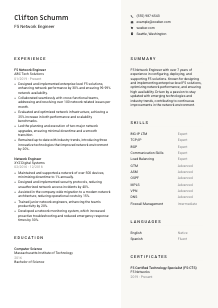
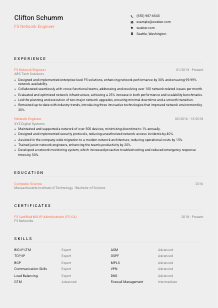
Balancing network loads, but your CV feels overloaded? Check out this F5 Network Engineer CV example, created with Wozber free CV builder. It shows how to tweak your networking prowess to match job specs, keeping your career path as fluid and efficient as the networks you orchestrate!
F5 Network Engineering work sits close to production uptime. Hiring teams want to see whether you can keep traffic flowing, tune application delivery, harden edge services, and troubleshoot failures across layered network environments without creating new risk. Your CV should quickly show hands-on depth with F5 platforms, core routing and switching concepts, and the kind of operational judgment that matters when availability and security are on the line.
CV tailoring changes how quickly your background reads as relevant for ADC and network infrastructure work. When your wording reflects the posting's language around BIG-IP modules, protocol knowledge, and performance or availability outcomes, an ATS-compliant CV is far more likely to surface for review. Wozber's free CV builder helps structure that alignment clearly, so both ATS screening and technical reviewers can see where your experience matches the network demands of the role.
For infrastructure roles, the top of the CV should remove friction immediately. Contact details, title, and location need to confirm that you are reachable, role-aligned, and workable for the position before the reader moves into your F5 and network experience.
Your name should be the easiest element to find on the page. Use a clean font, slightly larger than the body text, so it anchors the CV without distracting from the technical substance that follows.
Place "F5 Network Engineer" directly under your name when that is the role you are applying for. This helps frame the rest of the document around application delivery, load balancing, traffic management, and network operations rather than more general infrastructure work.
Use contact information that makes it easy to reach you for technical screening or interview scheduling.
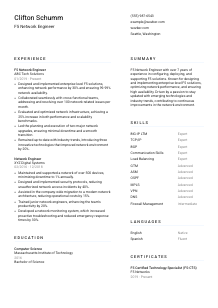
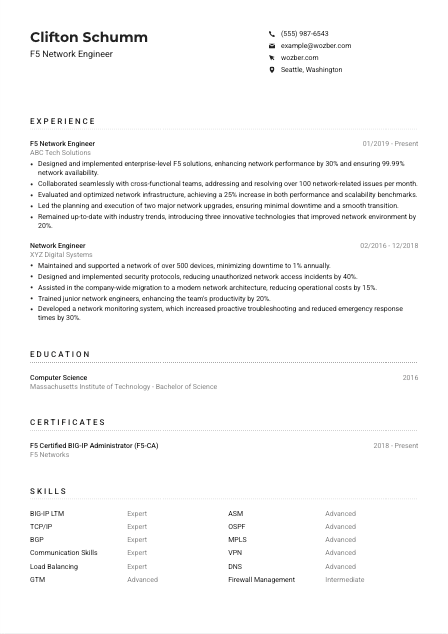
If the posting specifies a location or relocation requirement, address it directly in your header. In the example, listing Seattle, Washington supports a requirement that the candidate be local or willing to relocate. Use that kind of detail only when it matters to the role you are targeting.
A LinkedIn profile or professional website can help if it supports your CV with consistent titles, certifications, or project history. For an F5-focused role, this is most useful when it reinforces your experience with BIG-IP environments, network engineering scope, or current credentials rather than serving as a generic online presence.
The header should answer three questions at a glance: who you are, what role you are targeting, and whether basic logistics line up. Once that is clear, the CV can move straight into proof of your network engineering depth.




This section carries the most weight for an F5 Network Engineer. Hiring managers want to see what you designed, supported, upgraded, secured, and optimised, along with the business or operational effect. Strong bullets connect F5 platform work to uptime, incident reduction, scalability, security posture, or migration success.
Start by isolating the repeated demands in the job description. For this role, that includes designing enterprise-level F5 solutions, supporting BIG-IP modules, troubleshooting with cross-functional teams, and improving performance, security, and scalability. These themes should shape the language and ordering of your bullets so your experience reads as directly relevant.
List your most recent position first, then work backward. Include title, employer, and dates clearly. For network engineering hiring, this helps reviewers quickly track how your responsibilities evolved from general infrastructure support into deeper ownership of F5 delivery, migrations, monitoring, or architecture work.
Each bullet should show what environment you worked on, what you did, and what improved because of it. Instead of vague claims, use specifics such as deploying BIG-IP LTM policies, improving traffic distribution, supporting GTM or ASM, or leading upgrade work. The example bullet about improving network performance by 30% while sustaining 99.99% availability works because it ties F5 design work to measurable operational results.
Use numbers that fit the work: availability, latency improvement, issue volume, incident response time, migration scale, device count, or security reductions. "Resolved over 100 network-related issues per month" is effective because it shows support load and troubleshooting capacity in a live environment, not just general busyness.
Prioritise bullets that strengthen your case for application delivery, network reliability, protocol knowledge, and enterprise change work. General IT tasks, unrelated help desk work, or broad infrastructure bullets with no F5 or networking depth can dilute the message. Every line should help the reader understand your readiness to design, support, and optimise production network services.
A hiring team should be able to scan this section and see where you improved uptime, handled production issues, supported major upgrades, and worked with the F5 stack in meaningful ways. When the bullets are specific and measurable, your experience starts reading like operational proof rather than a list of duties.
Education matters most here as a qualification check, not as the main selling point. For an experienced F5 Network Engineer, this section should confirm the degree requirement quickly and leave more space for the hands-on infrastructure work that usually drives interviews.
If the role asks for a bachelor's degree in Computer Science, Information Technology, or a related field, list the degree in clear terms. When your background matches closely, as it does in the example with a Bachelor of Science in Computer Science, make that easy to spot.
Include school name, degree, field of study, and graduation year or date range. This is enough for most experienced network engineers and keeps the section ATS-friendly without crowding the CV with low-value detail.
For technical infrastructure roles, the major matters more than decorative formatting. Put "Computer Science," "Information Technology," or the relevant field in plain view so it supports the baseline technical foundation the employer is asking for.
Detailed coursework is usually unnecessary once you have several years of production network experience. Include it only if it fills a gap or reinforces something central to the job, such as networking, security, systems, or distributed infrastructure knowledge.
Honors, student projects, or technical organizations can stay if they strengthen your engineering profile, but they should not crowd out more important content. For a candidate with 5+ years of F5-focused work, certifications and recent infrastructure achievements usually matter more than older academic distinctions.
This section should confirm that you meet the stated degree requirement and then get out of the way. Clear formatting and direct wording are enough when your strongest case lives in network delivery and F5 operations.
F5 certifications carry real weight because they point to validated platform knowledge, not just general networking interest. In a role centered on BIG-IP deployment and support, current credentials can help separate engineers with hands-on depth from those with only adjacent experience.
If the posting asks for credentials such as F5 Certified BIG-IP Administrator or F5 Certified Technology Specialist, list those first. They are directly relevant to the platform and should be easy for both recruiters and technical reviewers to find.
Choose certifications that support the work you want to do. For an F5 Network Engineer, F5 credentials belong ahead of more general or older certifications unless another certification is central to the role's network architecture, security, or routing focus.
Show when the certification was earned and whether it is still active. This matters in fast-moving infrastructure environments where version familiarity and current product knowledge can affect deployment quality and troubleshooting confidence.
If you are working toward an advanced F5 track or adding complementary learning in security, DNS, routing, or cloud networking, include it when it supports the job target. The key is to show progression that makes sense for enterprise traffic management and network engineering work.
For this role, certifications can reinforce that your F5 knowledge is current, structured, and recognized by the vendor. Used well, they strengthen the technical story your experience section is already telling.
A networking skills section should read like an accurate map of the environments you can handle. For F5 roles, that means balancing platform-specific tools such as BIG-IP modules with the underlying protocols, security concepts, and operational skills required to deploy and support them well.
Pull directly from the job description before adding anything else. Here, that includes BIG-IP LTM, GTM, ASM, Layer 2 and Layer 3 networking, TCP/IP, BGP, OSPF, MPLS, VPN, DNS, and communication skills. Those are the terms most likely to matter in ATS matching and in technical review.
Lead with the skills that define the role, then support them with adjacent strengths. A useful order for this kind of CV is F5 platform expertise first, networking protocols second, then security, monitoring, or collaboration skills. The example does this well by putting BIG-IP LTM and core protocols near the top rather than burying them in a long mixed list.
Do not turn the skills section into a full inventory of every tool you have touched. Include the technologies you can defend in an interview and that connect to your work history. A concise list of F5 modules, routing protocols, DNS, VPN, load balancing, and related operational skills is stronger than a bloated catalogue with weak relevance.
This section should confirm your technical range in a few seconds: strong F5 knowledge, solid network fundamentals, and the supporting skills needed to keep enterprise traffic stable and secure. If the list matches the role and your experience backs it up, it does its job.
Language ability is rarely the main selection factor for network engineering, but it can matter when the role involves incident coordination, documentation, vendor communication, or cross-regional teams. Include it cleanly, and give English the emphasis it deserves when the posting calls it out.
When a posting asks for strong English communication skills, reflect that clearly in your languages section or summary. In technical operations roles, this often matters because engineers need to explain outages, document changes, and coordinate with security, systems, and application teams under time pressure.
List English at the top and rate it honestly as Native or Fluent if that matches your ability. This is a simple way to align with the job requirement and remove any doubt about your ability to handle technical communication.
Additional languages can support work with global teams, vendors, or distributed support models. If you include them, keep the same straightforward format used for English. In the example, Spanish adds useful context without distracting from the core network qualifications.
Avoid inflated labels. If you can read technical documentation but not lead a troubleshooting call, do not rate yourself as fluent. Accurate language ratings matter because communication gaps show up quickly in incident response and stakeholder coordination.
If the company works across regions or relies on multinational engineering teams, extra language capability can be worth listing. If not, keep the section short and let your infrastructure experience carry more weight.
For an F5 Network Engineer, language details should support the practical communication demands of the job. Lead with English when required, add other languages if they genuinely help, and keep the focus on technical clarity.
The summary is your chance to establish scope before the reader reaches the bullet points. For this role, it should quickly communicate years of experience, F5 specialization, and the kinds of network outcomes you have delivered, such as availability, optimisation, security improvement, or successful upgrades.
Before writing, pull the posting's main themes into one short checklist. For this job, those themes include F5 solution design, BIG-IP product expertise, protocol knowledge, troubleshooting, optimisation, and enterprise-scale support. Your summary should reflect that mix instead of sounding like a generic network engineer profile.
Start with your title and years of experience in direct terms. A line such as "F5 Network Engineer with 7+ years of experience in configuring, deploying, and supporting F5 solutions" works because it establishes seniority and platform focus immediately.
Follow your opening with specifics that matter in this field. Mention areas such as BIG-IP LTM, GTM, ASM, high availability, performance tuning, enterprise upgrades, or cross-functional incident support. The example summary is effective because it connects F5 experience with network performance and availability rather than relying on generic strengths.
Aim for three to five lines. Skip soft claims that could belong to any IT CV and use space for platform depth, network scope, and operational results. A concise summary with accurate terminology gives the reader a clear lens for the rest of the CV.
By the end of these opening lines, the reader should already understand that you are an F5-focused network engineer who can support production environments, improve performance, and contribute to stable enterprise delivery. That framing makes the rest of the CV easier to trust.
An effective F5 Network Engineer CV shows far more than familiarity with appliances and protocols. It shows where you improved availability, handled network incidents, supported secure traffic delivery, and executed upgrades or migrations without losing control of the environment.
Use Wozber's free CV builder and ATS CV scanner to tighten wording around the job description, strengthen ATS optimisation, and present your experience in an ATS-friendly CV format. The finished CV should make one conclusion easy to reach: you can be trusted with live F5 infrastructure.