



Use Wozber and land your dream job
Create CV
No registration required
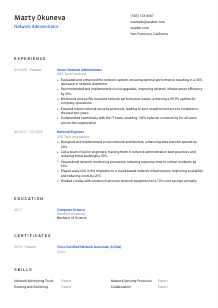
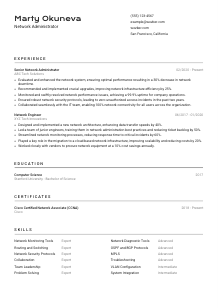
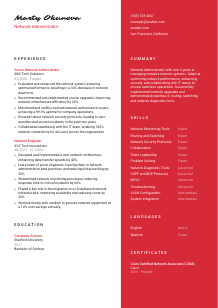
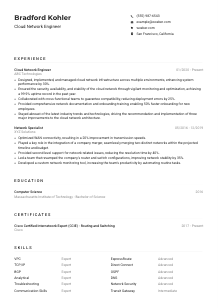
Mastering networks, but your CV isn't connecting? Check out this Network Administrator CV example, created with Wozber free CV builder. Learn how to match your network expertise to job expectations, and quickly find yourself plugged into the career pipeline!
Network administration work is judged in production. Hiring teams want to see whether you can keep connectivity stable, troubleshoot outages under pressure, secure access, and improve the environment before small issues turn into major interruptions. Your CV should make that operating value visible quickly, with concrete examples of uptime, incident response, routing and switching work, and infrastructure improvements.
For this kind of role, vague IT language gets screened out fast because it blurs the difference between general support experience and hands-on network administration. Wozber's free CV builder helps you shape an ATS-compliant CV around the exact networking terms, protocols, and outcomes a posting uses, so the document reads clearly to both the ATS and the team looking for someone who can keep the network performing day after day.
The top of your CV should remove friction immediately. For a Network Administrator, that means making it easy to confirm who you are, what role you are targeting, and whether basic logistical requirements such as location and contactability line up with the opening.
Your name should be the most visible line on the page, set in a clean, readable style. This is simple, but important. Network administration already asks employers to trust you with infrastructure stability and access-sensitive systems, so the CV should start with clarity and professionalism, not decorative formatting.
Place "Network Administrator" directly under your name when that is the role you are pursuing. This helps frame the rest of the CV around network operations, monitoring, routing, switching, and security work instead of leaving you looking like a broad IT generalist. If your current title is slightly different, such as Network Engineer, you can still target the role clearly as long as the experience supports it.
List a phone number you answer, a professional email address, and check every character. In infrastructure roles, small configuration mistakes cause real problems, so sloppy contact details send the wrong message. Use the same standard here that you would use when documenting IP ranges, firewall rules, or change windows.
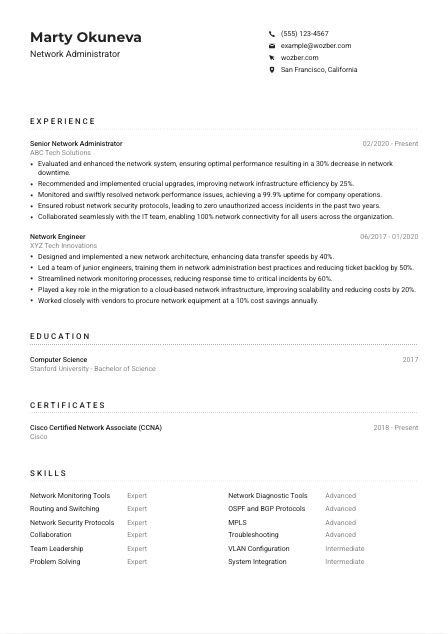
Some Network Administrator roles are tied to a site, data centre footprint, or office-based support model. When a posting specifies a location, reflect it plainly in your personal details. In the example here, San Francisco, California appears on the CV because the employer asked for candidates in that area. Treat location this way as a tailoring choice, not a rule for every application.
A LinkedIn profile, portfolio site, or professional page can strengthen this section if it supports your technical story. Keep it consistent with the CV and useful to the role. For example, a profile that reinforces your background in Cisco environments, network upgrades, cloud migration, or security work adds more value than a generic personal site.
This section should confirm the basics in seconds: your target role, how to reach you, and whether any stated logistics are already covered. That leaves more attention for the part that matters most in network hiring, your technical track record.




This section carries the most weight because network administration is hired on applied judgment. Employers look for signs that you have maintained performance, handled outages, improved architecture, strengthened security controls, and worked effectively with the wider IT team in live environments.
Before writing bullets, mark the terms that define the role's real scope. For this job, that includes network monitoring tools, diagnostic tools, network security protocols, routing, switching, VLAN, BGP, OSPF, MPLS, and troubleshooting. Those are not filler keywords. They tell you what kind of network environment the employer is running and what your experience bullets need to reflect.
List your most recent position first, then work backward. For each job, include title, company, and dates in a consistent format. That lets a hiring manager quickly follow your progression from related infrastructure work into deeper network administration responsibility, whether that growth came through design work, operations support, escalation handling, or upgrade ownership.
Focus each bullet on what you improved, protected, resolved, or delivered. Strong Network Administrator bullets mention results such as reduced downtime, faster incident response, improved throughput, stronger security posture, smoother user connectivity, or successful infrastructure upgrades. The sample CV does this well with outcomes like a 30% decrease in downtime and 99.9% uptime, which immediately tell the reader how the work performed in production.
This profession offers plenty of measurable signals. Use uptime percentages, latency improvements, reduced outage duration, response-time gains, ticket backlog reduction, throughput improvements, cost savings, or user-impact metrics when they are real. Numbers help separate hands-on operators from candidates who only describe duties at a high level.
Cut or shorten experience that does not support the target role. If an achievement relates to networking indirectly, frame the network angle clearly. A cloud migration bullet, for instance, is stronger when it explains the effect on scalability, connectivity, resilience, or operating costs. Keep the section centered on network reliability, infrastructure improvement, and secure daily operations.
A hiring team should be able to read this section and picture you handling the network, not just supporting IT in general. When your bullets show systems improved, incidents resolved, and users kept connected, your experience starts doing the heavy lifting.
Education is rarely the deciding factor in an experienced Network Administrator hire, but it still matters when a posting names a degree requirement. Present it cleanly and make it easy to confirm that your academic background supports the technical foundation expected for the role.
Start by checking the education line in the posting. Here, the employer asks for a bachelor's degree in Computer Science, Information Technology, or a related field. If you have that match, make it obvious. In the example CV, "Bachelor of Science in Computer Science" lines up cleanly with the requirement.
List degree, field of study, school, and graduation year or date range. Keep the order consistent and easy to read. This section does not need heavy design. It needs to confirm your academic qualification without making the reader hunt for the basics.
If your degree directly supports networking, systems, cybersecurity, or infrastructure work, make sure the field of study is visible. That helps connect your education to the technical demands of the role, especially when the posting asks for specific background in IT or computer science.
Early-career candidates can benefit from listing relevant courses in networking, network security, systems administration, or telecommunications. Once you have solid production experience, coursework becomes secondary unless it adds something distinctive, such as advanced routing, network architecture, or security engineering exposure.
Honors, technical projects, lab work, or student leadership can help if they reinforce networking capability. A capstone involving network design, security controls, or infrastructure monitoring is worth mentioning when you need more role-relevant detail. If you already have several years of strong experience, keep these additions brief.
This section should confirm that you meet the baseline educational requirement and have the technical grounding to work with production networks. Once that is clear, let your experience and certifications carry the deeper proof.
Certifications matter more in network administration than in many other IT paths because they point to specific technical standards. When a posting calls out Cisco credentials or protocol knowledge, your certifications section can quickly strengthen your case.
Check whether the employer lists a required or preferred credential and place that certification first if you have it. In this case, CCNA or higher is explicitly requested, so it should be prominent. That direct match helps your CV register as relevant before the reader even gets into your experience bullets.
Resist the urge to list every training badge. Focus on certifications tied to routing and switching, security, cloud networking, or vendor platforms you actually use. For many Network Administrator roles, Cisco credentials carry real weight because they connect directly to router, switch, VLAN, and protocol work.
If a certification is active, renewed, or tied to a current validity window, include dates so the employer can see it is current. The example CV shows CCNA with a continuing date range, which helps indicate that the credential remains relevant rather than sitting in the distant past.
As your responsibilities expand, your certifications should reflect that progression. A CV aimed at more advanced network administration or infrastructure roles may benefit from showing movement beyond entry-level credentials into deeper Cisco, security, cloud, or vendor-specific specializations when those align with your actual work.
A well-chosen certification list tells employers you have validated knowledge in the platforms and protocols they rely on. For network roles, that extra layer of credibility often matters early in the review.
The skills section should read like a compact map of the environment you can manage. For a Network Administrator, that usually means a mix of protocols, tools, infrastructure domains, security knowledge, and a few collaboration skills that matter during incidents and change work.
Start with the exact capabilities the employer names. In this description, that includes network monitoring tools, network diagnostic tools, network security protocols, routing, switching, VLAN, BGP, OSPF, MPLS, and troubleshooting. These should shape the core of your skills section because they define the operating context of the role.
Technical skills should dominate, but do not ignore the people side of the work. Network Administrators often coordinate with systems teams, security teams, help desk staff, vendors, and management during outages, upgrades, and maintenance windows. Skills like collaboration, problem solving, and team leadership belong here if they are supported by the experience section.
Choose the skills most relevant to the job instead of dumping every tool you have ever touched. A cleaner list helps the reviewer see the essentials fast. The sample CV handles this well by grouping recognizable networking capabilities like routing and switching, OSPF and BGP, MPLS, VLAN configuration, and monitoring tools alongside a few supporting soft skills.
Your skills section should confirm that you speak the language of the network the employer is running. When the right tools, protocols, and operational strengths appear here, the rest of the CV becomes easier to trust.
Language ability is usually a supporting section, but it can matter when the posting names a fluency requirement or the role involves constant coordination across teams. In network administration, clear communication matters during outages, escalations, documentation, and user-impact incidents.
If the employer specifies a language requirement, list it at the top with an accurate proficiency level. Here, English fluency is a stated requirement, so English should appear first and clearly. That makes the match immediate and avoids leaving a required detail buried lower on the page.
Extra languages can help in organizations with distributed teams, multilingual user groups, vendors, or regional operations. They are not a substitute for technical skill, but they can strengthen your profile when communication across locations or functions is part of the job.
Terms such as Native, Fluent, Intermediate, and Basic are usually enough. Keep them honest. Network roles often require precise communication during incident calls, ticket updates, and change documentation, so overstating language ability can create problems later.
Some Network Administrator positions are heavily internal and local. Others involve remote sites, managed service providers, international vendors, or cross-border teams. If your language skills support that kind of environment, they are worth keeping on the CV.
Only include languages you can genuinely use in professional settings or that add useful context to your profile. In the example, Spanish is a strong secondary language, but English remains the key item because it is the actual requirement for the role.
This section should quickly confirm required fluency and, where relevant, show added communication range. For a network role, that matters most when it supports coordination, documentation, and issue handling.
Your summary sits near the top, so it needs to define your technical identity quickly. A hiring manager should understand your level, your core network strengths, and the kind of operating results you have delivered before they reach the first job entry.
Read the posting for the themes that matter most, then reflect those themes in your opening lines. Here, the emphasis falls on network performance, security, monitoring, troubleshooting, and infrastructure improvement. Those are better anchors for a summary than vague claims about being hardworking or passionate.
Start with a direct statement of who you are professionally. The example summary opens with "Network Administrator with over 5 years in managing complex network systems," which works because it gives both role identity and tenure immediately. Use your own honest experience level, whether that is 3+ years or more.
Choose the capabilities that best overlap with the target role. For this job, good options include optimising network performance, troubleshooting outages, strengthening network security, and working with routing and switching environments. If you have protocol-specific experience with BGP, OSPF, VLANs, or MPLS and it is central to the role, weave that in naturally.
Aim for a short paragraph that gives the reader a reason to expect strong details in the sections below. One or two concrete results or areas of impact are enough. The sample summary works because it stays concise while still mentioning optimisation, security, collaboration, and upgrade work without turning into a full career history.
A useful summary makes your direction clear before anyone reads the rest of the CV. With Wozber's AI CV builder, you can refine this opening around the posting's terminology and build an ATS-friendly CV template that quickly shows your experience with network reliability, security, and infrastructure improvement.
A Network Administrator CV should leave no doubt about three things: the environments you have supported, the technical problems you have solved, and the operational results you delivered. If the document clearly shows network monitoring, troubleshooting, security, routing and switching work, and measurable reliability improvements, you are presenting the right story.
Before you send it, review the wording against the posting and tighten any section that sounds too broad for infrastructure hiring. Wozber's free CV builder and ATS CV scanner can help you align your language with the role, surface missing requirements, and produce an ATS-friendly CV format that makes your network administration experience easier to evaluate.




