



Use Wozber and land your dream job
Create CV
No registration required
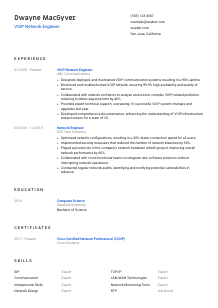
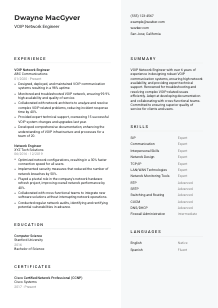
Dialing into your networking career, but the signal just isn't right on your CV? Connect with this VOIP Network Engineer CV example, built with Wozber free CV builder. Learn how to match your voice-over-IP expertise to job requirements, ensuring your career communication is always crystal clear!
Voice infrastructure failures are noticed immediately. When calls drop, jitter spikes, or a SIP trunk starts misbehaving, the VOIP Network Engineer is expected to isolate the issue fast, protect call quality, and keep service stable. Your CV should reflect that operational reality by showing where you designed voice networks, improved uptime, resolved protocol-level issues, and supported production environments without disrupting users.
A tailored CV changes how quickly your background reads against voice-specific requirements. With Wozber's free CV builder and an ATS-friendly CV format, you can mirror the language used for SIP, RTP, SRTP, network design, monitoring, and support so hiring teams can quickly connect your experience to the systems they run. That makes it easier to see whether you can handle live VOIP infrastructure, service reliability, and change work from day one.
This section is short, but it still carries practical screening value. For VOIP Network Engineer roles, the basics need to confirm who you are, how to reach you, and whether you meet location or communication requirements without making the reader search for them.
Use your full name in a clean, readable format so it is immediately identifiable at the top of the page. Skip nicknames or decorative styling. In infrastructure and engineering hiring, clarity beats personality branding every time.
Place "VOIP Network Engineer" directly under your name when that is the role you are pursuing. It keeps your CV aligned with the opening and helps distinguish you from broader network engineers who may not have voice specialization.
Your phone number and email should be accurate, professional, and easy to scan. These are small details, but they matter in technical hiring where precision is already part of the job.
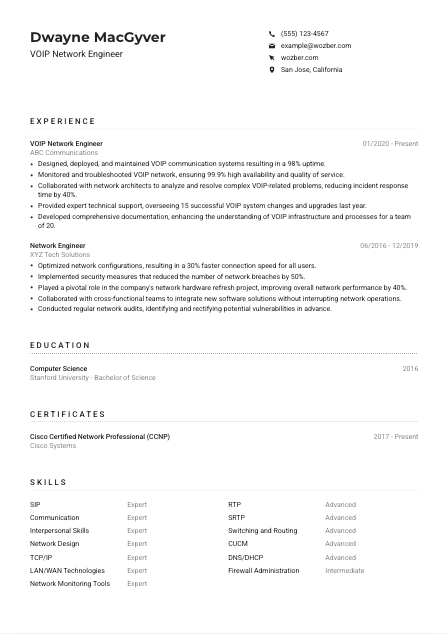
If a role specifies a city or on-site expectation, list your city and state clearly. In this example, San Jose, California belongs in the header because the employer explicitly asked for candidates based there. Treat that as tailoring to this opening, not a rule for every VOIP role.
A LinkedIn profile, portfolio, or professional site can support your application if it adds technical depth, such as certifications, project work, or infrastructure experience. Wozber's ATS-compliant CV formatting keeps those links easy to include without cluttering the header.
Your personal details should remove friction, not create it. When the top of the CV clearly shows your role focus, contact information, and any required location detail, the hiring team can move straight to your VOIP experience.




This is the section most likely to decide whether you move forward. VOIP hiring teams look for hands-on work with voice network design, deployment, monitoring, troubleshooting, upgrades, and documentation, especially in live environments where availability and call quality matter.
Start by matching your past work to the responsibilities in the posting. For a VOIP Network Engineer, that usually means design and deployment of voice systems, troubleshooting, QoS support, upgrades, and collaboration on complex incidents. If your background includes both general network engineering and voice work, lead with the voice-heavy material first.
List roles in reverse chronological order with job title, employer, and dates. That structure helps hiring teams quickly track how long you have worked in network engineering and whether you meet a requirement such as 5+ years with VOIP focus or adjacent infrastructure experience.
Each bullet should show what you owned, what environment you worked in, and what changed because of your work. The sample CV does this well with points like designing and maintaining VOIP communication systems and collaborating on complex VOIP-related issues. That is much stronger than generic bullets about "supporting networks" or "handling tickets."
Quantified results carry real weight here because service reliability is measurable. Uptime, availability, incident response time, successful change volume, latency improvement, call quality, or reduced outage impact all make your work more concrete. The example's 98% uptime, 99.9% availability, and 40% faster incident response are good models because they connect directly to production performance.
Prioritise bullets that show protocols, infrastructure decisions, troubleshooting depth, monitoring, and coordination with architects or operations teams. General statements about being hardworking or collaborative are better supported by actual work, such as resolving escalated SIP issues, supporting a voice upgrade, or documenting network changes for a larger team.
Your experience section should make your VOIP scope easy to trust. Use Wozber's ATS CV scanner to align your bullets with the posting's language so the CV surfaces the right mix of voice protocols, infrastructure work, reliability metrics, and support depth.
Education is usually a checkpoint rather than the main selling point for experienced VOIP engineers. Still, when a posting asks for a bachelor's degree in Computer Science, Engineering, or a related field, this section should answer that requirement cleanly and without extra noise.
If the posting asks for a bachelor's degree, list the degree and field exactly as earned so the requirement is easy to confirm. In the example, "Bachelor of Science in Computer Science" lines up cleanly with the employer's stated preference.
Include degree, field of study, school, and graduation year in a consistent order. Technical recruiters and ATS systems both benefit from a straightforward structure.
When the role asks for Computer Science, Engineering, or a related discipline, make that connection visible. If your degree title is broader, your field of study can help show the technical foundation behind your networking and voice work.
Most mid-career VOIP Network Engineers do not need coursework here. It becomes more useful if you are earlier in your career and want to show exposure to networking, communications systems, security, operating systems, or related infrastructure topics.
Honors, technical projects, or engineering clubs can add value if they support the rest of your CV, especially for newer candidates. If you already have several years of production VOIP work, keep this section lean and let your experience do the heavy lifting.
Education should confirm the required foundation and then get out of the way. Presented clearly in Wozber's ATS-friendly CV template, it supports your candidacy without distracting from the hands-on voice engineering work that matters most.
Certifications can be especially useful in network engineering because they show current knowledge of routing, switching, voice infrastructure, and vendor ecosystems. They are rarely a substitute for production VOIP experience, but they can reinforce your depth and continued development.
List certifications that directly strengthen your case for the role, especially those tied to networking, collaboration platforms, security, or voice systems. The sample's CCNP is a solid example because it supports advanced network knowledge even though the posting did not explicitly require a certification.
Choose certifications that add technical relevance. A short list of current, role-related credentials is more effective than a long list of unrelated courses or expired badges.
Include issue or validity dates when they help establish recency. For infrastructure roles, current certifications can reassure employers that your knowledge of network architecture, troubleshooting, and platform administration is not outdated.
VOIP environments evolve with changes in security expectations, cloud voice, platform upgrades, and hybrid network design. Recent certifications or renewals can show that you stay current as protocols, tools, and architectures shift.
This section should support the technical story told in your experience, not compete with it. When your certifications line up with the kind of voice and network infrastructure the employer runs, they add useful depth to the CV.
For this role, the skills section should quickly show whether you understand the protocol layer, the network foundation behind voice traffic, and the tools used to keep service stable. Focus on practical engineering capability, not a broad inventory of every technology you have touched.
Start with the language used in the job description. Here, SIP, RTP, SRTP, voice network design, implementation, support, and collaboration are all important cues. If you have those skills, use the same terminology so both ATS filters and technical reviewers can match them quickly.
Put the most relevant skills near the top, especially VOIP protocols, network design, routing and switching, QoS-related knowledge, monitoring tools, and platform experience such as CUCM when it genuinely applies. The sample skill list works because it keeps SIP, RTP, SRTP, and network design prominent instead of burying them under generic IT terms.
Technical expertise should dominate this section, but collaboration still matters because VOIP engineers often work with architects, systems teams, security teams, and support staff during incidents or changes. Include communication or interpersonal skills only after the technical core is established.
The best skills section for a VOIP Network Engineer reads like the environment you can support. Use Wozber's ATS optimisation features to mirror role-specific terminology naturally, then keep the list tight enough that the real priorities stand out.
Language requirements matter when the role involves cross-team coordination, user support, documentation, or client-facing communication. For VOIP work, professional English often matters because troubleshooting notes, change records, and escalation discussions need to be precise.
If the posting specifies professional English, list English at the top with an accurate proficiency level. That makes the requirement easy to confirm before the reader moves on.
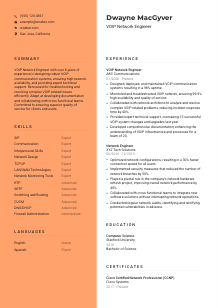
Include languages that you can use in documentation, meetings, troubleshooting calls, or stakeholder communication. In the example, English and Spanish can be valuable in a diverse technical environment, but only if both are genuinely usable in professional settings.
Use clear labels such as Native, Fluent, Advanced, or Professional Working Proficiency. Avoid vague wording that can create confusion about your ability to communicate in technical situations.
Extra languages can help, especially in global or multilingual environments, but they do not replace the technical requirements of the role. Keep them as supportive information unless multilingual communication is central to the specific opening.
Some VOIP teams support distributed users, international vendors, or regional operations centers. If additional language ability genuinely supports that kind of environment, it is worth including.
Language entries should clarify how you can work across documentation, support, and collaboration surfaces. Keep the levels honest and relevant to the communication demands of the role.
Your summary should quickly frame the kind of VOIP engineer you are. In a few lines, show your level of experience, the environments you support, and the results you tend to deliver so the reader knows what to expect from the rest of the CV.
Start with your title and years of relevant experience. For example, "VOIP Network Engineer with over 6 years of experience" works because it immediately establishes both specialization and career level.
Follow with the work that matters most for the target role, such as designing VOIP systems, maintaining call quality, troubleshooting protocol and network issues, or supporting upgrades. Keep the emphasis on the kind of production work the employer actually needs.
Aim for a short paragraph, usually three to four lines. Focus on role-specific capability and measurable outcomes instead of broad descriptors about being dedicated, passionate, or results-driven.
Adjust the wording for each application so the summary reflects the posting's priorities. In this example, that means bringing forward VOIP systems, high availability, quality of service, troubleshooting, documentation, and team collaboration. Wozber's free CV builder can help you refine that language so it stays aligned and ATS-readable.
A well-written summary tells the reader, within seconds, that you understand live voice infrastructure and can support it effectively. Once that framing is in place, the rest of the CV can reinforce it with specifics.
A VOIP Network Engineer CV should show more than general networking knowledge. It needs to make your voice infrastructure work, troubleshooting depth, protocol familiarity, and service reliability visible in clear, concrete terms.
Use Wozber to build an ATS-compliant CV that aligns your experience with the posting, highlights missing requirements, and keeps your structure clean from top to bottom. When the CV is tailored well, hiring teams can quickly judge whether you are ready to design, support, and stabilize the voice environment they depend on.